
Understanding curdlan gum specifications is essential for any buyer sourcing this fermentation-derived β-1,3-glucan polysaccharide. This unique polysaccharide is highly valued in food processing for its functional versatility. Two parameters matter most in commercial sourcing decisions: gel strength and total nitrogen content. These factors determine how the gelling agent performs in complex recipes. A product can meet the common gel strength benchmark of ≥600 g/cm² and still fail to qualify for certain export markets if its nitrogen level exceeds regulatory thresholds. Buyers who evaluate curdlan solely on gel strength risk selecting a grade that is technically functional but commercially unsuitable for their target market. BSH Ingredients, a leading curdlan supplier and exporter based in China, manufactures up to 500 tons of bulk curdlan raw materials annually across multiple specification grades, offering both high-gel-strength and low-nitrogen options tailored for global compliance needs. For food manufacturers, ingredient distributors, importers, meat processors, and plant-based product developers looking to evaluate bulk curdlan gum for formulation and regulatory fit, requesting a sample and detailed COA from a specialized manufacturer is the most reliable next step.

This guide breaks down the critical parameters found on a curdlan gum technical data sheet, compares the FDA, JECFA, and proposed EU E424 standards side by side, and explains how BSH Ingredients’ CY-1 and CY-2 grades map to real-world sourcing requirements. The goal is to help procurement teams and R&D formulators translate specification numbers into confident purchasing decisions.
What Are Curdlan Gum Specifications?
Curdlan gum specifications are the measurable chemical, physical, and microbiological parameters listed on a product’s specification sheet or certificate of analysis (COA). They define the identity, purity, safety, and functional performance of this polysaccharide. High-quality specifications ensure it acts as a reliable gelling agent during food processing.
A typical curdlan gum specification sheet includes data points such as:
- Assay (purity) as anhydrous glucose content
- Gel strength of a 2% aqueous suspension after heating
- Total nitrogen content
- Loss on drying (moisture content)
- Residue on ignition (sulfated ash/ash content)
- pH value of a water suspension
- Heavy metals (lead limit, arsenic limit)
- Residual methanol
- Microbial limits (total plate count, coliforms, E. coli, yeast, and mold)
These parameters serve two distinct purposes. First, they confirm that the product meets the regulatory requirements of the destination market, whether that market follows FDA, JECFA, or EU E424 standards. Second, they predict how curdlan will perform in a specific formulation, particularly in terms of gel formation, elasticity, firmness, and heat stability.
In practice, not all specification sheets are equal. Some suppliers provide only basic purity and moisture data, omitting gel strength or nitrogen values entirely. Buyers evaluating curdlan for export-market compliance should always request a full curdlan gum technical data sheet that includes gel strength testing results and total nitrogen analysis. Without both values, it is difficult to confirm whether a lot is appropriate for the intended application and regulatory environment.
Key Parameters That Define Curdlan Gum Grades
Gel strength and nitrogen content are the two specification parameters that most directly determine a curdlan gum grade’s commercial suitability. Beyond these, purity, moisture, ash, pH, heavy metals, and microbial limits round out the full quality profile that appears on a COA.
Gel Strength
Gel strength is the most frequently cited performance metric for curdlan gum. It measures the firmness of the curdlan gel formed from a 2% aqueous suspension. This thermally irreversible gel is known for its ability to maintain structure under high heat.
Common commercial benchmarks include:
| Grade Description | Gel Strength Range |
|---|---|
| Low gel strength curdlan | Below 600 g/cm² |
| Standard commercial grade | ≥600 g/cm² |
| High gel strength curdlan | ≥800 g/cm² |
A curdlan gum gel strength of 600 g/cm² is widely considered the minimum threshold for effective gelling performance in processed meat products, surimi seafood, and noodle applications. Products rated at 800 g/cm² or above deliver stronger elastic gels and are preferred for applications requiring pronounced bite, such as grilled sausages, plant-based meat analogs, and frozen foods where freeze-thaw stability matters.
Gel strength measurement is typically performed using a texture analyzer or gel strength tester on a heat-induced gel. The curdlan is dispersed in water at 2% concentration, heated above 80°C to form an irreversible (high-set) gel, cooled, and then measured for rupture force. Buyers should confirm which test method the supplier uses, as slight variations in heating temperature and hold time can affect reported values.
Nitrogen Content
Total nitrogen in curdlan gum is a purity indicator that reflects residual protein and cellular material from the Agrobacterium fermentation process. This is the parameter that most frequently creates compliance gaps for buyers who focus only on gel strength.
The FDA standard under 21 CFR §172.809 sets a maximum total nitrogen limit of 0.5%. JECFA’s specification for INS 424 allows up to 0.6%. This difference may seem small, but it has real sourcing consequences. A curdlan lot with 0.55% nitrogen passes JECFA criteria and may perform well functionally, yet it does not meet FDA requirements for the U.S. market.
Low-nitrogen curdlan gum, typically specified at below 0.3% total nitrogen, requires more rigorous purification during manufacturing. Not all producers achieve consistently low nitrogen across production batches. Buyers targeting FDA-regulated markets should request batch-specific COA data confirming nitrogen content rather than relying solely on general specification sheets.
Other Key Curdlan Gum Specification Parameters
Beyond gel strength and nitrogen, parameters such as water-holding capacity and purity define quality. These factors determine how the ingredient behaves during various food processing cycles.
| Parameter | Typical Specification |
|---|---|
| Assay (anhydrous glucose) | ≥80% |
| Loss on drying (moisture) | ≤10% |
| Residue on ignition (sulfated ash) | ≤6% |
| pH (1% suspension) | 6.0–7.5 |
| Lead | ≤2 mg/kg |
| Arsenic | ≤3 mg/kg |
| Residual methanol | ≤0.1% (varies by standard) |
Curdlan gum bulk density and particle size also matter for downstream processing. Coarser mesh sizes disperse differently during hydration than fine powders, which can affect gel uniformity in high-speed mixing environments. Buyers integrating curdlan into automated production lines should specify particle size distribution alongside chemical parameters.
International Curdlan Gum Quality Standards

Three major regulatory frameworks govern food-grade curdlan gum globally: the U.S. FDA standard, the JECFA specification adopted by the Codex Alimentarius, and the proposed EU E424 specification informed by EFSA’s 2024 safety evaluation. Each framework sets slightly different purity criteria and testing requirements, creating compliance considerations that directly influence sourcing strategy.
U.S. FDA Standard, 21 CFR §172.809
The FDA regulates curdlan as a food additive under 21 CFR §172.809. Under this standard, curdlan is defined as a β-1,3-glucan produced by fermentation of Agrobacterium biobar 1. This microorganism was historically known as Alcaligenes faecalis var. myxogenes.
Key FDA specification limits include:
- Total nitrogen: ≤0.5%
- Residue on ignition: ≤6%
- Gel formation: required from a 2% aqueous suspension heated to 80°C or above
- Lead: ≤2 ppm
The FDA standard does not explicitly define a minimum gel strength value in g/cm², but it does require demonstration of gel formation. The nitrogen limit of 0.5% is stricter than JECFA’s threshold, making it the most demanding major-market nitrogen requirement for curdlan gum.
Buyers selling into the U.S. market should confirm FDA compliance on a per-batch basis through a certificate of analysis. Stating that a product is “curdlan gum FDA approved” based on general specifications alone is insufficient; batch COA confirmation is always required.
JECFA Standard, INS 424
JECFA evaluates this β-1,3-glucan under INS number 424. This polysaccharide is produced through the fermentation of Alcaligenes faecalis. The JECFA curdlan specification has been adopted as the basis for the Codex Alimentarius food additive standard and is referenced by many countries outside the U.S. and EU.
Key JECFA specification parameters:
- Assay: ≥80% (as anhydrous glucose)
- Total nitrogen: ≤0.6%
- Loss on drying: ≤10%
- Residue on ignition (sulfated ash): ≤6%
- Lead: ≤2 mg/kg
- Residual methanol: specified limit
The JECFA standard allows 0.1% more nitrogen than the FDA standard, giving manufacturers slightly more tolerance. For buyers exporting to markets that follow Codex Alimentarius guidelines, the JECFA specification is the primary reference document. China’s national standard GB 28304 for curdlan also aligns closely with JECFA parameters.
EU E424, Proposed EU Specification Based on EFSA 2024
Curdlan has been proposed for authorization in the EU under the E number E424. EFSA published a safety evaluation in 2024 that assessed curdlan’s suitability as a food additive in the European market.
The proposed EU E424 specification is expected to align with JECFA criteria in most parameters, but may introduce additional requirements around:
- Detailed microbiological limits
- Specific identity testing for beta-1,3-glucan structure
- Residual solvent and impurity profiles
As of early 2026, the EU E424 authorization process is not fully finalized. Buyers planning to export curdlan-containing products to European markets should monitor EFSA updates and confirm the current regulatory status before committing to large-volume procurement.
FDA vs JECFA vs EU E424: Key Differences for Buyers
| Parameter | FDA (21 CFR §172.809) | JECFA (INS 424) | EU E424 (Proposed) |
|---|---|---|---|
| Total nitrogen | ≤0.5% | ≤0.6% | Expected ≤0.6% |
| Assay | Not numerically specified | ≥80% anhydrous glucose | Expected ≥80% |
| Residue on ignition | ≤6% | ≤6% | Expected ≤6% |
| Loss on drying | Not specified separately | ≤10% | Expected ≤10% |
| Lead | ≤2 ppm | ≤2 mg/kg | Expected ≤2 mg/kg |
| Gel formation test | Required (2% suspension, ≥80°C) | Referenced | Expected |
The practical takeaway: a curdlan lot that passes JECFA’s 0.6% nitrogen limit does not automatically pass the FDA’s 0.5% limit. Buyers sourcing a single grade for multi-market distribution must target the strictest applicable standard, which currently is the FDA nitrogen threshold.
BSH Curdlan Gum Specifications, Grade Overview
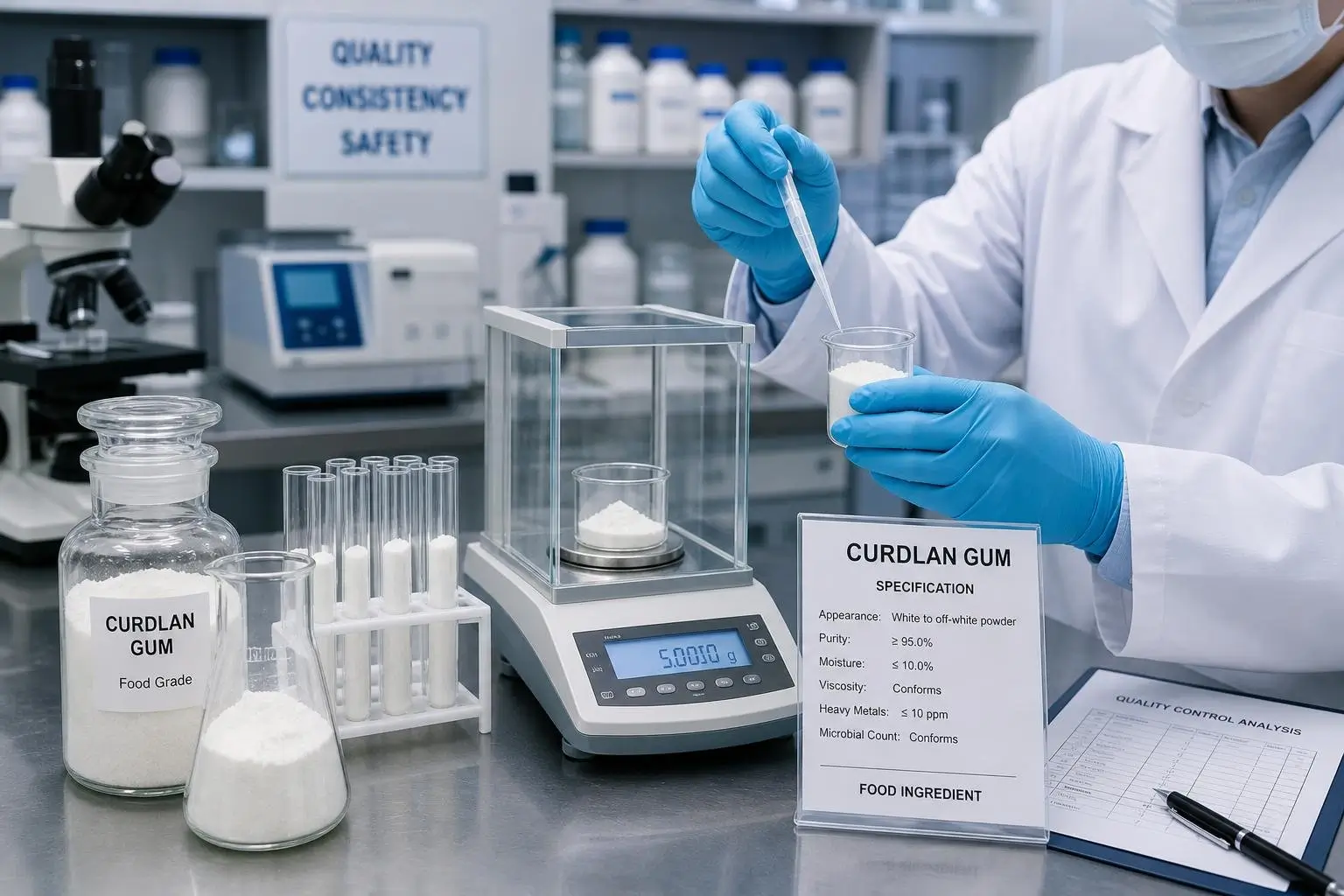
BSH Ingredients offers two primary curdlan gum grades, BSH CY-1 and BSH CY-2, each targeting different performance and compliance requirements. Both grades are produced through controlled microbial fermentation at BSH’s dedicated curdlan manufacturing facility in China, with batch testing and full documentation support for global export.
BSH CY-1, High Gel Strength Low Nitrogen Curdlan
BSH CY-1 is designed for buyers who require both high functional performance and compliance with the most stringent purity standards. Key characteristics of this grade include:
- Gel strength: ≥800 g/cm² (2% aqueous suspension)
- Total nitrogen: Low nitrogen specification, targeting compliance with the FDA’s ≤0.5% limit
- Purity (assay): ≥80% anhydrous glucose
- Appearance: White to off-white odorless powder
This grade is suited for applications where strong elastic gel formation and low residual protein are critical, such as processed meat products, surimi seafood, and plant-based meat formulations targeting the U.S. market. BSH high-gel-strength curdlan at the CY-1 level indicates more intensive purification steps during manufacturing.
Buyers should still request a batch-specific COA to confirm nitrogen values for each shipment, as natural variation in fermentation-based production means specification compliance must be verified at the lot level.
BSH CY-2, Middle Gel Strength Commercial Curdlan
BSH CY-2 is a mid-range gel-strength curdlan grade for cost-effective applications. It serves as a versatile gelling agent where maximum gel firmness is less critical.
- Gel strength: ≥600 g/cm² (2% aqueous suspension)
- Total nitrogen: Standard commercial range
- Purity (assay): ≥80% anhydrous glucose
This grade works well in rice and flour products, braised and marinated meats, yogurt stabilization, and bakery applications where moderate gel strength provides adequate texture improvement and water retention without over-firming the final product. It is also commonly specified by ingredient distributors and private-label brands sourcing curdlan gum for broad food-processing markets.
Custom Curdlan Gum Specifications
Beyond CY-1 and CY-2, BSH Ingredients supports custom curdlan gum specifications for buyers with unique formulation or regulatory needs. Customization options include:
- Gel strength adjustment to specific target ranges
- Particle size and mesh size selection for processing compatibility
- Nitrogen content control for specific market compliance
- Custom blends combining curdlan with other functional ingredients
- OEM and private label packaging for contract manufacturing
This flexibility is particularly relevant for plant-based food companies and nutraceutical manufacturers developing proprietary formulations that require precise rheological properties. Buyers can request technical support from BSH Ingredients to determine which combination of gel strength, nitrogen content, and particle size best fits their application and target market.
Frequently Asked Questions
What are the typical purity, moisture, and ash limits for curdlan gum?
Food-grade curdlan gum typically requires an assay of ≥80% (measured as anhydrous glucose), loss on drying (moisture content) of ≤10%, and residue on ignition (sulfated ash) of ≤6%. These values align with both the JECFA INS 424 specification and the FDA standard under 21 CFR §172.809. Batch COA documents should confirm all three parameters for each shipment.
Which viscosity range and particle size distribution are commonly specified for curdlan gum powder?
Curdlan gum does not behave like traditional thickeners, so viscosity is less commonly specified than gel strength. Particle size distribution, typically defined by mesh size, varies based on end-use requirements; finer powders (80-200 mesh range) disperse more readily in high-speed mixing systems. Buyers integrating curdlan into automated production lines should specify their preferred particle size to ensure consistent hydration and gel uniformity.
What is the standard microbial specification for curdlan gum (total plate count, yeast and mold, coliforms)?
Standard microbial limits for food-grade curdlan gum generally include a total aerobic plate count of ≤1,000 CFU/g, yeast and mold counts of ≤100 CFU/g, coliform bacteria at or below detectable limits, and the absence of E. coli and Salmonella. Specific limits may vary by customer or destination-market requirements. Third-party testing through laboratories such as SGS or Intertek provides independent verification.
How is curdlan gum tested for gel strength and thermal stability in quality control?
Gel strength is measured by preparing a 2% curdlan aqueous suspension, heating it above 80°C to induce irreversible (high-set) thermal gelation, cooling the gel, and then testing rupture force using a texture analyzer. Results are reported in g/cm² or dyne/cm². Thermal stability is confirmed by verifying the thermal irreversible gel does not melt upon reheating. This property, combined with high water-holding capacity, distinguishes it from other hydrocolloids.
What food-grade certifications and regulatory standards are most often required for curdlan gum?
Buyers commonly require ISO 22000 or FSSC 22000 certification, HACCP compliance, and GMP manufacturing standards from their curdlan gum supplier. Halal and kosher certifications are frequently requested for products entering markets with religious dietary requirements. For regulatory compliance, FDA conformity (21 CFR §172.809) is essential for the U.S. market, while JECFA INS 424 serves as the reference for Codex-aligned markets.
What are the recommended storage conditions and shelf life criteria for curdlan gum?
Curdlan gum powder should be stored in a cool, dry, and well-ventilated environment, away from direct sunlight and moisture. Sealed packaging, typically 25 kg bags with inner polyethylene liners, helps maintain product integrity. Under proper storage conditions, curdlan gum generally maintains its specified gel strength and purity for up to 24 months from the date of manufacture, though buyers should verify the shelf life stated on each batch’s COA.