
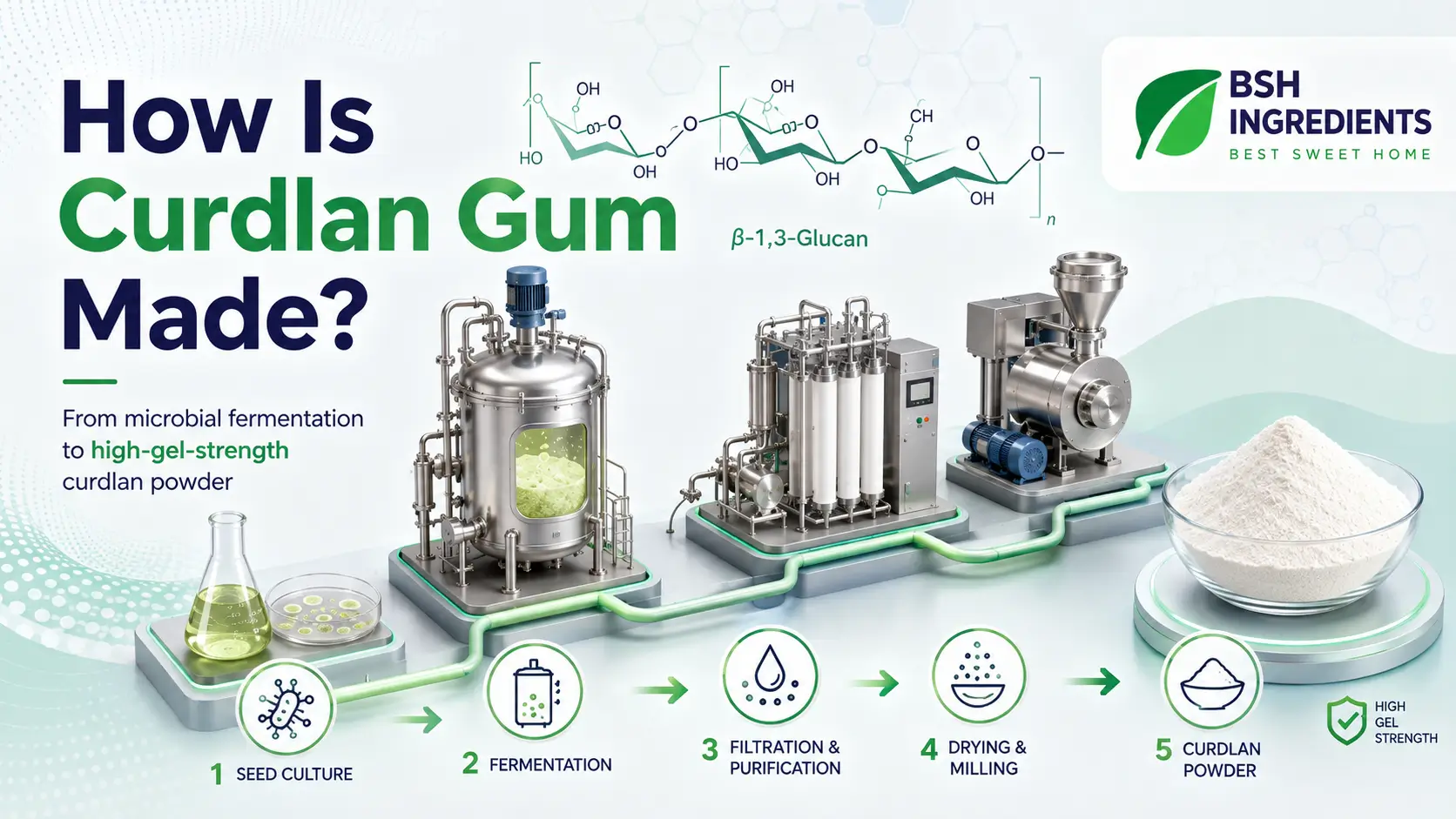
How Is Curdlan Gum Made? The curdlan gum manufacturing process is a fermentation-based manufacturing route, not an extraction process. Unlike pectin, carrageenan, or guar gum, curdlan is not harvested from a plant or seaweed. It is a water-insoluble exopolysaccharide produced by bacteria during controlled cultivation, then separated, purified, precipitated, filter-pressed, dried, milled, screened, tested, and packed as a fine white powder.
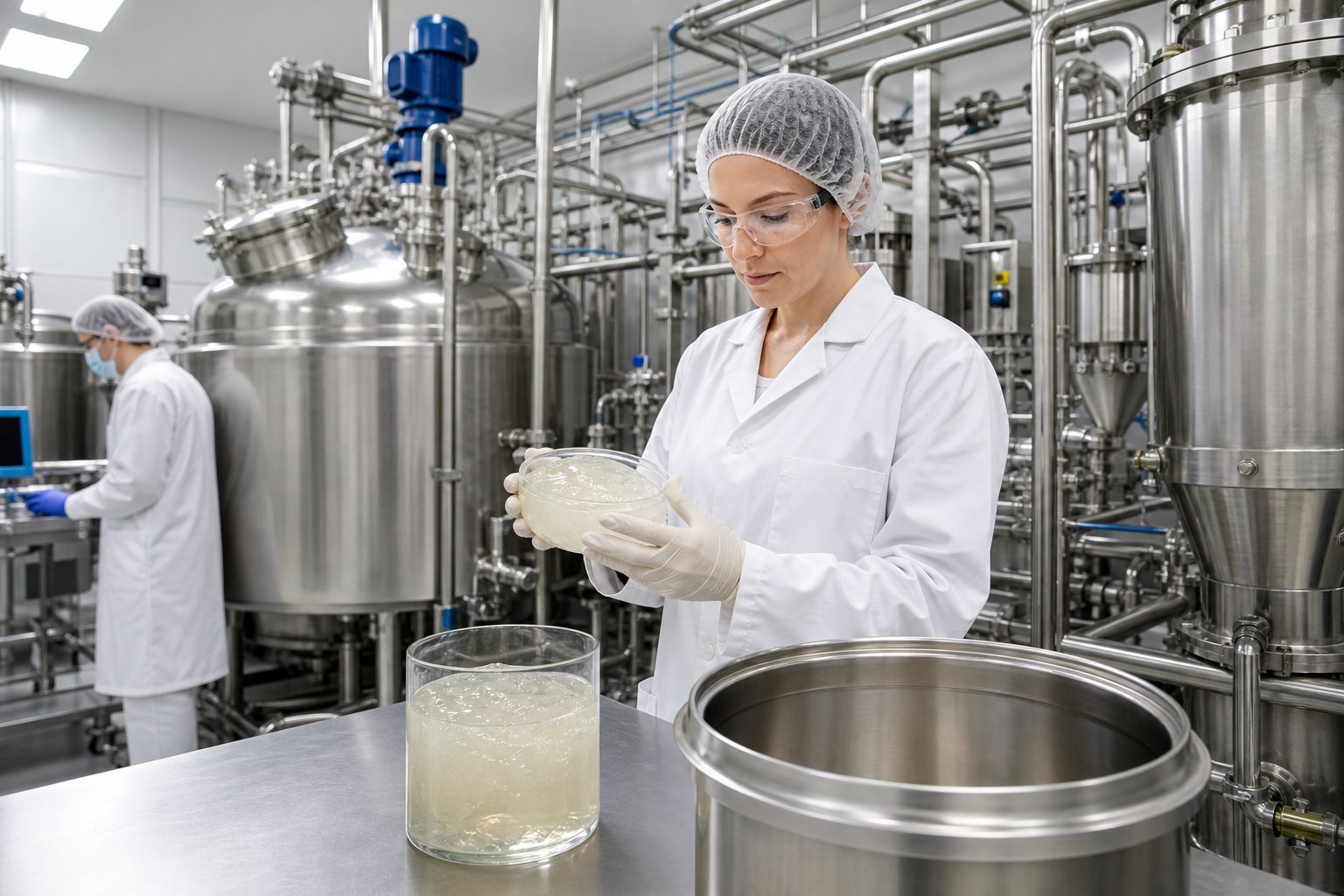
That distinction matters commercially, because the production line does far more than turn broth into powder. Fermentation conditions and downstream purification are what actually set the parameters buyers pay for: gel strength, curdlan assay, total nitrogen, moisture, ash, microbiological quality, residual solvent, particle size, and batch-to-batch consistency. Two suppliers can both sell “food grade curdlan” and still deliver powders that behave differently in a sausage emulsion or a surimi gel.
If you are sourcing curdlan in bulk, it helps to read a production flow the way a quality manager reads it: each unit operation maps to a line on the certificate of analysis. Standard food-grade grades are commonly specified at ≥600 g/cm², high gel strength grades at ≥800 g/cm², with customized ultra-high grades reaching around 1,000 g/cm² and low-nitrogen grades below 0.3% total nitrogen. When you know which step controls which number, supplier comparison stops being guesswork.
Whichever grade you are evaluating, ask for a sample and a batch-specific COA before you commit. BSH Ingredients supplies bulk curdlan gum with customizable gel strength, particle size, and nitrogen targets, and you can reach the team by email, phone, or WhatsApp to request specification sheets, technical support, or a bulk quotation.
Curdlan Structure, Function, and Manufacturing Controls
Curdlan is a linear beta-1,3-glucan whose gelling behavior comes from heat, not from cooling or ion bridging. Its molecular architecture, its two distinct gel types, and the process controls needed to reproduce them are tightly linked, which is why manufacturing discipline shows up directly in texture performance.
Curdlan as a Fermentation-Derived Microbial Polysaccharide
Curdlan is produced by bacteria as an extracellular polysaccharide during submerged cultivation on a sugar substrate. The organism secretes it once growth conditions shift, and the polymer accumulates outside the cell as an insoluble solid.
Because it is a microbial product rather than a plant extract, supply is not tied to harvest cycles or crop variability. Consistency instead depends on strain performance, medium control, and downstream recovery.
The finished material is a white to off-white powder, essentially tasteless and odorless, and insoluble in cold water. It disperses as a suspension and only develops structure when heated.
Molecular Structure and Heat-Induced Gel Formation
Curdlan is a linear homopolysaccharide built entirely from glucose monomer units, specifically D-glucopyranose units joined by β-1,3-glycosidic bonds. There are no side chains and no charged groups, which explains its neutral character and low solubility in water.
In aqueous suspension, the chains adopt a triple helix conformation when hydrated and heated. The molecular weight of curdlan and its degree of polymerization influence how firmly those helices associate, and both are set upstream during fermentation.
Thermogelation happens in two useful modes:
| Gel type | Typical heating | Behavior | Practical use |
|---|---|---|---|
| Low-set gel | Around 55 to 60 °C, then cooled | Softer, thermo-reversible | Delicate textures, softer fillings |
| High-set gel | Heated above roughly 80 °C | Firm, elastic, thermo-irreversible | Retort meats, surimi, heat-stable structures |
The thermo-irreversible gelation is the property most formulators buy curdlan for. Once a high-set gel forms, it does not melt on reheating.
Functional benefits that follow from this structure include high water-holding capacity, freeze-thaw stability, syneresis resistance, film-forming ability, emulsion stabilization, and retrogradation resistance in starch-based systems.
Why Industrial Production Requires Tight Process Control
Every specification line on a curdlan COA traces back to a specific stage of manufacture. Polymer characteristics and gel firmness originate in fermentation; residual protein and cellular debris, reflected as total nitrogen, are governed by separation and washing; moisture and ash come from drying and desalting.
Residual processing solvent depends on how thoroughly precipitation and pressing are followed by drying. Microbiological quality reflects sanitation across the whole line, and particle size is decided at milling and screening.
Batch-to-batch consistency is therefore not a single control point. It is the cumulative result of holding a dozen operations within range at the same time.
Factory Flow From Qualified Materials to Finished Powder
A working curdlan plant runs one main production line supported by several utility loops. The sequence moves from qualified raw materials through staged seed culture into the production fermenter, then into a recovery train that ends in packed powder.
Raw Material Inspection and Batch Preparation
Incoming materials are checked for identity, quality, batch conformity, cleanliness, storage condition, supplier qualification, and traceability before release to production. Nothing enters batching without a qualified status.
Broad material categories include a fermentation carbon source, a nitrogen or nutrient source, minerals, processing aids, water, and other approved auxiliary materials. Common carbon options across the industry include sucrose carbon source, glucose carbon source, glycerol substrate, and molasses substrate, with corn steep liquor frequently used as a complex nutrient.
Batching then covers accurate weighing, recipe control, mixing, water addition, and full batch records. Culture medium optimization at this stage governs fermentation efficiency and the impurity profile that purification later has to remove.
One point worth separating clearly: process nutrients fed during fermentation are not the same thing as nitrogen remaining in the finished powder. The first drives biosynthesis; the second is a purification and QC outcome.
Disinfection, Steam, and Sterile Air Systems
Sanitary preparation precedes inoculation. Disinfection protects the intended production culture, prevents contamination, improves batch consistency, and reduces the risk of fermentation failure.
Steam serves as the plant utility associated with sanitation and process operations across vessels and transfer lines. Sterile air supplies filtered aeration to the fermentation vessel, supporting aerobic metabolism while keeping foreign organisms out.
Process hygiene here directly protects the microbiological limits reported on the finished-product COA.
Primary and Secondary Seed Culture Development
Seed culture development activates the production culture and builds viable biomass in stages rather than dumping a small inoculum straight into a large fermenter. Inoculum preparation aims for consistent cell density and vitality at transfer.
The staged path looks like this:
Culture → Primary Seed → Secondary Seed → Production Fermenter
Primary seed activates and expands the strain. Secondary seed scales that biomass further so the production fermenter starts predictably, with a controlled lag phase and less batch-to-batch variability.
Strain selection and improvement sits behind this stage across the industry, using approaches from UV mutagenesis and NTG chemical mutagenesis to genetic engineering of curdlan strains and metabolic engineering aimed at higher yield or broader substrate range.
The End-to-End Manufacturing Flow and Supporting Utilities
The main line runs as follows:
Raw Material Inspection → Batching → Disinfection → Primary Seed → Secondary Seed → Fermentation → Filtration → Stirring & Precipitation → Filter Pressing → Drying → Pulverizing → Screening → Packaging → Finished Curdlan Powder
Around that line sit the supporting systems that make it economical and compliant:
- Steam and sterile air
- Ethanol supply and alcohol tanks
- Vacuum system, vacuum wastewater, and vacuum exhaust gas
- Circulating water and condensation
- Alcohol distillation and waste ethanol handling
These utilities are the difference between a laboratory procedure and an industrial process. Solvent recovery, in particular, has a measurable effect on curdlan production cost.
Microbial Fermentation and Biosynthesis
Fermentation is where the polymer is actually built, and where most of the functional performance is decided. Industrial curdlan synthesis typically runs around 30 ± 2 °C at roughly pH 7, with culture time in the range of 1 to 36 hours depending on the production protocol.
Production Microorganisms and Strain Selection
Commercial curdlan fermentation process work centers on a small group of soil bacteria. The reference workhorse is Agrobacterium sp. ATCC 31749, historically described alongside Alcaligenes faecalis var. myxogenes strains including ATCC 31750 and ATCC 21680.
Other producers reported in the literature include Agrobacterium radiobacter, various Rhizobium species, Cellulomonas flavigena, and Paenibacillus polymyxa. Not all are used at scale; yield, broth handling, and purification behavior decide industrial suitability.
Strain improvement remains active research, with UV mutagenesis, NTG chemical mutagenesis, and targeted metabolic engineering all applied to raise curdlan yield g/L and volumetric productivity.
Curdlan Biosynthesis From UDP-Glucose
Inside the cell, glucose is converted to glucose-6-phosphate, then to glucose-1-phosphate by phosphoglucomutase, then to UDP-glucose by UDP-glucose pyrophosphorylase. UDP-glucose is the direct sugar donor.
Curdlan synthase CrdS, encoded within the crdASC operon, polymerizes those units into the β-1,3-glucan chain and exports it outside the cell. Competing routes matter too: carbon diverted into the glycogen synthase pathway does not become curdlan, and beta-1,3-glucanase activity can degrade product late in the run.
The trigger is nutritional. Curdlan accumulates once cells stop dividing, typically under nitrogen source limitation or phosphate limitation, so the carbon to nitrogen ratio effectively controls when synthesis starts. Trace elements uracil supplementation and magnesium sulfate are commonly reported as yield-supporting additions.
Bioreactor Operation and Fermentation Strategies
Production runs as submerged fermentation, usually in a stirred-tank bioreactor, though airlift bioreactor designs are used where shear sensitivity or viscosity handling favors them.
| Mode | Characteristic | Typical fit |
|---|---|---|
| Batch fermentation | Single charge, fixed nutrients | Simple, predictable, widely used |
| Fed-batch fermentation | Controlled substrate feeding | Higher yields, avoids substrate inhibition |
| Continuous fermentation | Ongoing feed and withdrawal | Research and specialized cases |
A two-stage fermentation strategy is the norm: a growth phase with adequate nitrogen, then a production phase where nitrogen runs out and carbon flows into polymer. A pH shift strategy, dropping from near-neutral growth pH to a lower production pH, is a documented method of extending the synthesis window.
Temperature, pH, Oxygen, and Broth Rheology Control
Fermentation temperature 30 °C sits at the practical optimum for the standard producers, with pH near 7 during growth. Fermentation time, aeration rate, agitation speed, and dissolved oxygen control then determine how much polymer forms before productivity plateaus.
Oxygen is the hard constraint. As curdlan accumulates, broth viscosity climbs and the fluid develops strongly non-Newtonian rheology, which suppresses the oxygen transfer rate kLa exactly when demand is highest.
Increasing agitation restores oxygen transfer but adds shear and heat load. Balancing kLa against shear is one of the more difficult scale-up problems in this fermentation and a real differentiator between producers.
How Fermentation Consistency Influences Functional Performance
Gel strength is not an additive stirred into finished powder. It reflects the polymer that fermentation produced, then how gently downstream processing preserved it.
Chain length and molecular weight distribution set the ceiling. Purification, drying temperature and residence time, and final milling then determine how much of that ceiling survives into the packed product.
Treat any relationship here as multi-factor rather than linear. A fermentation that yields more grams per liter does not automatically yield firmer gels, which is why batch-specific gel strength testing is the only reliable confirmation.
Recovery, Purification, Drying, and Particle-Size Finishing
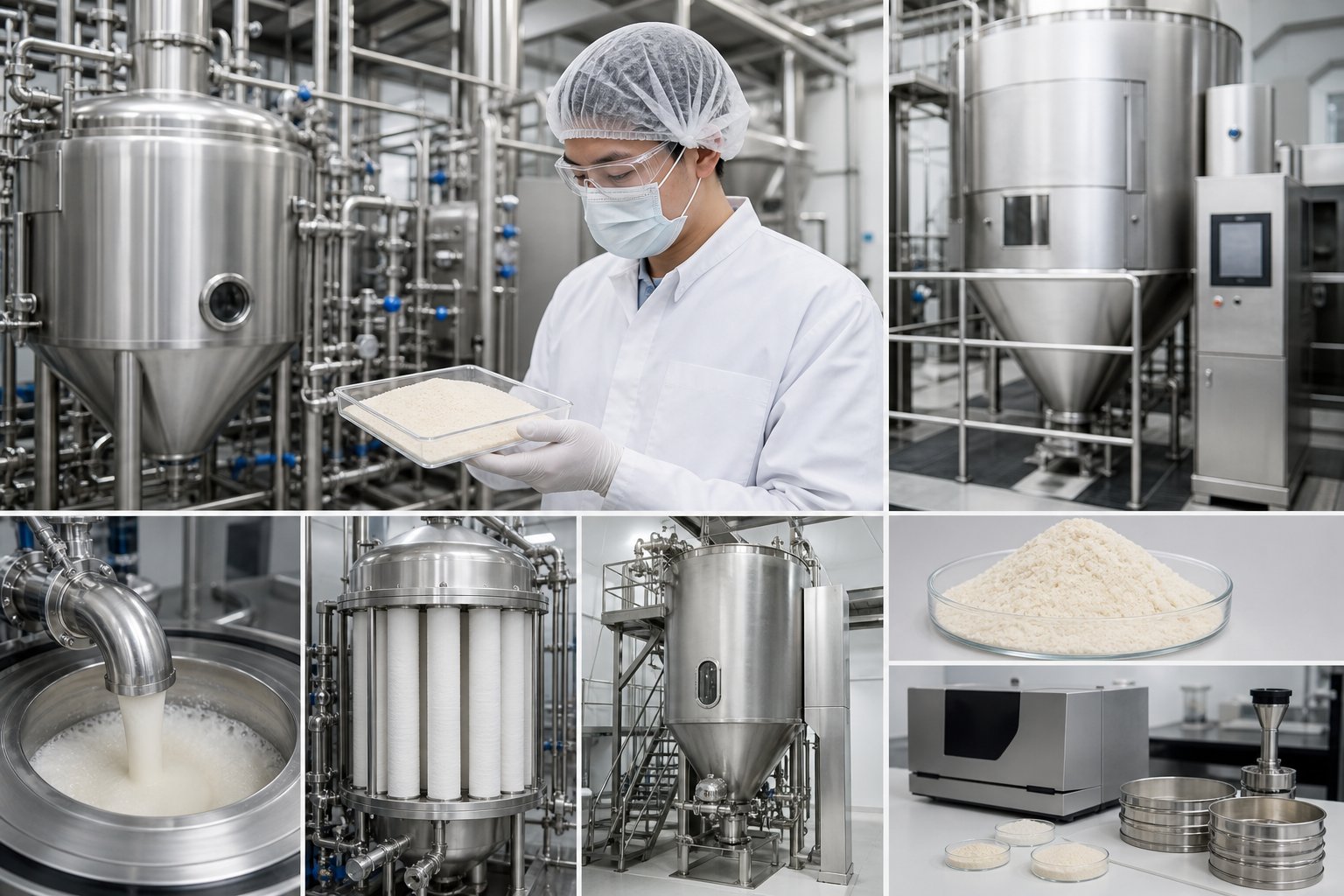
Downstream processing converts a viscous, cell-laden broth into a purified, free-flowing powder. This is where total nitrogen, ash, color, odor, residual processing solvent, and particle size are actually determined, and where purity and recovery yield are traded against each other.
Fermentation Broth Filtration and Cell Separation
At the end of fermentation, curdlan sits in a complex mixture with cells, unconsumed nutrients, salts, and metabolites. Cell separation centrifugation is the standard first unit operation for removing biomass from the broth, sometimes supported by microfiltration.
Separation efficiency at this stage sets the baseline for everything downstream. Cellular material carried forward shows up later as elevated total nitrogen, higher ash, off-color, and residual odor.
Getting this step right is cheaper than trying to correct it during washing.
Alkali Treatment, Neutralization, and Controlled Precipitation
Because curdlan is insoluble in water but dissolves in dilute alkali, alkali extraction NaOH is the classic route to bring the polymer into solution and leave insoluble debris behind. Typical laboratory practice uses around 0.5 N NaOH.
Neutralization acid precipitation follows, commonly HCl precipitation, which brings the pH back down and drops the purified glucan out of solution. In the plant flow, this corresponds to the stirring and precipitation stage.
Ethanol operates within this recovery system as well. It participates in separation and purification, helping isolate curdlan from soluble impurities, and it is recovered rather than discarded. Exact concentrations, solvent ratios, and wash cycle counts are process-specific and generally not published.
Alkali and acid handling must be controlled carefully, since aggressive conditions can degrade chain length and reduce the gel performance the fermentation earned.
Filter Pressing, Washing, and Desalting
Filter pressing performs the solid-liquid separation that produces a curdlan wet cake, removing most process liquid before drying. Less liquid entering the dryer means shorter thermal exposure and lower energy cost.
Washing and desalting then remove residual salts formed during neutralization, which is what keeps ash within specification. Ultrafiltration is used in some processes for desalting and concentration.
Optional refining steps include bleaching decolorization with hydrogen peroxide bleaching or activated carbon treatment where color specifications are tight. These should be applied conservatively, since oxidative bleaching can affect the polymer.
Vacuum Operations, Condensation, and Ethanol Recovery
The vacuum system supports evaporation and solvent removal at reduced temperature, which protects the polymer during concentration and drying. Circulating water and condensation capture condensable vapors from those operations.
Recovered alcohol follows a defined loop:
Ethanol → Processing → Condensation → Alcohol Tank → Distillation → Controlled Reuse
Spent alcohol, vacuum wastewater, and vacuum exhaust gas are handled through the plant’s environmental controls. This loop is not incidental. Solvent recovery is one of the largest levers on operating cost and a meaningful part of a plant’s environmental profile.
Drying, Pulverizing, Screening, and Packaging
Drying converts wet cake into a stable dry solid. Spray drying is the dominant industrial method and strongly influences particle bead structure, with typical spray-dried polymer particles falling in the 5 to 150 μm range. Freeze drying lyophilization is used mainly for research and specialty material.
Drying control is a balance: over-processing can affect functionality, while insufficient drying pushes loss on drying above specification and shortens shelf life.
Milling and sieving follow. Pulverizing reduces particle size and improves uniformity, flowability, and dispersion characteristics; screening then delivers a defined mesh or customized particle-size distribution.
Packaging closes the line with final screening, QC approval, lot identification, food-grade inner liner, outer bag or drum, batch coding, and traceability records.
Specifications, Nitrogen Control, and Quality Verification
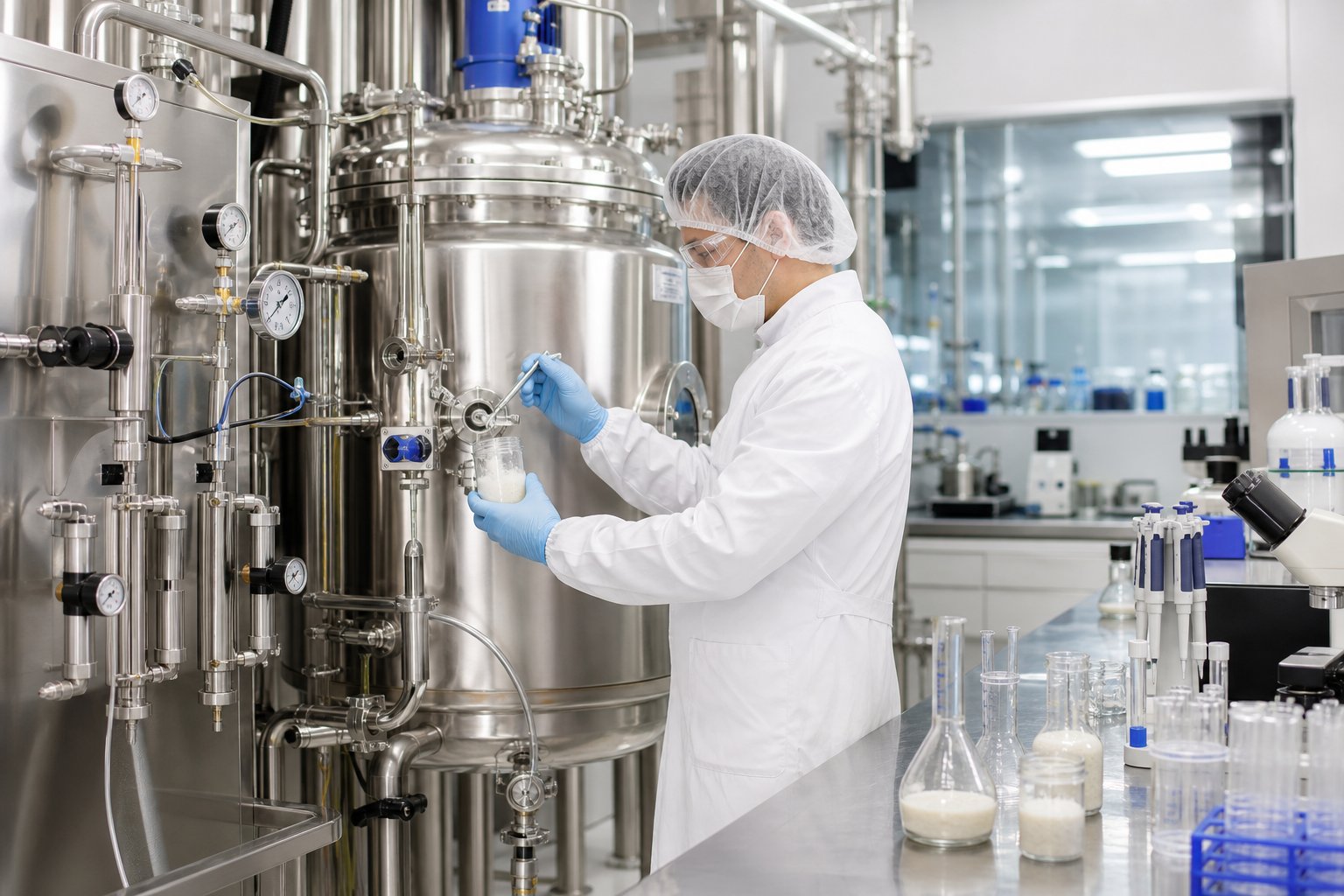
Commercial curdlan is not one universal powder. Grades differ in gel strength, assay, total nitrogen, and particle size, and each of those is verified separately at batch release rather than inferred from the others.
How Production Conditions Create Different Commercial Grades
Fermentation sets the polymer; purification sets the purity. Combining both gives producers a grade ladder rather than a single product.
| Grade positioning | Gel strength | Total nitrogen | Typical fit |
|---|---|---|---|
| Standard food grade | ≥600 g/cm² | Standard specification | Processed meat, noodles, rice products, tofu, bakery fillings |
| High gel strength | ≥800 g/cm² | Can be <0.3% | Premium surimi, high-elasticity sausage, plant-based meat |
| Customized ultra-high | Around 1,000 g/cm² or a specified target | <0.3% or lower agreed target | Demanding formulations and market-specific export requirements |
These are manufacturer product categories, not regulatory classifications. As a reference point, BSH Ingredients publishes CY-2 at ≥600 g/cm² and CY-1 at ≥800 g/cm², with one tested CY-1 batch reporting 815.7 g/cm² and total nitrogen below 0.3%.
Higher gel strength expands formulation options; it is not automatically better. The right grade depends on your texture target, thermal process, dosage, protein system, and any other hydrocolloids present.
Gel Strength, Assay, and Total Nitrogen as Separate Indicators
Buyers sometimes read a single number as a proxy for overall quality. Each parameter answers a different question.
| Parameter | What it indicates | Why buyers care |
|---|---|---|
| Curdlan assay (as anhydrous glucose) | Curdlan content and purity | Identity and composition |
| Gel strength | Functional gel performance | Texture, firmness, elasticity |
| Total nitrogen | Residual fermentation-related impurities | Purity control and market specifications |
| Moisture | Dryness and stability | Shelf life and storage |
| Ash | Inorganic residue | Purity, desalting efficiency |
| pH | Product characteristic | Formulation consistency |
| Particle size | Powder physical properties | Mixing, dispersion, dosing |
| Microbiology | Hygienic quality | Food safety |
| Residual solvents | Downstream processing control | Compliance |
Gel strength testing prepares a defined suspension, applies a standardized heating cycle, allows gel formation under set conditions, and measures firmness in g/cm². Results are comparable only when the same method and preparation are used across samples, so always request the test protocol alongside the number.
Producing and Verifying Low-Nitrogen Curdlan
Total nitrogen reflects residual cellular and proteinaceous material carried through from fermentation. It is a purification performance indicator more than a fermentation one.
Reaching low nitrogen curdlan below 0.3% requires controlled fermentation, efficient cell separation, well-managed precipitation, thorough washing and desalting, effective filter pressing, and verification by batch testing. Each step removes a portion of the load; skipping one is visible in the result.
The practical message for buyers is simple: high gel strength curdlan powder and low nitrogen are engineered and verified independently, and one does not guarantee the other. If both matter to you, specify both and confirm both on the COA.
Finished-Powder Testing and Batch Release
A complete release panel covers appearance, curdlan content as anhydrous glucose, gel strength, total nitrogen, loss on drying, ash content, pH, lead and heavy metal testing, residual solvents, and particle size.
Microbial testing includes total plate count, coliforms, yeast and mold, E. coli, and Salmonella. Viscosity measurement may be requested for specific applications.
Analytical characterization such as FTIR characterization, NMR analysis, XRD analysis, and SEM imaging is used mainly for identity confirmation, structural work, and R&D rather than routine release.
Regulatory, Certification, and Documentation Considerations
Curdlan carries FDA GRAS status in the United States and is permitted as a formulation aid, processing aid, stabilizer, thickener, and texturizer under 21 CFR 172.809. In the European system it is identified as E 424 food additive.
Buyers commonly reference Food Chemicals Codex grade and JECFA specifications, and Chinese producers frequently work to QB/T 4322-2012. Halal certification and kosher certification are standard requests for export.
Documentation should include a batch-specific Certificate of Analysis (COA), specification sheet, MSDS, microbiological analysis, production flow chart, certificate of origin, packing list, and commercial invoice. Third-party verification through bodies such as SGS or Intertek is worth requesting for first orders.
Application Fit and Supplier Evaluation
Grade selection should start from the finished product, not from the highest number on a spec sheet. Curdlan performs across meat, seafood, staple foods, plant-based systems, and a growing set of pharmaceutical and industrial uses, each with different gel strength and particle size requirements.
Selecting Gel Strength and Particle Size for Food Formulations
Match gel strength to the texture target and thermal process. A 600 g/cm² grade covers most general texture modification; 800 g/cm² and above earns its place where firmness, elasticity, or retort stability are the limiting factors.
Particle size affects dispersion, hydration behavior, powder handling, automated dosing, and premix uniformity. Finer grades disperse faster but can be more prone to lumping without proper dry-blending; coarser grades handle better in bulk dosing systems.
Confirm both against your own trial protocol. Supplier gel data is a screening tool, not a substitute for pilot work.
Meat, Seafood, Plant-Based, and Staple Food Applications
- Processed meat and sausage: improves water-holding capacity, yield, and bite. Standard grades suit most emulsified products; higher gel strength supports firmer, more elastic textures.
- Surimi application: thermo-irreversible gelation reinforces gel strength and thermal stability during heat setting.
- Plant-based meat analogues: contributes structure, binding, and heat-stable texture where protein alone underperforms.
- Tofu and soy products: supports firmness and moisture retention.
- Noodle texturizer and rice products: adds chewiness, processing tolerance, and retrogradation resistance.
- Jelly and dessert gels, bakery improver applications: low-set and high-set behavior allow both soft and heat-stable textures, including bake-stable fillings.
- Yogurt and dairy: contributes creaminess and syneresis resistance.
Curdlan also counts as insoluble dietary fiber, which can support fiber claims depending on jurisdiction.
Specialty, Pharmaceutical, and Industrial Uses
Beyond food, curdlan serves as a pharmaceutical excipient and drug delivery carrier, valued for biodegradability and controlled release behavior.
Derivatives extend the range. Curdlan sulfate has been studied as an antiviral agent including anti-HIV research, while carboxymethyl curdlan improves water solubility. Native β-1,3-glucan is also investigated as an immunomodulator and antitumor polysaccharide, and in tissue engineering scaffold work.
Industrial uses include concrete admixture applications, biodegradable packaging film, and cosmetics and personal care formulations. Historically, Takeda Chemical Industries commercialized curdlan, with Mitsubishi Corporation Life Sciences among later suppliers; Chinese producers such as Zhengzhou Ruipu Biological Engineering and Wuhan Ruiji Chemical now supply significant volume.
Questions Buyers Should Ask Before Approving a Supplier
Work through this list before qualification:
- What is the guaranteed gel strength, and what is the typical batch result?
- Which gel strength test method and preparation conditions are used?
- What is the curdlan assay, reported as anhydrous glucose?
- What is the total nitrogen specification, and can it be customized below 0.3%?
- Can 800 or approximately 1,000 g/cm² grades be manufactured reliably?
- Is particle size customizable, and to what mesh?
- What are the microbiological specifications and residual solvent controls?
- Is a batch-specific COA provided, and is third-party testing available?
- Which manufacturing certifications are held, and what is annual capacity?
- What is the MOQ, standard packaging, and lead time?
- Are free samples available for formulation testing?
- Can specifications be adapted for different export markets?
Suppliers focused specifically on curdlan, including BSH Ingredients with its 500-ton annual fermentation capacity and OEM support, are generally better positioned to answer the process-level questions than general ingredient traders.
Frequently Asked Questions
What is curdlan gum and what are its main applications?
Curdlan gum is a water-insoluble linear beta-1,3-glucan produced by bacterial fermentation, notable for forming thermo-irreversible gels when heated. It is used in processed meats, surimi, noodles and rice products, tofu, plant-based meat, yogurt, and bakery fillings, with additional roles as a pharmaceutical excipient and industrial biopolymer.
Which bacteria are used to produce curdlan?
The primary industrial producer is Agrobacterium sp. ATCC 31749, historically described alongside Alcaligenes faecalis var. myxogenes strains such as ATCC 31750 and ATCC 21680. Other reported producers include Agrobacterium radiobacter, Rhizobium species, Cellulomonas flavigena, and Paenibacillus polymyxa, though not all are used at commercial scale.
What are the main steps involved in manufacturing curdlan gum?
The flow runs from raw material inspection and batching through disinfection, primary and secondary seed culture, fermentation, filtration, stirring and precipitation, filter pressing, drying, pulverizing, screening, and packaging. Supporting utilities for steam, sterile air, vacuum, condensation, and ethanol recovery operate around that main line.
How is curdlan extracted and purified after fermentation?
Cells are separated from the broth by centrifugation or microfiltration, then curdlan is dissolved in dilute NaOH and recovered by neutralization with acid, commonly HCl. Washing, desalting, filter pressing, and controlled drying follow, with optional decolorization where color specifications are tight.
What conditions affect curdlan yield during fermentation?
Yield depends on strain, carbon source, temperature near 30 °C, pH around 7, aeration rate, agitation speed, and dissolved oxygen. Nitrogen source limitation is the key trigger for biosynthesis, while rising broth viscosity and non-Newtonian rheology reduce oxygen transfer and become the practical ceiling on productivity.
How is curdlan gum dissolved and used in food formulations?
Curdlan does not dissolve in cold water; it is dispersed as a suspension, usually dry-blended with other powders to prevent lumping, then hydrated and heated. Heating to roughly 55 to 60 °C forms a softer thermo-reversible low-set gel, while heating above about 80 °C forms a firm, thermo-irreversible high-set gel.