
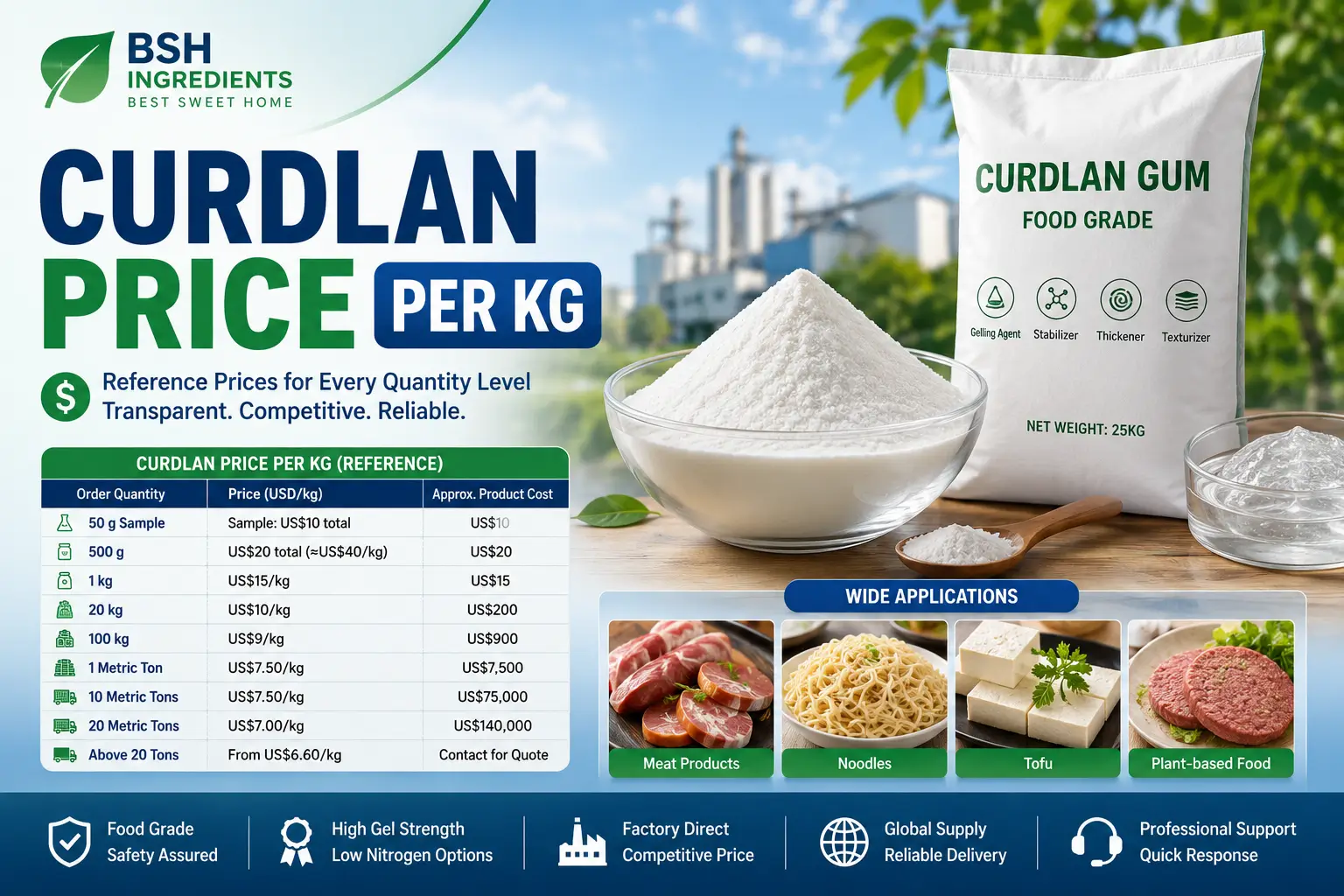
The Curdlan Price per kg in 2026 ranges from approximately US$15/kg for a 1 kg order to US$6.60/kg for bulk purchases above 20 metric tons for general standard food-grade curdlan. Smaller R&D quantities are naturally more expensive: a 50 g curdlan sample is approximately US$10, while 500 g is approximately US$20. For commercial purchasing, the reference price is about US$10/kg for 20 kg, US$9/kg for 100 kg, US$7.50/kg for 1 metric ton, and US$7.00/kg for 20 metric tons.
These prices are reference prices rather than fixed quotations for every curdlan specification. Actual curdlan gum prices depend on order volume, gel strength, total nitrogen, curdlan content, food-grade standard, packaging, shipping terms, and customized requirements. Higher gel strength and lower nitrogen levels can substantially increase the final cost.
For buyers sourcing directly from China, understanding both quantity pricing and specification pricing is therefore essential before comparing curdlan suppliers.
What Is the Curdlan Price per kg in 2026?
The following table provides a practical 2026 curdlan price guide for general standard food-grade curdlan. It is intended for purchasing comparison, budgeting, formulation trials, and preliminary sourcing.
Food Grade Curdlan Price by Quantity
| Order Quantity | Reference Price | Equivalent Price per kg | Approx. Product Cost |
|---|---|---|---|
| 50 g sample | US$10 total | Approx. US$200/kg equivalent | US$10 |
| 500 g | US$20 total | Approx. US$40/kg equivalent | US$20 |
| 1 kg | US$15/kg | US$15/kg | US$15 |
| 20 kg | US$10/kg | US$10/kg | US$200 |
| 100 kg | US$9/kg | US$9/kg | US$900 |
| 1 metric ton | US$7.50/kg | US$7.50/kg | US$7,500 |
| 10 metric tons | US$7.50/kg | US$7.50/kg | US$75,000 |
| 20 metric tons | US$7.00/kg | US$7.00/kg | US$140,000 |
| Above 20 metric tons | From US$6.60/kg | From US$6.60/kg | Request quotation |
Quick answer: The standard curdlan price per kg is approximately US$15/kg for 1 kg, US$10/kg for 20 kg, US$9/kg for 100 kg, US$7.50/kg for 1 metric ton, US$7.00/kg for 20 metric tons, and from US$6.60/kg for purchases above 20 metric tons.
These are reference product prices. Freight, customized specifications, special packaging, testing requirements, and Incoterms can change the final quotation.
Buyers interested in commercial supply can also review BSH Ingredients’ bulk curdlan gum manufacturing and supply capabilities.
Curdlan Price by Order Quantity
The quantity purchased is one of the most important factors affecting the bulk curdlan price. Small samples have high handling and packaging costs relative to their weight, while metric-ton orders benefit from industrial-scale production, packaging, warehousing, and logistics.
50 g Curdlan Sample Price: Approximately US$10
A 50 g curdlan sample costs approximately US$10 as a reference.
This quantity is intended mainly for laboratory evaluation, preliminary formulation development, gel testing, supplier qualification, and initial R&D work. Because only 50 g is supplied, calculating the sample price directly as a commercial price per kilogram would be misleading.
The equivalent unit cost is approximately US$200/kg, but this does not represent the normal wholesale curdlan gum price.
For qualified B2B projects, sample arrangements may vary according to specification and shipping requirements.
500 g Curdlan Price: Approximately US$20
The reference 500 g curdlan price is approximately US$20, equivalent to about US$40/kg.
A 500 g package provides more material for pilot formulations, comparison testing, heat-gel experiments, texture evaluation, and repeated laboratory trials.
The significant price difference between 500 g and commercial bulk curdlan illustrates an important point: small-quantity curdlan prices should not be used to estimate industrial raw-material costs.
1 kg Curdlan Price: Approximately US$15/kg
The reference 1 kg curdlan price is approximately US$15/kg for general standard food-grade material.
One kilogram is a useful quantity for product development laboratories, startup food companies, ingredient evaluation, pilot production, and customers testing curdlan in several formulations.
However, US$15/kg should still be considered a small-volume price rather than a true factory-scale wholesale price.
20 kg Curdlan Price: Approximately US$10/kg
At 20 kg, the reference curdlan price falls to approximately US$10/kg, giving an approximate product cost of US$200.
This quantity is much closer to normal commercial packaging and is suitable for pilot production, initial commercial batches, small food manufacturers, distributors testing a new market, and customers moving from laboratory evaluation into actual production.
The difference is substantial. A 1 kg purchase is approximately US$15/kg, while a 20 kg order is approximately US$10/kg.
100 kg Curdlan Price: Approximately US$9/kg
The reference 100 kg curdlan price is approximately US$9/kg, or around US$900 for 100 kg.
At this quantity, buyers are moving into genuine wholesale curdlan purchasing. A 100 kg order may be appropriate for commercial food production, regional ingredient distribution, production-scale validation, or an initial import order.
For companies evaluating different grades, the Curdlan Gum Specifications guide explains why gel strength, nitrogen content, assay, moisture, ash, microbiological limits, and particle size should be compared alongside price.
1 Ton Curdlan Price: Approximately US$7.50/kg
For a 1 metric ton order, the reference bulk curdlan price is approximately US$7.50/kg.
Since one metric ton equals 1,000 kg:
1,000 kg × US$7.50/kg = approximately US$7,500
This is an important purchasing level for food manufacturers, ingredient importers, distributors, private-label businesses, and industrial users because the economics begin to reflect factory-direct bulk production rather than small-order handling.
The exact curdlan price per ton can still vary significantly if the buyer requires higher gel strength, lower total nitrogen, stricter assay limits, specialized testing, or non-standard packaging.
10 Ton Curdlan Price: Approximately US$7.50/kg
The reference 10 metric ton curdlan price is approximately US$7.50/kg, producing an estimated raw-material value of US$75,000.
At this volume, purchasing terms may increasingly depend on production scheduling, annual demand, shipment planning, destination, payment terms, and the customer’s exact technical specification.
For recurring customers, annual purchasing agreements can also provide greater supply stability than placing individual spot orders.
20 Ton Curdlan Price: Approximately US$7.00/kg
At 20 metric tons, the reference price decreases to approximately US$7.00/kg.
The approximate product value is:
20,000 kg × US$7.00/kg = US$140,000
This is a high-volume commercial purchase and is more representative of container-scale or long-term ingredient procurement.
Buyers at this level should compare not only the factory price but also batch consistency, production capacity, quality documentation, export support, lead time, and specification stability.
Above 20 Tons: From Approximately US$6.60/kg
For purchasing quantities above 20 metric tons, the reference standard curdlan price can start from approximately US$6.60/kg.
This is the lowest reference price level in this guide, but it applies to large-volume standard material under suitable commercial conditions. It should not be interpreted as a fixed price for an 800+ g/cm² high-gel-strength, ultra-low-nitrogen, custom-grade curdlan.
Large-volume buyers should request an individual quotation based on annual consumption, shipment schedule, required specification, packaging, destination, and Incoterm.
Why Does the Curdlan Price per kg Decrease with Larger Orders?
The relationship between quantity and curdlan cost per kg is clear from the reference prices:
US$15/kg at 1 kg → US$10/kg at 20 kg → US$9/kg at 100 kg → US$7.50/kg at 1 ton → US$7.00/kg at 20 tons → from US$6.60/kg above 20 tons.
Larger production orders generally allow more efficient batch planning, packaging, warehouse handling, quality-control allocation, export processing, and logistics. Small quantities require many of the same administrative and handling procedures as larger orders, but those costs are distributed across far fewer kilograms.
This is why a retail, sample, or laboratory curdlan price cannot be directly compared with a factory-direct wholesale curdlan price.
What Specification Does This Curdlan Price Apply To?
The prices above are intended as reference prices for general standard food-grade curdlan, rather than a universal quotation covering every possible grade.
For Chinese food-grade sourcing, one important reference is QB/T 4322-2012. Under the standard discussed in this price guide, total nitrogen is controlled at ≤1.0%, while gel strength requirements differ according to grade. BSH Ingredients can supply material with gel strength above the applicable minimum standard.
Buyers who want to understand the Chinese specification in more detail can review the QB/T 4322-2012 Curdlan Standard guide.
For international purchasing, it is also important to distinguish between a basic standard food-grade specification and customized products requiring higher gel strength, lower total nitrogen, tighter microbial limits, specific particle sizes, or additional third-party testing.
For example, BSH Ingredients supplies a 600 g/cm² food-grade curdlan powder for standard commercial applications, while more technically demanding formulations may require a high-gel-strength curdlan gum powder at 800 g/cm² or higher.
These products should not be expected to have identical prices.
How Does Gel Strength Affect Curdlan Price per kg?
Gel strength is one of the largest technical factors affecting curdlan pricing.
Curdlan is a fermentation-derived β-1,3-glucan hydrocolloid valued for its thermal gel formation. Food manufacturers use it as a gelling agent, stabilizer, texture modifier, and structure-building ingredient in meat products, surimi, noodles, plant-based foods, frozen foods, prepared meals, tofu, bakery systems, and other processed foods.
For comparable food-grade products with similar nitrogen levels, the internal market reference indicates the following general pricing relationship:
| Gel Strength | Positioning | Approx. Price Difference |
|---|---|---|
| 400-600 g/cm² | Basic/reference grade | Baseline |
| 600-800 g/cm² | Mainstream medium/high performance | Approx. 18%-28% higher |
| ≥800 g/cm² | High-elasticity custom grade | Approx. 70%-130% higher |
These percentage ranges are market references rather than fixed BSH quotations. Actual differences vary according to nitrogen content, assay, quantity, and application requirements.
A buyer comparing US$7/kg and US$10/kg curdlan should therefore first ask whether both products have the same gel strength.
For buyers interested in how this parameter is measured, see the Curdlan Gel Strength Test method and procedure.
How Does Nitrogen Level Affect Curdlan Price?
Total nitrogen is another important factor separating standard commercial curdlan from more highly purified grades.
For comparable food-grade material with similar gel strength, the market reference shows approximately:
| Total Nitrogen | Commercial Positioning | Approx. Price Difference |
|---|---|---|
| 0.5%-1.0% | Standard reference range | Baseline |
| 0.2%-0.5% | Refined low-nitrogen curdlan | Approx. 20%-35% higher |
| ≤0.3% | Ultra-low-nitrogen / premium grade | Approx. 50%-90% higher |
The reason is mainly purification. Producing lower-nitrogen curdlan can require additional washing, filtration, protein removal, purification, tighter fermentation control, and reduced production yield.
Therefore, a customer requesting ≤0.3% nitrogen and ≥800 g/cm² gel strength should not expect the same curdlan price per kg as a buyer purchasing a standard food-grade grade with nitrogen closer to the normal range.
This is also why procurement teams should always request a batch-specific Certificate of Analysis rather than comparing supplier website prices alone.
Does Curdlan Content and Purity Affect the Price?
Yes. Curdlan content, sometimes described as assay or calculated as anhydrous glucose, is another important specification.
Commercial curdlan gum should not be evaluated only by a marketing claim such as “high purity.” Buyers should compare the actual analytical method, assay basis, gel strength, nitrogen content, moisture, ash, pH, microbiological limits, and other specification parameters.
BSH Ingredients has published a detailed Curdlan Content Determination as Anhydrous Glucose method explaining how curdlan content is determined.
A supplier offering an unusually low curdlan powder price may be providing a product with a different assay, gel strength, nitrogen level, or performance profile. That makes price-only comparisons unreliable.
Why Can Two Curdlan Suppliers Offer Very Different Prices?
Buyers researching China curdlan prices, Alibaba listings, manufacturer quotations, distributor offers, or small retail packs often see enormous price differences.
One supplier may advertise US$6/kg, another US$10/kg, another US$15/kg, and laboratory material may cost many times more.
The prices may all be technically real while representing completely different products or commercial conditions.
The main variables include gel strength, total nitrogen, curdlan assay, food-grade status, purity, particle size, microbiological specification, batch consistency, order volume, package size, testing requirements, shipping terms, destination, payment terms, and whether the price is EXW, FOB, CIF, or another Incoterm.
A US$7/kg curdlan quotation is only comparable with another US$7/kg quotation when the specification, quantity, packaging, quality requirements, and delivery terms are also comparable.
This is particularly important for high gel strength curdlan. A low-cost 400-600 g/cm² product should not be compared directly with a customized ≥800 g/cm² low-nitrogen grade.
Curdlan Price Trend from 2023 to 2026
The Chinese curdlan market has experienced significant pricing adjustments over the past several years.
Industry reference data indicates that mainstream mid-range curdlan prices increased by approximately 4.5% in 2024 compared with 2023, partly reflecting higher purification costs and increasing demand for better-quality low-nitrogen grades.
The market changed substantially in 2025, when increased production capacity and stronger competition pushed the reference industry average down by approximately 31.4% compared with 2024.
During January through August 2026, the reference average declined by approximately another 17.6% compared with the 2025 average. The market has since moved closer to a more stable pricing environment.
However, the price decline has not been uniform.
Basic and lower-end grades have experienced greater competition and stronger downward pricing pressure. Low-nitrogen curdlan and high-gel-strength curdlan have generally retained a larger price premium because additional purification, process control, and manufacturing capability are required.
This is why buyers should not assume that a general decline in the China curdlan market automatically means that every custom grade will fall by the same percentage.
Curdlan Manufacturing Cost and Price
Understanding how curdlan is produced also helps explain its price.
Curdlan is not simply milled from a plant raw material. It is a microbial fermentation-derived β-1,3-glucan polysaccharide. Manufacturing involves fermentation, separation, purification, washing, drying, milling, quality control, and packaging.
Additional purification requirements can affect nitrogen levels, while fermentation and downstream processing conditions influence final gel performance.
Buyers interested in the production side can read How Is Curdlan Gum Made?.
Production cost can therefore be influenced by fermentation yield, energy, purification requirements, water consumption, filtration, drying, labor, quality testing, packaging, factory utilization, and required product specifications.
High-performance curdlan cannot be evaluated solely on the lowest factory price.
Price per kg vs Cost-in-Use
For a food manufacturer, the lowest curdlan price per kg does not always create the lowest finished-product cost.
Suppose one curdlan grade costs slightly more but provides stronger and more consistent gel performance. Depending on the formulation, it may allow the manufacturer to achieve the target texture more reliably, reduce batch-to-batch adjustment, improve water retention, maintain better shape during heating, or optimize formulation dosage.
This is why professional buyers often evaluate cost-in-use in addition to raw material price.
The commercially relevant comparison is not simply:
Which curdlan supplier has the lowest price per kg?
It is:
Which curdlan specification delivers the required performance, compliance, consistency, and landed cost at the most competitive total cost?
Packaging, Shipping and Landed Curdlan Cost
The factory price is only one component of the final landed curdlan cost.
A buyer purchasing 1 kg by express shipment has a very different logistics structure from an importer purchasing 10 or 20 metric tons by sea.
Final landed cost can be affected by packaging, pallet requirements, freight, insurance, customs clearance, import duties, destination charges, local transportation, and the selected Incoterm.
An EXW curdlan price, FOB curdlan price, and CIF curdlan price therefore cannot be compared without adjustment.
For international buyers, BSH Ingredients can also provide quality and export documentation. More information about factory quality systems and documentation is available on the Curdlan Gum Certifications and Quality Control page.
How to Get an Accurate Curdlan Price per kg
For an accurate quotation, buyers should provide the purchasing quantity, target gel strength, maximum nitrogen level, required curdlan content or grade, application, package size, destination country or port, and preferred shipping term.
For example, an inquiry stating only “What is your curdlan price?” leaves too many variables unanswered.
A much better RFQ would specify: 1 metric ton, food grade, gel strength ≥650 g/cm², nitrogen ≤0.5%, standard bulk packaging, FOB China port.
That allows the supplier to quote a product that actually matches the customer’s technical and commercial requirements.
For buyers purchasing standard material, the prices in this guide provide a useful starting point:
1 kg: US$15/kg
20 kg: US$10/kg
100 kg: US$9/kg
1 ton: US$7.50/kg
10 tons: US$7.30/kg
20 tons: US$7.00/kg
Above 20 tons: from US$6.60/kg
Actual quotations should always be reconfirmed before purchase because curdlan market prices, freight, specifications, and commercial conditions can change.
Curdlan Price per kg FAQs
What is the Curdlan Price per kg in 2026?
For general standard food-grade curdlan, the reference 2026 price is approximately US$15/kg for 1 kg, US$10/kg for 20 kg, US$9/kg for 100 kg, US$7.50/kg for 1 metric ton, US$7.00/kg for 20 metric tons, and from US$6.60/kg for orders above 20 metric tons. Final prices depend on gel strength, total nitrogen, assay, packaging, quantity, and delivery terms.
How much does a 50 g curdlan sample cost?
A 50 g curdlan sample is approximately US$10 as a reference. Sample pricing should not be converted directly into an industrial wholesale price because laboratory quantities carry much higher packaging and handling costs per kilogram.
How much does 500 g of curdlan cost?
The reference 500 g curdlan price is approximately US$20. This is equivalent to about US$40/kg but is intended mainly for R&D and pilot testing rather than large-scale commercial purchasing.
How much does 1 kg of curdlan cost?
The reference 1 kg curdlan price is approximately US$15/kg for general standard food-grade material.
How much does 20 kg of curdlan cost?
The reference price is approximately US$10/kg, making a 20 kg order approximately US$200 before any applicable freight, custom packaging, or additional commercial costs.
How much does 100 kg of curdlan cost?
The reference 100 kg curdlan price is approximately US$9/kg, giving an approximate product value of US$900.
What is the price of one ton of curdlan?
The reference 1 ton curdlan price is approximately US$7.50/kg. Since one metric ton contains 1,000 kg, the approximate product cost is US$7,500 per metric ton before freight and other applicable costs.
What is the 10 ton curdlan price?
The reference price for 10 metric tons is approximately US$7.50/kg, or approximately US$75,000 in product value.
What is the 20 ton curdlan price?
The reference 20 ton curdlan price is approximately US$7.00/kg, giving an approximate product value of US$140,000.
What is the cheapest bulk curdlan price?
For general standard material and purchase quantities above 20 metric tons, reference pricing can start from approximately US$6.60/kg. An exact quotation requires confirmation of specification, order size, packaging, destination, and delivery terms.
Why is curdlan more expensive in small quantities?
Small orders have proportionally higher packaging, handling, administration, sampling, warehousing, and shipment-preparation costs. This is why a 1 kg price may be US$15/kg while a large bulk order can fall below US$7/kg.
Does higher gel strength increase the curdlan price?
Generally, yes. For comparable nitrogen levels, 600-800 g/cm² food-grade curdlan can carry a premium compared with 400-600 g/cm² material, while ≥800 g/cm² custom high-gel-strength curdlan can cost substantially more. Exact pricing depends on the total specification and quantity.
Does low-nitrogen curdlan cost more?
Generally, yes. Low-nitrogen grades such as ≤0.5% or ≤0.3% total nitrogen require greater purification than standard material. Market reference data indicates that low-nitrogen grades can command meaningful premiums over standard specifications.
Is food-grade curdlan the same price as industrial curdlan?
No. Food-grade curdlan requires applicable quality and safety specifications, production controls, and documentation. Industrial or non-food material should not be compared directly with food-grade Curdlan E424 or other food-additive grades solely by price per kilogram.
What information is needed for a bulk curdlan quotation?
For the most accurate curdlan price quotation, provide your quantity, gel strength, nitrogen limit, assay requirement, application, packaging, destination, and preferred Incoterm. These parameters allow the manufacturer to determine the correct grade and calculate a meaningful factory-direct or landed price.
Where can I buy curdlan in bulk?
BSH Ingredients supplies food-grade curdlan gum powder for food manufacturers, importers, distributors, ingredient companies, private-label businesses, and other B2B buyers. Standard, high-gel-strength, low-nitrogen, and customized specifications are available depending on project requirements. Buyers can start from the BSH Ingredients bulk curdlan gum supplier page to request specifications, samples, COA documentation, and current pricing.
Pricing note: All prices in this guide are reference prices for budgeting and purchasing comparison and are not fixed offers. Actual curdlan prices can change with specifications, quantity, production conditions, packaging, freight, exchange rates, and commercial terms. For a current quotation, confirm your technical requirements and purchasing volume directly with BSH Ingredients.