
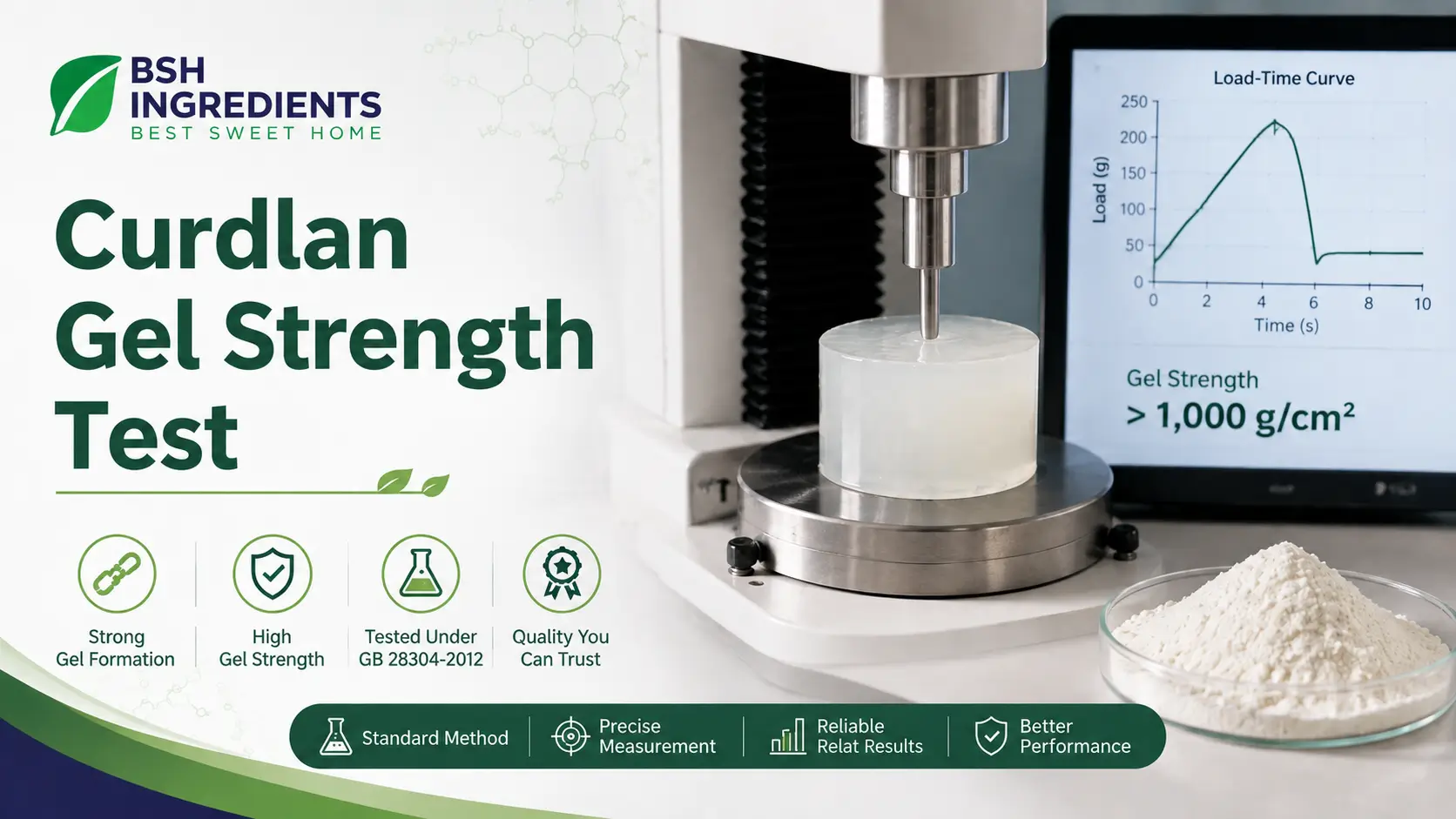
A curdlan gel strength test is one of the most important methods for evaluating the functional quality of food-grade curdlan gum. It measures the force required to fracture a standardized curdlan gel after controlled dispersion, heating, cooling, cutting, and texture analysis.
BSH Ingredients conducted a curdlan gel strength test according to the sample preparation and measurement conditions described in the Chinese national food safety standard GB 28304-2012. The tested BSH Ingredients curdlan sample achieved a gel strength of more than 1,000 g/cm².
The minimum gel strength specified in GB 28304-2012 is 450 g/cm². Therefore, the tested BSH Ingredients sample reached more than 2.2 times the minimum value required by the standard.
This article explains the test objective, laboratory equipment, sample preparation procedure, texture analyzer settings, calculation formula, result interpretation, and the factors that can influence curdlan gel strength.
Curdlan Gel Strength Test Result at a Glance
| Test item | GB 28304-2012 requirement | BSH Ingredients test result |
|---|---|---|
| Curdlan gel strength | ≥450 g/cm² | >1,000 g/cm² |
| Test method | Appendix A.3 | Based on Appendix A.3 |
| Sample amount | 0.3 g | 0.3 g |
| Water volume | 15 mL | 15 mL |
| Heating condition | Boiling-water bath for 10 minutes | Boiling-water bath for 10 minutes |
| Cooling condition | Cold water for 30 minutes | Cold water for 30 minutes |
| Probe diameter | 0.5 cm | 0.5 cm |
| Probe speed | 250 mm/min | 250 mm/min |
The reported result applies to the tested curdlan sample under the stated laboratory conditions. Buyers should request a batch-specific certificate of analysis or test report when evaluating commercial shipments.
What Is Curdlan Gum?
Curdlan is a fermentation-derived polysaccharide composed mainly of β-1,3-linked glucose units. Its chemical name is β-1,3-glucan, and its molecular formula is expressed as:
(C₆H₁₀O₅)n
GB 28304-2012 describes food-additive curdlan as a product manufactured through biological fermentation using selected microorganisms and carbohydrate raw materials such as sucrose or glucose. The fermentation product is subsequently purified, dried, and milled into a white or nearly white powder.
Curdlan does not dissolve directly in water under normal conditions. Instead, it forms a suspension. When the properly dispersed suspension is heated, the curdlan chains associate and create a three-dimensional gel network.
This heat-induced gel-forming ability is the main reason curdlan is used as a texture modifier, stabilizer, gelling agent, and structural ingredient in food processing.
Why Is Curdlan Gel Strength Important?
Gel strength indicates how much force a prepared curdlan gel can withstand before its structure breaks. It is an important functional parameter for ingredient manufacturers, food processors, formulation laboratories, and quality-control teams.
A curdlan powder may meet basic identity and purity requirements but still produce a relatively weak gel. For many industrial applications, this difference can affect the texture, cutting performance, stability, and structural integrity of the finished food.
Firmness and structural stability
A stronger curdlan gel can provide greater resistance to compression, cutting, handling, and thermal processing. This can be valuable in products that must maintain a defined shape during production, packaging, cooking, or transportation.
Batch-to-batch consistency
Measuring gel strength under standardized conditions allows buyers to compare different production batches. Consistent gel-strength results can help reduce formulation adjustments and production variability.
Formulation efficiency
Curdlan with reliable gel performance may help formulators achieve the required texture more predictably. However, the optimum dosage still depends on the target application, water content, processing conditions, and other ingredients in the formulation.
Raw-material comparison
Gel strength is useful when comparing curdlan samples from different manufacturers. Such comparisons are only meaningful when the samples are tested using the same concentration, equipment, probe, heating procedure, cooling conditions, specimen size, and calculation method.
GB 28304-2012 Curdlan Gel Strength Requirement
GB 28304-2012 is the Chinese national food safety standard for food-additive curdlan. The standard establishes sensory, physicochemical, and microbiological requirements for the ingredient.
For gel strength, the standard requires:
Curdlan gel strength: not less than 450 g/cm²
The BSH Ingredients test result of more than 1,000 g/cm² is therefore:
- More than 2.2 times the standard minimum
- More than 550 g/cm² above the minimum value
- More than 122% higher than the 450 g/cm² minimum requirement
The comparison is calculated as follows:1,000÷450=2.22
Because the actual BSH Ingredients result exceeded 1,000 g/cm², its performance relative to the minimum standard was also greater than 2.22 times.
A high test result should be interpreted as evidence of strong gel formation under the specified test conditions. It should not be described as proof that the product is the strongest curdlan available on the market unless controlled comparative tests have been conducted on multiple commercial samples.
Objective of the Curdlan Gel Strength Test
The main objective of the test is to prepare a standardized heat-set curdlan gel and measure the force required to fracture it.
The procedure is designed to:
- Confirm that the curdlan sample forms a gel after heating
- Evaluate the strength of the resulting gel
- Compare the result with the GB 28304-2012 requirement
- Support routine batch quality control
- Provide technical data for buyers and formulation teams
- Identify variations in functional performance between samples
The official method controls the sample concentration, dispersion speed, heating time, cooling time, gel dimensions, probe diameter, and probe movement speed. These controls improve the comparability of test results.
Equipment Used for the Curdlan Gel Strength Test
The official method requires a gel tester or texture analyzer. Additional equipment is needed to disperse the curdlan, remove trapped air, heat the suspension, cool the gel, and prepare the test specimen.
| Equipment | Purpose |
|---|---|
| Gel tester or texture analyzer | Measures the load at which the gel fractures |
| Column-type emulsifying disperser | Produces a uniform curdlan suspension |
| Analytical balance | Accurately weighs the curdlan sample |
| 18 mm × 180 mm test tube | Holds the sample during heating and cooling |
| Vacuum equipment | Treats the suspension before heating |
| Boiling-water bath | Heats the suspension and induces gel formation |
| Cold-water bath | Cools and sets the prepared gel |
| Stainless-steel cylindrical probe | Applies force to the gel specimen |
| Cutting tool | Prepares a uniform 10 mm-high gel sample |
| Timer | Controls dispersion, vacuum treatment, heating, and cooling times |
Instrument calibration and proper sample positioning are also important for obtaining reliable results.
Texture Analyzer Test Conditions
GB 28304-2012 specifies the following conditions for measuring curdlan gel strength:
| Test parameter | Required condition |
|---|---|
| Instrument | Gel tester or texture analyzer |
| Instrument mode | Mode 4 |
| Probe shape | Cylindrical piston |
| Probe material | Stainless steel |
| Probe diameter | 0.5 cm |
| Probe movement speed | 250 mm/min |
| Probe cross-sectional area | 0.196 cm² |
| Measurement curve | Load-time curve |
| Result unit | g/cm² |
The probe dimensions are especially important because the gel strength calculation uses the probe cross-sectional area.
A probe with a diameter of 0.5 cm has a cross-sectional area of approximately 0.196 cm². Using a different probe diameter without modifying the calculation would produce an incorrect result.
Step-by-Step Curdlan Gel Strength Test Procedure
The following procedure is based on Appendix A.3 of GB 28304-2012 and the attached BSH Ingredients test instructions.
Step 1: Weigh the curdlan sample
Accurately weigh 0.3 g of curdlan powder.
The sample weight should be controlled carefully because even a small variation can change the curdlan concentration and affect the final gel strength.
Step 2: Add the sample to water
Place the 0.3 g curdlan sample in 15 mL of water.
This produces a curdlan concentration of approximately 2% by weight relative to the water volume used in the test.
Because curdlan is insoluble in water, the objective is to prepare a uniform suspension rather than a true solution.
Step 3: Disperse the suspension
Use a column-type emulsifying disperser to mix the curdlan suspension at:
- Speed: 3,500 r/min
- Mixing time: 5 minutes
Adequate dispersion is essential. Undispersed particles or agglomerates can create non-uniform gel regions and lead to inconsistent fracture measurements.
Step 4: Transfer the suspension
Transfer the dispersed curdlan suspension into an 18 mm × 180 mm test tube.
The specified tube dimensions help control the shape and diameter of the final gel.
Using a different tube size could change heat transfer, gel geometry, and specimen uniformity.
Step 5: Apply vacuum treatment
Treat the suspension under vacuum for 3 minutes.
The attached method describes this stage as treatment under vacuum. In practical sample preparation, this step helps reduce trapped air and visible bubbles in the suspension before heating.
Air bubbles can create weak points inside the gel. They may also cause premature fracture or abnormal texture analyzer readings.
Step 6: Heat the suspension
Immediately place the test tube in a boiling-water bath for 10 minutes.
Heating causes the curdlan suspension to form a gel network. The heating time should be measured after the test tube is placed in the boiling-water bath.
Consistent heating conditions are necessary because insufficient or uneven heating may result in incomplete gel formation.
Step 7: Cool the gel
After heating, transfer the test tube to cold water and cool it for 30 minutes.
Cooling allows the gel structure to stabilize before cutting and measurement.
The cooling time should remain consistent across all samples. Testing one specimen immediately and another after prolonged storage could lead to differences unrelated to the original raw-material quality.
Step 8: Remove the gel from the tube
Carefully remove the formed gel from the test tube without compressing, tearing, or deforming it.
The gel should be handled gently because physical damage before testing can reduce the measured fracture force.
Step 9: Cut the test specimen
Locate the section between 20 mm and 30 mm above the bottom of the gel.
Cut a gel specimen with a height of 10 mm from this section.
Selecting a defined position helps reduce variation caused by differences between the upper, middle, and lower portions of the test-tube gel.
Step 10: Measure the gel strength
Place the 10 mm gel specimen on the texture analyzer or gel tester.
Use the following settings:
- Mode 4
- 0.5 cm-diameter cylindrical stainless-steel probe
- Probe movement speed of 250 mm/min
Start the test and allow the probe to compress the gel until the structure fractures.
The instrument records a load-time curve. The fracture point is identified where the curve suddenly drops after reaching the breaking load.
How Is Curdlan Gel Strength Calculated?
The official calculation is:w1=0.196f
Where:
- w₁ is the gel strength, expressed in g/cm²
- f is the load at the gel fracture point, expressed in grams
- 0.196 is the cross-sectional area of the 0.5 cm-diameter cylindrical probe, expressed in cm²
The fracture load is obtained from the point on the load-time curve where the recorded value drops sharply as the gel breaks.
Example calculation for 1,000 g/cm²
If the measured gel strength is exactly 1,000 g/cm²:f=1,000×0.196 f=196 g
Therefore, a gel strength above 1,000 g/cm² means the recorded fracture load was above 196 g, provided that the specified 0.5 cm probe and official calculation method were used.
Additional calculation examples
| Fracture load | Calculated gel strength |
|---|---|
| 88.2 g | 450 g/cm² |
| 117.6 g | 600 g/cm² |
| 156.8 g | 800 g/cm² |
| 196.0 g | 1,000 g/cm² |
| 215.6 g | 1,100 g/cm² |
The 450 g/cm² minimum specified in GB 28304-2012 corresponds to a fracture load of approximately 88.2 g when using the prescribed probe.
BSH Ingredients Curdlan Gel Strength Result
Under the specified test conditions, the tested BSH Ingredients curdlan sample achieved:
Curdlan gel strength: more than 1,000 g/cm²
This result substantially exceeded the GB 28304-2012 minimum requirement of 450 g/cm².
| Comparison | Gel strength |
|---|---|
| GB 28304-2012 minimum | 450 g/cm² |
| BSH Ingredients tested sample | >1,000 g/cm² |
| Difference above the minimum | >550 g/cm² |
| Relative performance | >2.2 times the minimum |
The result demonstrates that the tested sample produced a strong heat-set gel under the defined laboratory conditions.
For complete technical evaluation, the gel strength result should be reviewed together with the batch number, test date, instrument model, replicate results, calculation records, and other quality parameters.
What Does a Curdlan Gel Strength Above 1,000 g/cm² Mean?
A result above 1,000 g/cm² means that the prepared curdlan gel resisted a relatively high compressive load before fracturing.
For food manufacturers, this may indicate potential advantages in applications that require:
- Firm heat-set gel formation
- Strong structural support
- Good shape retention
- Resistance to cutting and handling
- Stable texture after thermal processing
- Consistent performance between production runs
However, a laboratory gel-strength value should not be interpreted as a direct prediction of every finished food formulation.
The final performance of curdlan in a commercial product can also depend on:
- Curdlan dosage
- Water availability
- Dispersion efficiency
- Heating temperature
- Heating duration
- Cooling conditions
- Product pH
- Salt concentration
- Sugar concentration
- Protein content
- Starch content
- Other hydrocolloids
- Processing shear
- Filling and forming methods
Manufacturers should conduct application trials using their own formula and processing system before finalizing the curdlan dosage.
Is Higher Curdlan Gel Strength Always Better?
Higher gel strength is beneficial when the target product requires a firm, strong, or highly stable structure. It may be suitable for products that need to resist deformation, cutting, cooking, packaging, or transportation.
However, the highest available gel strength is not automatically the best choice for every application.
Some products require:
- A softer bite
- Greater flexibility
- Lower hardness
- Easier chewing
- A more delicate gel structure
- Controlled breakdown during consumption
The appropriate curdlan grade should therefore be selected according to the target texture, processing conditions, formulation composition, and required dosage.
Gel strength is a key selection criterion, but it should be evaluated together with dispersibility, purity, particle size, microbiological quality, regulatory compliance, and application performance.
Factors That Can Affect Curdlan Gel Strength Test Results
Curdlan gel strength testing requires careful control. Small changes in sample preparation or instrument settings may produce significantly different values.
Sample weight and water volume
The official method uses 0.3 g of curdlan in 15 mL of water. Increasing or decreasing the sample concentration changes the amount of curdlan available to form the gel network.
Dispersion speed and time
The sample is dispersed at 3,500 r/min for 5 minutes. Inadequate dispersion may leave agglomerates, while excessive or inconsistent mixing may alter sample uniformity.
Air bubbles
Entrapped air can create internal defects and weak points. Vacuum treatment should be performed consistently before heating.
Test-tube dimensions
The specified 18 mm × 180 mm test tube controls the gel diameter and heating environment. Different containers may produce different thermal and structural conditions.
Heating time
The sample must remain in a boiling-water bath for 10 minutes. Insufficient heating can cause incomplete gel formation.
Water-bath performance
The water bath should be boiling and capable of maintaining stable heating conditions after the sample is introduced.
Cooling time
The prepared gel is cooled in cold water for 30 minutes. Differences in cooling time or temperature can affect the stabilized gel structure.
Specimen position
The official method requires a 10 mm specimen taken from the section located 20 to 30 mm above the bottom of the gel.
Testing a sample from another position may introduce variation.
Specimen dimensions
Gel height affects compression and fracture behavior. Each specimen should be cut to a consistent 10 mm height.
Probe dimensions
The official probe has a diameter of 0.5 cm and an area of 0.196 cm². Any change in probe size requires a corresponding change in the area used in the calculation.
Probe movement speed
The specified speed is 250 mm/min. A faster or slower test speed may change the recorded fracture load.
Instrument calibration
An uncalibrated load cell or incorrectly configured texture analyzer can produce inaccurate results.
Time before testing
The time between cooling, cutting, and measurement should remain consistent. Extended storage may change gel moisture distribution or structure.
Curdlan Identification Gel Test
GB 28304-2012 also includes a qualitative gel-formation test for identifying curdlan.
The procedure is:
- Weigh 0.2 g of curdlan.
- Add it to 10 mL of water in an 18 mm × 180 mm test tube.
- Stir to prepare a suspension.
- Heat the suspension in a boiling-water bath for 10 minutes.
- Cool it to room temperature.
- Observe whether a gel forms.
Formation of a gel after heating and cooling supports the identification of curdlan. This qualitative test is different from the quantitative gel strength measurement, which uses 0.3 g of sample, controlled dispersion, a texture analyzer, and a numerical calculation.
Other Curdlan Identification Tests
In addition to gel formation, GB 28304-2012 describes other identification characteristics.
Water and ethanol solubility
The standard describes curdlan as insoluble in water and ethanol.
Alkali solubility
A curdlan sample can dissolve after sodium hydroxide solution is added under the prescribed test conditions.
Copper tartrate precipitation reaction
The standard also describes an identification reaction involving acid hydrolysis, neutralization, centrifugation, and reaction with hot Fehling solution. A red precipitate is formed during the test.
These tests help confirm product identity but do not replace quantitative gel-strength testing.
Other Quality Requirements for Food-Grade Curdlan
Gel strength is an important functional specification, but it is not the only parameter used to evaluate curdlan quality.
GB 28304-2012 includes the following physicochemical requirements:
| Quality parameter | GB 28304-2012 requirement |
|---|---|
| Gel strength | ≥450 g/cm² |
| Curdlan content, calculated as anhydrous glucose | ≥80% |
| pH of 1% aqueous suspension | 6.0 to 7.5 |
| Loss on drying | ≤10% |
| Ash | ≤6.0% |
| Total nitrogen | ≤1.5% |
| Lead | ≤0.5 mg/kg |
The standard also includes microbiological limits:
| Microbiological parameter | GB 28304-2012 requirement |
|---|---|
| Total plate count | ≤10,000 CFU/g |
| Coliforms | <3.0 MPN/g |
Buyers should evaluate all relevant specifications rather than making a purchasing decision based only on the highest gel-strength number.
Depending on the intended market and application, buyers may also request:
- Batch-specific certificate of analysis
- Product specification
- Safety data sheet
- Allergen statement
- GMO statement
- Manufacturing flow chart
- Heavy-metal report
- Microbiological report
- Third-party test report
- Country-of-origin statement
- Shelf-life statement
- Halal or Kosher documentation
- Export and customs documents
Practical Applications of High Gel Strength Curdlan
In practical food formulation, curdlan may be considered for products that require heat-induced structure and stable texture.
Potential application areas include:
Plant-based meat products
Curdlan can contribute to binding, firmness, shape retention, and heat-set structure in plant-based meat formulations.
Processed meat products
It may be evaluated in sausages, formed meat products, meatballs, and other systems where water binding and structural stability are important.
Seafood and surimi-style products
Curdlan may support gel structure and cutting performance in processed seafood, fish analogues, and surimi-style formulations.
Noodles and starch-based foods
It can be used to modify firmness, elasticity, processing tolerance, and cooking stability in selected noodle and starch systems.
Prepared and frozen foods
Curdlan may provide structural support in products exposed to heating, cooling, freezing, thawing, or reheating.
Gelled food products
High gel strength curdlan may be useful in food systems that require a firm and stable heat-set gel.
Suitability and dosage should be confirmed through application testing because finished-product performance depends on the complete formulation.
How to Compare Curdlan Gel Strength from Different Suppliers
When comparing samples from different curdlan manufacturers, buyers should confirm that all suppliers used the same method.
The following information should be requested:
| Comparison item | Why it matters |
|---|---|
| Test standard | Different methods may produce different numerical results |
| Sample concentration | Higher concentration generally produces a stronger gel |
| Water volume | Changes the effective curdlan concentration |
| Dispersion equipment | Affects sample uniformity |
| Dispersion speed and time | Influences particle distribution and agglomeration |
| Heating temperature and time | Controls gel formation |
| Cooling method and time | Influences final gel structure |
| Probe diameter | Determines the calculated contact area |
| Test speed | Can affect fracture force |
| Specimen dimensions | Affect compression and breaking behavior |
| Replicate number | Shows repeatability |
| Average and individual values | Reveals variation |
| Batch number | Connects the result to a specific commercial lot |
A result obtained using a different concentration, larger probe, slower test speed, or different specimen size should not be directly compared with a GB 28304-2012 value.
Recommended Curdlan Gel Strength Test Report Format
A complete laboratory report should contain enough information for buyers or quality teams to review the result.
| Report item | Recommended information |
|---|---|
| Product name | Food-grade curdlan gum |
| Manufacturer | BSH Ingredients |
| Batch number | Batch-specific identification |
| Test date | Date of analysis |
| Test standard | GB 28304-2012, Appendix A.3 |
| Sample amount | 0.3 g |
| Water volume | 15 mL |
| Dispersion condition | 3,500 r/min for 5 minutes |
| Test tube | 18 mm × 180 mm |
| Vacuum treatment | 3 minutes |
| Heating | Boiling-water bath for 10 minutes |
| Cooling | Cold water for 30 minutes |
| Specimen size | 10 mm high |
| Specimen position | 20 to 30 mm above the gel bottom |
| Probe | 0.5 cm cylindrical stainless-steel probe |
| Probe speed | 250 mm/min |
| Fracture load | Actual instrument reading in grams |
| Calculated strength | Result in g/cm² |
| Number of replicates | Preferably reported |
| Average result | Mean value, when replicate testing is used |
| Conclusion | Pass, fail, or exceeds internal specification |
The attached files provide the official method and calculation but do not include the exact instrument model, individual replicate values, standard deviation, or complete load-time curve for the reported BSH Ingredients result. These details can be added to a downloadable test report when available.
Why Choose BSH Ingredients Curdlan?
BSH Ingredients supplies food-grade curdlan for food manufacturers, ingredient distributors, importers, formulation companies, and industrial buyers.
The tested BSH Ingredients curdlan sample achieved a gel strength exceeding 1,000 g/cm² under the stated test conditions, substantially above the 450 g/cm² minimum specified in GB 28304-2012.
Strong heat-set gel performance
A result above 1,000 g/cm² demonstrates strong gel formation in the standardized laboratory test.
Standardized testing procedure
The sample preparation, heating, cooling, cutting, probe dimensions, test speed, and calculation were based on the GB 28304-2012 method.
Batch quality documentation
Buyers can request current specifications, batch-specific quality documents, and available gel-strength information before placing a bulk order.
Samples for formulation testing
Customer testing remains essential because curdlan performance can vary according to formulation ingredients, dosage, pH, processing temperature, and manufacturing equipment.
Bulk supply support
BSH Ingredients supports commercial inquiries for food-grade curdlan, including product evaluation, documentation review, sampling, bulk quotation, packaging, and international shipment requirements.
Frequently Asked Questions About Curdlan Gel Strength Testing
What is the minimum curdlan gel strength under GB 28304-2012?
GB 28304-2012 requires food-additive curdlan to have a gel strength of at least 450 g/cm².
What was the BSH Ingredients curdlan gel strength result?
The tested BSH Ingredients curdlan sample achieved a gel strength of more than 1,000 g/cm² under the stated test conditions.
How much higher is 1,000 g/cm² than the standard requirement?
A value of 1,000 g/cm² is approximately 2.22 times the 450 g/cm² minimum. It is approximately 122% above the minimum value.
Because the reported BSH Ingredients result exceeded 1,000 g/cm², its relative performance was also greater than these figures.
Which instrument is used to measure curdlan gel strength?
The method permits the use of a gel tester or texture analyzer fitted with a 0.5 cm-diameter cylindrical stainless-steel probe.
What sample concentration is used?
The official quantitative test uses 0.3 g of curdlan in 15 mL of water, which is approximately a 2% suspension.
Why is curdlan dispersed instead of dissolved?
Curdlan is insoluble in water under normal conditions. It must therefore be distributed uniformly as a suspension before heating.
Why is the suspension heated?
Heating induces the formation of the curdlan gel network. The official method uses a boiling-water bath for 10 minutes.
Why is the sample cooled for 30 minutes?
Controlled cooling allows the prepared gel to stabilize before it is removed, cut, and tested.
Why must air bubbles be removed?
Air bubbles can create internal defects and weak points in the gel. They may cause premature fracture and reduce measurement repeatability.
How is the fracture point identified?
The texture analyzer records a load-time curve. The fracture point is identified at the sudden drop in the curve when the gel structure breaks.
How is curdlan gel strength calculated?
Gel strength is calculated by dividing the fracture load in grams by the 0.196 cm² cross-sectional area of the specified probe.
Is higher gel strength always better?
No. Higher strength can be advantageous for firm and stable food structures, but some products require softer, more elastic, or more delicate textures.
Can results from two curdlan suppliers be compared directly?
Only when both samples are tested using the same concentration, dispersion procedure, heating conditions, cooling conditions, specimen dimensions, probe, test speed, and calculation method.
Does a raw-material gel strength of 1,000 g/cm² guarantee the same value in a finished food?
No. The official value is obtained from a standardized laboratory gel. Finished-product texture also depends on dosage, water, pH, salt, proteins, starches, other hydrocolloids, and processing conditions.
Can BSH Ingredients provide samples for customer testing?
Customers should contact BSH Ingredients to request sample availability, current specifications, quality documents, and commercial terms for their target application.
Conclusion
The curdlan gel strength test provides an objective method for evaluating the functional gel-forming performance of curdlan gum.
Under the test conditions based on GB 28304-2012, the BSH Ingredients curdlan sample achieved a gel strength of more than 1,000 g/cm². This substantially exceeded the national standard minimum of 450 g/cm² and demonstrated strong heat-set gel performance in the standardized laboratory test.
The official procedure uses 0.3 g of curdlan in 15 mL of water, dispersion at 3,500 r/min for 5 minutes, vacuum treatment for 3 minutes, heating in a boiling-water bath for 10 minutes, cooling in cold water for 30 minutes, and measurement with a 0.5 cm cylindrical stainless-steel probe moving at 250 mm/min.
For purchasing and formulation decisions, gel strength should be reviewed together with curdlan content, pH, moisture, ash, nitrogen, heavy metals, microbiological quality, batch consistency, documentation, and application-test results.
Contact BSH Ingredients to request a curdlan sample, product specification, batch-specific COA, gel strength information, technical documentation, and a quotation for bulk food-grade curdlan gum.