
Curdlan for Surimi, Fish Balls & Processed Seafood
Home / Applications / Curdlan for Surimi, Fish Balls & Processed Seafood
What Does Curdlan Do in Surimi?
Surimi is a washed fish paste used to make fish balls, kamaboko, and imitation crab. Curdlan is a fermentation-derived β-1,3-glucan that forms a gel when heated. In surimi, it can reinforce the fish protein network, improve water-holding capacity, and give the cooked product a springier bite.
The result depends on the fish species, curdlan dosage, salt and water levels, and how the paste is heated. For frozen fish balls, compare gel strength, thaw drip, and bite after reheating against your current formula.

Curdlan Applications in Fish Balls, Fish Cakes & Imitation Crab
Food-grade curdlan is a heat-setting hydrocolloid that seafood processors can evaluate in surimi formulations for boiled fish balls, steamed Japanese fish cakes such as kamaboko, and imitation crab sticks. Each product calls for a different balance of gel strength, elasticity, and water retention.
When testing curdlan, compare the trial batch with your current formula at the same salt level, added water, and heating profile. Measure cooking loss and water-holding capacity. For frozen surimi products, also record thaw drip and check the texture after reheating.
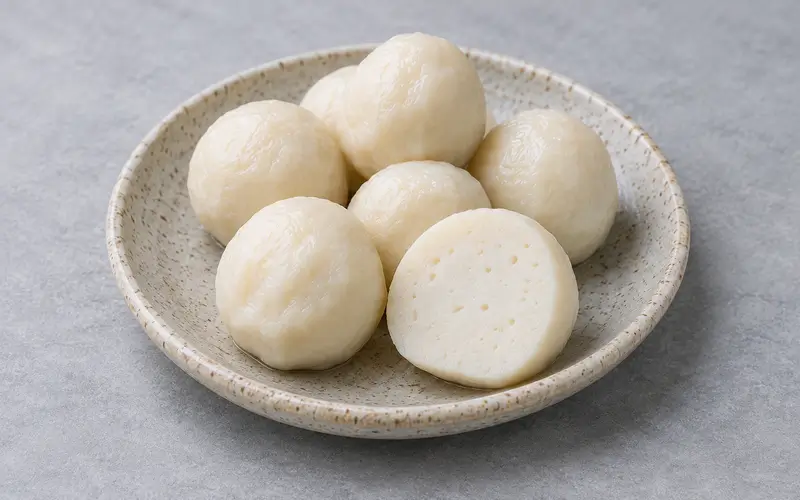
Fish Balls
Trial curdlan in boiled or frozen fish balls to tune gel strength and springiness. Compare bite after reheating and measure thaw drip.
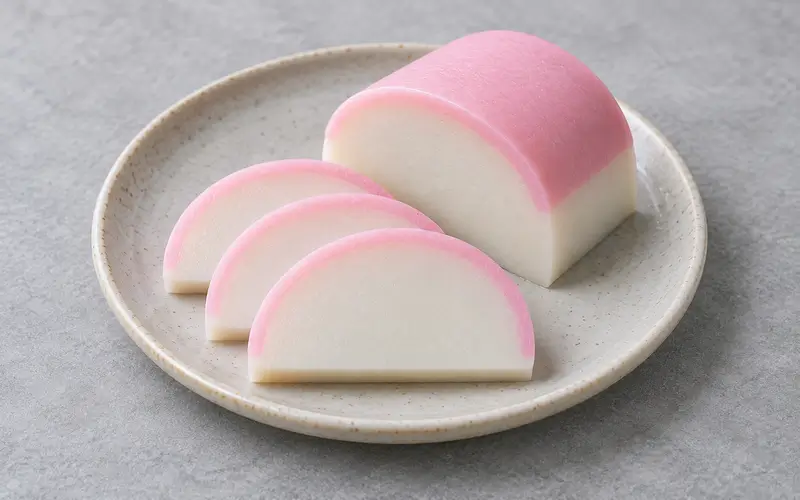
Fish Cakes & Kamaboko
Evaluate curdlan in steamed fish cakes and kamaboko for a firm, elastic bite. Check whether slices cut cleanly and hold their shape after cooling.
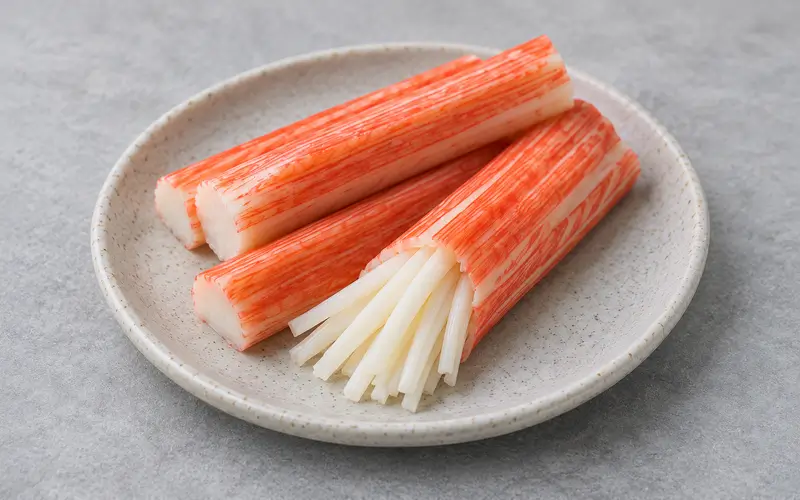
Imitation Crab
Evaluate curdlan in imitation crab sticks. Check whether the strands separate cleanly and measure moisture loss after thawing.
How Curdlan Builds Gel Strength in Surimi
Primary mechanism
Surimi gel strength starts with myosin, a major fish muscle protein. Salt helps dissolve myosin and other muscle proteins during mixing. As the paste cooks, these proteins form the network that gives fish balls and fish cakes their bite.
Curdlan also forms a gel during heating. In a fish myosin model, adding curdlan made the gel network denser and reduced water mobility. Gel strength and water-holding capacity improved at first, then fell as the curdlan level increased.
What to check in a production trial
Keep the fish lot, salt level, and added water fixed. Record the temperature at the center of the product and compare breaking force and deformation with your current formula.
Two ways curdlan sets
Low-set gel · Reversible on reheating
High-set gel · Heat-irreversible
Published Research on Curdlan in Surimi
Curdlan improved gel strength, springiness or water-holding capacity (WHC) in several published surimi trials. For a pilot trial, start with the study that best matches your fish species, cooking process and formulation.
Scroll sideways to see all columns.
| Study | Surimi System | Main Findings |
|---|---|---|
| Ding et al. (2015) View DOI | Freshwater surimi products. Direct addition at 0.05%, 0.1%, 0.2% and 0.4%, with a 0% control. | At 0.2%, gel strength rose from 2,527.96 to 3,467.03 g·mm. The authors favored 0.1–0.2% based on texture and ingredient cost. |
| Li et al. (2023) View DOI | Catfish fish balls. The blend paired 0.9% curdlan with 6% cassava acetate starch. | The blend reached 92.07% WHC and had the highest mean springiness among the starch–curdlan blends tested. |
| Chen et al. (2020) View DOI | Silver carp surimi. A comparison of curdlan, κ-carrageenan, xanthan gum and gelatin. | Microscopy showed a finer, denser gel network in the sample with 4 g/kg curdlan. |
| Ma et al. (2025) View DOI | Low-salt marine surimi with transglutaminase (TGase) and lysine. The study tested 0.2–1.0% curdlan in place of egg-white protein. | At 0.4%, the fracture-strength index peaked at 788.02 g·cm. WHC rose from 85.76% in the egg-white control to 91.50%. |
| Wei et al. (2018) View DOI | Retorted Alaska pollock surimi. The study tested 2%, 3% and 4% curdlan by weight of the surimi gel. | Breaking force increased with curdlan concentration under the study’s 120 °C retort conditions. |
| Wu et al. (2025) View DOI | Emulsified threadfin bream surimi. The protein dispersion contained 6% w/v curdlan. The prepared emulsion was added at 10%. | The emulsion treatment reached 90.14% WHC, compared with 82.39% for the soybean oil control. |
Before scaling a formula, check what the percentage is based on. Use results from the same test method to compare texture. Probe shape and sample size can affect the reading.
How to Use the Research in a Surimi Trial
Check texture after chilling
For fish balls, use texture profile analysis (TPA) to measure springiness after compression. For imitation crab sticks, test whether the strands separate cleanly after chilling.
Measure finished-product yield
Lab WHC and production yield answer different questions. Weigh fish balls or fish cakes before cooking and after a fixed drain time. Use the cooked-to-raw weight ratio to compare batch yields.
Choose a control for each change
For a curdlan–starch trial, run a starch-only control at the same starch level. If replacing egg-white protein, compare with your current egg-white formula and hold the TGase and lysine levels constant.
Curdlan Dosage for Surimi and Fish Balls
For a first pilot trial, compare 0.1%, 0.2% and 0.4% dry curdlan powder against a curdlan-free control. Calculate each dose on the total weight of the uncooked batter, including added water, starch, salt and curdlan.
Pilot Batch Weights
Scroll sideways to see all batch sizes.
| Curdlan in batter | Per 1 kg batter | Per 10 kg batter | Per 100 kg batter |
|---|---|---|---|
| 0% (control) | 0 g | 0 g | 0 g |
| 0.1% | 1 g | 10 g | 100 g |
| 0.2% | 2 g | 20 g | 200 g |
| 0.4% | 4 g | 40 g | 400 g |
Ding et al. (2015) favored 0.1–0.2% in their freshwater surimi formulation. View DOI
Weigh the Dose and Run the Trial
100 kg × 0.2% = 0.2 kg (200 g)
Use one surimi lot and one curdlan grade for the trial. Keep salt, water and starch proportions and cooking conditions consistent.
Select the lowest dose that meets your bite and cooking yield targets. Confirm it with a second lot of surimi before scaling up.
Before Commercial Use
These levels are for pilot screening. Check the permitted use level for your finished product and destination market.
Freeze–Thaw Stability in Frozen Fish Balls and Surimi
Repeated freezing and thawing can increase drip loss in raw surimi paste and weaken the gel in cooked products. Researchers have tested curdlan blends at both stages.
Raw Grass Carp Surimi
0.45% curdlan + 6.79% MOS by weight
Lin et al. screened blends of curdlan and mannan oligosaccharides (MOS) in raw grass carp surimi. They validated this ratio after five freeze–thaw cycles.
- Thaw loss
- 0.85%
- Mean gel strength
- 2,191.31 g·mm
Cooked Surimi Gel
Shi et al. tested 1% curdlan with 0.4% transglutaminase (TGase). The blend reduced quality losses after five freeze–thaw cycles.
What to Measure in a Freeze–Thaw Trial
Use your current formula as the control. Record a baseline before freezing and use the same pack size and freeze–thaw schedule for each batch.
Weigh the liquid released during thawing, then cook the thawed paste and test its gel strength.
Check gel strength and water-holding capacity after thawing. Assess bite after reheating.
How to Add Curdlan to Surimi Paste
Add curdlan during mixing so it spreads through the surimi paste before you form fish balls or fish cakes. Curdlan is insoluble in cold water, so use a dry premix or make a suspension with part of the recipe water.
Start With the Salt Mix
Mix the chilled surimi with the salt in your formula to help extract myofibrillar proteins. Then add the curdlan.
Dry Premix
Blend the curdlan with part of the starch already in the recipe, or another compatible dry ingredient. Feed the premix gradually into the cold paste while the mixer runs.
This method fits a line that already meters dry ingredients into the mixer.
Cold-Water Dispersion
Add curdlan gradually to a portion of the recipe’s cold water while stirring. Keep the suspension moving until you add it to the paste. Count this water toward the batch total.
Wei et al. used a stirred curdlan suspension in Alaska pollock surimi.
Wei et al. (2018) · View DOI
Check the Paste Before Forming
Look for dry specks or lumps and record the paste temperature at mixer discharge. Once the paste is uniform, form it and follow your product’s usual cooking and cooling process.
Curdlan vs. Starch, Carrageenan, Egg White and TGase in Surimi
Start with the stage where the product falls short. If fish balls lose bite on reheating, test heat-set structure. If kamaboko breaks during chilled slicing, test the cold gel. For a high-water formula, use cooked yield to compare binders.
Scroll sideways to see all columns.
| Ingredient | Best Fit | How to Choose for Your Formula |
|---|---|---|
| Curdlan Wei et al. (2018) | Bite and shape retention in reheated fish balls or retorted surimi. | Curdlan can form a heat-irreversible gel under high-set conditions. Check breaking force, deformation and shape after your full heat cycle. |
| Starch Potato and tapioca starch study | Water retention and cooking yield in fish cakes or fish balls. | Compare potato, tapioca or modified starch at the same added-water level. Starch gelatinizes during cooking. Measure cooked yield and springiness. |
| κ-Carrageenan Chen et al. (2020) | A firm chilled bite and clean slices in fish cakes or kamaboko. | κ-Carrageenan gels on cooling, and the salts in the formula affect the gel. Test chilled firmness, slice breakage and water release. |
| Egg-white protein Hunt et al. (2009) | Heat-set protein binding, including trials for fish paste that softens during cooking. | If fish proteases weaken the gel during heating (modori), test the egg-white grade in your fish species. Compare breaking force and deformation. |
| Transglutaminase (TGase) Sakamoto et al. (1995) | Weak protein setting on a line with a controlled suwari step. | This enzyme cross-links fish muscle proteins. Compare grades by enzyme activity and check the set at your line’s time and temperature. |
When to Test a Blend
In catfish fish balls, researchers paired curdlan with cassava acetate starch to improve springiness and water-holding capacity. If starch already meets your yield target, test how much bite curdlan adds when you keep the starch level fixed.
Li et al. (2023) · View DOICompare Ingredient Cost Per Kilogram of Cooked Product
Divide each batch’s ingredient cost by its cooked weight. Compare batches that meet the same texture and yield targets.
Curdlan Regulations for Surimi & Processed Seafood
Curdlan is a heat-setting β-1,3-glucan identified as INS 424. In surimi, it can help build gel strength and improve the bite and shape retention of fish balls, fish cakes, and imitation crab sticks. Before setting a commercial dose, confirm the finished food category, the permitted use level, and the curdlan ingredient specification in your destination market.
Scroll sideways to see the full market comparison.
| Market and Rule | How the Rule Applies | Use Level in the Finished Food |
|---|---|---|
| European Union Regulation (EU) 2026/2298 | Category 09.2 covers processed fish and fishery products, including molluscs and crustaceans. European Commission guidance includes surimi and similar products. | 30,000 mg/kg (3%) Maximum for E 424 in category 09.2. In force since 8 November 2026. |
| China GB 2760-2024 | Category 09.02.03 covers frozen minced aquatic products and products made from them, including frozen fish balls. | As needed for production The curdlan entry sets no numerical maximum for this category. |
| United States 21 CFR § 172.809 | The FDA food additive rule allows curdlan for specified functions in foods whose applicable standards of identity permit its use. | Good manufacturing practice (GMP) § 172.809 gives no numerical maximum for surimi. |
| Japan Existing Food Additives List | Curdlan is listed as an existing food additive under entry 57. Japan publishes a separate ingredient specification. | Surimi-specific maximum unconfirmed Check the applicable rules for the finished product. |
| South Korea MFDS Food Additives Code | The code lists curdlan as a thickener and stabilizer and refers to the general use standard in Section II.2(1). | Minimum needed for the technical effect The curdlan entry gives no numerical surimi limit. |
| Singapore Food Regulations, Sixth Schedule | The Sixth Schedule lists curdlan among permitted emulsifiers and stabilizers. Individual food standards can restrict use. | Good manufacturing practice (GMP) Use the smallest amount needed for the intended effect, subject to the applicable food standard. |
| Taiwan Food Additive Standard, Appendix 1 | Thickener entry 025 lists curdlan as 卡德蘭熱凝膠. | As practically needed The curdlan entry applies across food categories. |
EU E 424 Rules for Surimi Exports
European Commission guidance places shaped fish-protein products, fish pastes, and crustacean pastes in category 09.2. Calculate the applicable maximum against the food as marketed. For a prepacked EU product, declare the additive by its principal function followed by its name or E number. If its principal function is gelling, one example is gelling agent (E 424).
Check the curdlan powder against the E 424 specification under Regulation (EU) No 231/2012, as amended. The specification identifies Rhizobium radiobacter biovar 1 strain NTK-u as the production strain. It also requires an assay of at least 80% calculated as anhydrous glucose and a gel strength of at least 600 g/cm². Ask the supplier for a lot certificate of analysis and documentation on the production organism and purification process.
Published regulation text · EU food-category guidance · EU ingredient labeling rules
Product Classification and Ingredient Checks by Market
- China. GB 2760-2024 lists curdlan as CNS 20.042 / INS 424. Alongside the frozen minced aquatic products category, a separate 16.07 entry covers specified imitation seafood products such as imitation abalone and imitation sea cucumber. Match the finished product to the relevant entry before setting the dose. GB 2760-2024
- United States. The FDA rule covers functions including texturizing, stabilizing, and thickening. For procurement, verify the 0.20% maximum total nitrogen in the curdlan powder alongside the other identity and purity requirements. FDA curdlan rule
- Japan. The Consumer Affairs Agency’s curdlan specification requires an assay of at least 80%. Organo Food-Tech also markets a curdlan compound for fish paste, an example of commercial use in Japan. CAA ingredient specification · Fish paste application
- South Korea. For a fish ball or fish cake, document the intended function and the lowest level that achieved it in your trial. This gives your quality team a basis for the use level under the MFDS general use standard. MFDS general use standard
What to Document Before Shipping a Surimi Product
For each destination market, record the finished food category, intended function, actual curdlan level, supplier specification, lot certificate of analysis, and ingredient declaration. If you use a premix, obtain its curdlan percentage and calculate the amount of curdlan it contributes to the finished food. Use the FAO/WHO JECFA monograph as an ingredient reference and apply the destination market’s rules for permission, dose, and labeling.
BSH Curdlan Powder Grades for Surimi
BSH Ingredients supplies bulk food-grade curdlan powder for surimi, fish balls, kamaboko fish cakes, and imitation crab sticks. Start with a grade for your destination market, then compare gel strength in your formula.
BSH CY-1
European Union and Japan
- Powder gel strength
- ≥600 g/cm²
- Total nitrogen
- ≤0.3%
Start with CY-1 for EU or Japanese buyer qualification. Confirm the full ingredient specification for your destination.
View CY-1 specificationsBSH CY-2 Series
China domestic market
- Powder gel strength
- ≥600 g/cm²
- Total nitrogen
- ≤0.5%
These are the published values for the standard 600 g/cm² grade. The CY-2 series includes other gel strength options.
View the standard CY-2 gradeBSH CY-3
United States
- Powder gel strength
- ≥600 g/cm²
- Total nitrogen
- ≤0.2%
Start with this low-nitrogen grade for U.S. buyer qualification. Confirm the applicable FDA gel strength test method and units.
View CY-3 specificationsReady Stock and Custom Curdlan Gel Strength
600, 800, and 1,000+ g/cm²
BSH Ingredients keeps these food-grade curdlan gel strengths in stock for bulk orders. We can also customize gel strength to your target specification.
Send Your Curdlan Specification
Share your application and destination market, along with any target gel strength, total nitrogen, particle size, curdlan assay, or microbiological limits. We’ll reply as soon as possible.
info@bshingredients.comCompare Grades in Your Surimi Formula
Powder gel strength comes from a separate ingredient test. To compare grades in surimi, keep the formula, dry curdlan dose, and heat cycle fixed. After chilling, compare breaking force and deformation to see which grade gives you the bite you want. Measure springiness separately if your product specification calls for it.
Frequently Asked Questions About Curdlan in Surimi
How much curdlan should I trial in fish balls?
For a first pilot trial, compare 0.1%, 0.2%, and 0.4% dry curdlan against a curdlan-free control. Calculate each level on the total weight of the uncooked batter. Compare bite and cooked yield to choose a dose.
How do I calculate the dosage for a curdlan premix?
Calculate the dose from the curdlan content listed on the premix specification. A 100 kg batch of uncooked fish ball batter at a target of 0.2% curdlan needs 200 g of curdlan. If the premix is 50% curdlan by weight, use 400 g of premix and account for its carrier in the recipe.
When should I add curdlan during surimi chopping?
Add curdlan to chilled surimi paste after the salt-mixing step. Feed it in as a dry premix with part of the recipe starch or as a cold-water suspension. Count that water toward the batch total and check for clumps before forming.
How do I test freeze–thaw stability in cooked fish balls?
Record the fresh batch’s gel strength and water-holding capacity. Freeze and thaw the trial and control with the same pack size and schedule. Compare both measures after thawing, then assess bite after reheating.
Can curdlan replace carrageenan or egg white in surimi?
Start with a partial replacement trial. Curdlan builds a heat-set gel, κ-carrageenan helps build a gel as the product cools, and egg-white protein can contribute to heat-set binding. Compare breaking force, deformation, and water release against your current formula.
Can curdlan work with modified starch in fish balls?
Yes. A catfish fish ball study reported 92.07% water-holding capacity with 0.9% curdlan and 6% cassava acetate starch. If your formulation already uses modified starch, hold the starch level constant and compare batches with and without curdlan. Measure cooked yield and assess whether the bite still meets your target.
What is the difference between curdlan and transglutaminase in surimi?
Curdlan is a heat-gelling polysaccharide. Microbial transglutaminase (TGase) is an enzyme that cross-links fish muscle proteins during setting. Trial curdlan when your target is a firmer cooked bite. Trial TGase when you want to strengthen the fish protein network during setting. If your recipe already contains TGase, keep its dose fixed while testing what curdlan adds.
Can curdlan help maintain gel strength in low-salt surimi?
In a low-salt marine surimi formulation containing TGase and lysine, 0.4% curdlan increased fracture strength and water-holding capacity compared with the egg-white control. Compare against your current formulation at the same target salt level.
Can curdlan be used in retorted surimi products?
An Alaska pollock study found that curdlan increased the breaking force of surimi gels heated at 120°C. If your fish balls or fish cakes are retorted, compare bite, shape retention, and liquid release after your existing validated retort cycle.
Why do fish balls become rubbery after adding curdlan?
Your dose or powder gel strength may be too high for the bite you want. Run a lower-dose trial with the same fish paste, starch, and cooking cycle. After chilling, check hardness and springiness separately.
What does the FDA require for curdlan in surimi?
Under 21 CFR § 172.809, curdlan may be used as a texturizer, stabilizer, or thickener under good manufacturing practice, subject to any applicable standard-of-identity restrictions. The rule sets no separate numerical limit for curdlan in surimi. Its 0.2% total nitrogen limit applies to the curdlan powder.
Is E 424 curdlan allowed in surimi and fish balls in the EU?
Yes. Commission Regulation (EU) 2026/2298 authorizes curdlan (E 424) at up to 30,000 mg/kg (3%) in the food as marketed for category 09.2, processed fish and fishery products. European Commission guidance includes surimi and similar shaped fish-protein products in this category.
Read Commission Regulation (EU) 2026/2298 · Check EU food category guidance
Can curdlan be used in frozen fish balls in China?
Yes. China’s GB 2760-2024 permits curdlan at levels needed for production in category 09.02.03, which includes frozen minced aquatic products and products made from them, such as frozen fish balls.
Which BSH curdlan grade should I sample for my process and export market?
Start with BSH CY-1 for the EU or Japan, CY-2 for China domestic production, or low-nitrogen CY-3 for the United States. Compare gel strength options at the same dose. Confirm the full ingredient specification for your market.
Scientific References
-
Chen, J., Deng, T., Wang, C., Mi, H., Yi, S., Li, X., & Li, J. (2020).
Effect of hydrocolloids on gel properties and protein secondary structure of silver carp surimi.
Journal of the Science of Food and Agriculture, 100(5), 2252–2260.
https://doi.org/10.1002/jsfa.10254 -
Ding, L.-L., Guo, H.-M., Wu, J., & Zhang, S. (2015).
Study on the application of curdlan in freshwater fish surimi-based products.
Science and Technology of Food Industry, (17), 262–264.
https://doi.org/10.13386/j.issn1002-0306.2015.17.045 -
Hunt, A., Park, J. W., & Handa, A. (2009).
Effect of various types of egg white on characteristics and gelation of fish myofibrillar proteins.
Journal of Food Science, 74(9), C683–C692.
https://doi.org/10.1111/j.1750-3841.2009.01354.x -
Jiang, X., Liu, J., Xiao, N., Zhang, X., Liang, Q., & Shi, W. (2024).
Characterization of the textural properties of thermally induced starch-surimi gels: Morphological and structural observation.
Food Bioscience, 58, Article 103675.
https://doi.org/10.1016/j.fbio.2024.103675 -
Li, L., Ding, H., Huo, S., & Zheng, J. (2023).
Effects of curdlan gum and modified starch on gel properties of cat fish surimi.
Journal of Tianjin University of Science & Technology, 38(5), 8–14.
https://doi.org/10.13364/j.issn.1672-6510.20220287 -
Li, Q., Wang, P., Miao, S., Zhang, L., & Zheng, B. (2019).
Curdlan enhances the structure of myosin gel model.
Food Science & Nutrition, 7(6), 2123–2130.
https://doi.org/10.1002/fsn3.1055 -
Lin, Y., Zhang, L., Tang, W., Ren, J., Mo, Y., Guo, X., Lin, L., & Ding, Y. (2025).
Synergistic cryoprotective effects of mannan oligosaccharides and curdlan on the grass carp surimi.
Food Chemistry: X, 25, Article 102250.
https://doi.org/10.1016/j.fochx.2025.102250 -
Ma, W., Liang, G., Huang, Q., Ling, F., Pan, W., Cao, Y., & Chen, M. (2025).
Curdlan-induced significant enhancement of lipid oxidation control and gelling properties of low-salt marine surimi gel containing transglutaminase and lysine.
Gels, 11(7), Article 535.
https://doi.org/10.3390/gels11070535 -
Mi, H., Li, Y., Wang, C., Yi, S., Li, X., & Li, J. (2021).
The interaction of starch-gums and their effect on gel properties and protein conformation of silver carp surimi.
Food Hydrocolloids, 112, Article 106290.
https://doi.org/10.1016/j.foodhyd.2020.106290 -
Nakao, Y., Konno, A., Taguchi, T., Tawada, T., Kasai, H., Toda, J., & Terasaki, M. (1991).
Curdlan: Properties and application to foods.
Journal of Food Science, 56(3), 769–772.
https://doi.org/10.1111/j.1365-2621.1991.tb05378.x -
Sakamoto, H., Kumazawa, Y., Toiguchi, S., Seguro, K., Soeda, T., & Motoki, M. (1995).
Gel strength enhancement by addition of microbial transglutaminase during onshore surimi manufacture.
Journal of Food Science, 60(2), 300–304.
https://doi.org/10.1111/j.1365-2621.1995.tb05660.x -
Shi, X., Wang, Y., Liu, S., Ding, Y., Zhou, X., & Zhu, S. (2026).
Improving the freeze-thaw quality of frozen surimi gel based on the dual network strategy.
Science and Technology of Food Industry, 47(6), 88–95.
https://doi.org/10.13386/j.issn1002-0306.2025030397 -
Wei, Y., Zhang, T., Yu, F., Xue, Y., Li, Z., Wang, Y., & Xue, C. (2018).
Effects of curdlan on the texture and structure of Alaska pollock surimi gels treated at 120°C.
International Journal of Food Properties, 21(1), 1778–1788.
https://doi.org/10.1080/10942912.2017.1306557 -
Wu, Z., Qu, Y., Li, O., Benjakul, S., & Zhou, A. (2025).
Improvement of gel properties of Nemipterus virgatus myofibrillar protein emulsion gels by curdlan: Development and application to emulsified surimi.
Gels, 11(9), Article 753.
https://doi.org/10.3390/gels11090753