
Low-Nitrogen Curdlan Powder for the U.S. Market
- Total nitrogen ≤0.2%
- Curdlan assay ≥80% as anhydrous glucose
What Is BSH CY-3 Low-Nitrogen Curdlan Powder?
BSH CY-3 is a low-nitrogen curdlan gum powder developed for U.S. food manufacturers, ingredient importers, and distributors. The grade is supplied in 10 kg bags for formulation trials and bulk sourcing.
Curdlan is a fermentation-derived food hydrocolloid made of β-(1→3)-linked glucose units. This high-molecular-weight β-1,3-glucan forms gels when heated in water. Food teams can evaluate it where firmness, structure, and heat-set texture matter.
CY-3 specifies total nitrogen ≤0.2% and curdlan assay ≥80% as anhydrous glucose. The supplied COA for example lot 2026110603 reports <0.2% nitrogen and 91.9% assay. Request the current offered-lot COA and review the applicable identity and test records under 21 CFR §172.809.
Formulators can assess CY-3 in surimi, starch-based noodles, and plant-based foods. Compare texture after the finished product’s actual cooking, cooling, and reheating cycle.
- Chemical identity
- Curdlan · β-1,3-glucan
- CAS No.
- 54724-00-4
- Polymer formula
- (C₆H₁₀O₅)ₙ
- Molecular weight
- Variable polymer
The glucose repeat unit has a molar mass of 162.14 g/mol. Curdlan does not have one fixed molecular weight.
FDA Curdlan Requirements Under 21 CFR §172.809
The U.S. curdlan regulation defines the substance and sets requirements for its identity, assay, purity, gel strength, and microbiological quality.
Under 21 CFR §172.809(a), curdlan is a high-molecular-weight β-1,3-glucan (CAS No. 54724-00-4) produced by pure-culture fermentation from the specified nonpathogenic and nontoxicogenic Alcaligenes faecalis var. myxogenes bacterium. Subsection (b) lists a positive identification test and ten quantitative criteria.
The table below summarizes the FDA requirements. They are the regulatory criteria for curdlan, not the CY-3 specification or results from a BSH production lot. The next section compares these values with the CY-3 specification and example COA.
FDA Identity, Purity, Gel Strength, and Microbial Limits
| Parameter | FDA requirement | §172.809 reference |
|---|---|---|
| Curdlan identification | Positive for curdlan | (b)(1) |
| Assay, calculated as anhydrous glucose | Not less than 80% | (b)(2) |
| pH of 1% aqueous suspension | 6.0–7.5 | (b)(3) |
| Lead | Not more than 0.5 mg/kg | (b)(4) |
| Heavy metals, as Pb | Not more than 0.002% | (b)(5) |
| Total nitrogen | Not more than 0.2% | (b)(6) |
| Loss on drying | Not more than 10% | (b)(7) |
| Residue on ignition | Not more than 6% | (b)(8) |
| Gel strength of 2% aqueous suspension | Not less than 600 × 103 dyne/cm² | (b)(9) |
| Aerobic plate count | Not more than 1,000 per g | (b)(10) |
| Coliform bacteria | Not more than 3 per g | (b)(11) |
Swipe the table sideways to view all columns.
Source: U.S. Electronic Code of Federal Regulations, 21 CFR §172.809 — Curdlan .
What U.S. Ingredient Buyers Should Also Verify
Production identity: The material must fit the substance definition in §172.809(a). Numerical test results alone do not establish the production identity.
Analytical methods: Section 172.809(b) incorporates specified methods for the identity and quality tests. Review the methods and conditions behind a supplier's COA, especially the 2% suspension and dyne/cm² units used for FDA gel strength.
Intended food use: Under §172.809(c), curdlan may be used in accordance with good manufacturing practice as a formulation aid, processing aid, stabilizer and thickener, or texturizer in foods whose standards of identity do not preclude its use.
How BSH CY-3 Compares with FDA Curdlan Requirements
For U.S. curdlan buyers, the product specification sets the supplier’s release limits, while the certificate of analysis (COA) records one manufactured lot. The example CY-3 lot is numerically within many of the limits in 21 CFR §172.809. Identity records and test-method details are still needed for a complete U.S. qualification review.
Swipe across the table to view all columns →
| Parameter | FDA requirement | CY-3 specification | Example lot result | U.S. buyer’s reading |
|---|---|---|---|---|
| Production identity | Pure-culture fermentation from the organism specified in §172.809(a) | Not shown on supplied COA | Not shown | Request strain and production records. |
| Positive curdlan identification | Positive for curdlan | Not separately shown on supplied COA | Not shown | Request the identification test record. |
| Curdlan assay, as anhydrous glucose | ≥80% | ≥80.0% | 91.9% | Above the printed minimum; confirm the calculation and method. |
| pH | 6.0–7.5 in a 1% aqueous suspension | 6.0–7.5 | 6.58 | Within range; confirm suspension concentration and method. |
| Lead | ≤0.5 mg/kg | ≤0.5 mg/kg | <0.5 mg/kg | Numerically below the limit. |
| Heavy metals, as Pb | ≤0.002% | ≤0.002% | <0.002% | Numerically below the limit. |
| Total nitrogen | ≤0.2% | ≤0.2% | <0.2% | Numerically below the U.S. limit. |
| Loss on drying | ≤10% | ≤10.0% | 9.14% | Numerically within the limit. |
| Residue on ignition | ≤6% | ≤6.0% | <6.0% | Numerically within the limit; confirm the ignition method. |
| Gel strength | ≥600 × 10³ dyne/cm² in a 2% aqueous suspension | ≥600 g/cm² | 639.7 g/cm² | Confirm units and the FDA-incorporated test method. |
| Aerobic plate count | ≤1,000 per g | ≤1,000 CFU/g | <1,000 CFU/g | Numerically within the limit; confirm the method. |
| Coliform bacteria | ≤3 per g | <3.0 MPN/g | <3.0 MPN/g | Review the MPN method and reporting basis. |
Sources: BSH CY-3 specification and example COA, lot 2026110603 (manufactured November 6, 2026); and 21 CFR §172.809 ↗. The supplied COA cites GB28304 and does not list individual test methods. Numerical comparison alone does not establish regulatory conformity.
Gel strength needs a separate U.S. method check
The FDA minimum is 600 × 10³ dyne/cm² for a 2% aqueous suspension. If the COA’s “g/cm²” means gram-force per square centimeter, the example result of 639.7 g/cm² converts mathematically to about 627.3 × 10³ dyne/cm². However, the CY-3 specification minimum of 600 g/cm² converts to only about 588.4 × 10³ dyne/cm² on that same assumption. A unit conversion cannot confirm that the preparation and test methods are equivalent. Request a test report in FDA units and a U.S. release specification using the applicable method.
For supplier qualification: request the current offered-lot COA, the positive curdlan identification result, fermentation-organism documentation, and methods supporting the §172.809 tests. The results above describe the example lot only; each shipment should be evaluated against its own COA.
Why Total Nitrogen ≤0.2% Matters for U.S. Curdlan Buyers
Total nitrogen is a defined quality parameter for curdlan under 21 CFR §172.809. The U.S. limit is no more than 0.2%. BSH CY-3 is specified at ≤0.2% total nitrogen, and the supplied example lot reports <0.2%. This makes nitrogen one of the first figures to check when screening bulk curdlan powder for the U.S. food market.
What does “low-nitrogen curdlan” mean?
“Low nitrogen” describes this grade’s measured total-nitrogen limit. It is a practical sourcing term, not a separate FDA ingredient category. The test concerns nitrogen present in the curdlan ingredient; it does not measure nitrogen gas or, by itself, establish that a product is protein-free or allergen-free.
How should an importer or food manufacturer check a lot?
Start with the current CY-3 specification and the COA for the actual lot offered for shipment. Check the reported total-nitrogen result, its reporting limit, the test method, and the lot number. The example result of <0.2% is numerically below the FDA ceiling, but it represents one batch. A new shipment needs its own COA.
Does the nitrogen result complete FDA qualification?
No single result covers all the conditions in §172.809. U.S. quality teams should also review the curdlan identity test, fermentation-organism records, assay, contaminants, microbiology, and gel strength under the applicable methods. Finished-food manufacturers should confirm that curdlan’s intended function and use fit the rule and their product category.
Source: 21 CFR §172.809(b)(6) and the supplied BSH CY-3 specification and example COA for lot 2026110603.
Food Applications for Low-Nitrogen Curdlan Powder
Curdlan is a heat-gelling β-1,3-glucan used to build structure in suitable food formulations. U.S. manufacturers can screen BSH CY-3 in seafood, starch-based foods, and plant protein systems where texture must hold through cooking, cooling, or reheating. Evaluate each use in the finished recipe and its actual process.

Screen curdlan in cooked fish-protein systems where a firm, elastic bite and moisture retention matter.
Measure: gel strength, bite, and water release.
Test rice and other starch-based noodle formulas for strand integrity after cooking, holding, and reheating.
Measure: breakage, firmness, and cooking loss.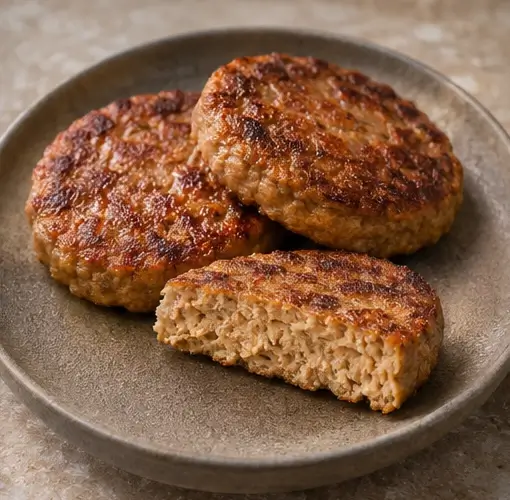
Evaluate heat-set cohesion and shape retention in formed pea- or soy-protein foods.
Measure: firmness, structure, and moisture retention.Surimi, Fish Cakes, and Formed Seafood
In surimi and other comminuted seafood, curdlan can be evaluated alongside fish protein, starch, salt, and existing binders. Prepare a control and several trial formulas, then run the same mixing and heating cycle used in production. Compare gel strength, elastic bite, shape retention, and expressible water. If the product is frozen, test texture and water release after thawing. The best addition level depends on the fish species and the complete formulation.
Rice Noodles, Starch Noodles, and Prepared Meals
Heat-treated noodles can lose firmness or break during cooking and reheating. Test CY-3 in the intended rice- or starch-based formula, then compare strand breakage, cooking loss, surface stickiness, and bite against a control. For chilled, frozen, or shelf-stable meals, repeat these checks after the real storage and reheating cycle. Published rice-noodle studies provide a useful research starting point, but their results should not be treated as a guaranteed outcome in another recipe.
Pea-Protein and Soy-Protein Formed Foods
Plant-based patties, pieces, and other formed foods need enough cohesion to survive forming and cooking. Curdlan’s heat-set behavior can be screened with pea protein, soy protein, and other food-grade binders. Compare firmness, bite, moisture retention, and shape after cooking. Protein source, fat, water, pH, and heating conditions can all change the result, so use the finished product’s process for each trial.
Under 21 CFR §172.809(c), curdlan may be used according to good manufacturing practice for its stated technical functions in foods whose standards of identity do not preclude its use. Confirm the finished food category and use only the amount needed for the intended technical effect.
Research context: surimi gel study · rice noodle study · soy protein gel study. U.S. use condition: 21 CFR §172.809.
How Curdlan Forms a Heat-Set Gel
Curdlan is a water-insoluble β-1,3-glucan that can be dispersed in water and converted into a gel by heating. The heating and cooling cycle affects the final texture. This gives food developers two useful starting points when screening BSH CY-3 in seafood, noodles, and formed protein foods.
| Gel behavior | Typical heating cycle | What to evaluate in food |
|---|---|---|
| Low-set gel | Heat the aqueous dispersion to about 55–60°C (131–140°F), then cool it. | A softer, more thermoreversible gel under suitable conditions. Check firmness, bite, and texture after cooling. |
| High-set gel | Heat the aqueous dispersion above approximately 80°C (176°F). | A firmer, more heat-stable structure. Check shape, water release, and texture after the product’s heating and reheating cycle. |
These temperatures describe typical gel behavior in research. They are formulation starting points, not fixed processing instructions or the FDA gel-strength test.
How to Run a CY-3 Formulation Trial
Compare a control formula with several CY-3 trial levels. Keep the ingredients, mixing method, and heat treatment consistent between samples. Curdlan does not simply dissolve like sugar: control how the powder is dispersed so lumps or uneven distribution do not distort the result. Record the complete time-and-temperature profile, then test the food as it will be sold and prepared.
Disperse Evenly
Add CY-3 to the water phase with controlled mixing, or dry-blend it with other powders before addition. Use the same procedure for every trial.
Recreate Production
Match the intended cooking, holding, cooling, freezing, or reheating steps. Record the temperature reached by the food, not only the equipment setting.
Measure the Result
Compare firmness, bite, shape retention, and water release against the control. Repeat measurements after storage or reheating when relevant.
For U.S. quality review: these food formulation trials serve a different purpose from the gel-strength specification in 21 CFR §172.809(b)(9). That regulatory test specifies a 2% aqueous suspension and an incorporated analytical method. Gelation background: Food Science and Technology Research study.
Documents to Request When Qualifying CY-3 for U.S. Food Use
A U.S. supplier review should connect the curdlan ingredient’s production identity, current product specification, batch results, analytical methods, and intended food use. The example CY-3 COA is a useful starting point. Request the following records for the actual grade and lot you plan to purchase.
-
01
Current CY-3 Specification and Offered-Lot COA
Match the product name, lot number, and release limits to the shipment being offered. Review total nitrogen, curdlan assay, pH, lead, heavy metals, loss on drying, residue on ignition, aerobic plate count, and coliform bacteria. The example result for lot 2026110603 describes that batch only; a later shipment needs its own certificate of analysis.
-
02
Production Organism and Curdlan Identification
Ask for documentation connecting the production culture to the nonpathogenic, nontoxigenic organism named in §172.809(a), Alcaligenes faecalis var. myxogenes. Also request the positive curdlan identification result required by §172.809(b)(1). The product name and powder appearance on a COA do not replace these records.
-
03
Test Methods and Gel-Strength Report
Section 172.809(b) specifies analytical methods incorporated by reference. The supplied CY-3 COA cites GB28304 but does not list an individual method for each result. Ask how the reported methods compare with the U.S. methods. For gel strength, request the 2% aqueous-suspension test result in dyne/cm² and confirm that the U.S. release criterion meets the FDA minimum.
-
04
Lot Traceability and Shipment Documents
Confirm that the COA, product label, manufacturing date, and shipping documents identify the same lot. Ask about packaging, storage conditions, and shelf life for the material offered. Keep the approved specification and shipment records together so incoming quality control can check each delivery.
-
05
Intended Food Application
Document why curdlan is used in the finished food, such as for texture, thickening, or stabilization. Section 172.809(c) requires use according to good manufacturing practice and limits use where a food’s standard of identity precludes it. The finished-food manufacturer should check its product category and validate the amount needed for the intended technical effect.
CY-3 is a low-nitrogen curdlan grade developed for U.S. buyers. Its example COA provides numerical results for an initial comparison with FDA limits. Confirm the production identity, identification result, applicable analytical methods, and gel-strength release criterion before making an unqualified FDA conformity claim for the offered material.
Frequently Asked Questions About U.S. Curdlan Powder
These answers help U.S. food manufacturers, ingredient importers, and quality teams compare CY-3 with the FDA curdlan rule and understand why JECFA, Chinese, and EU specifications are not interchangeable.
What is the total-nitrogen specification for BSH CY-3?
The CY-3 product specification sets total nitrogen at ≤0.2%. The supplied example COA for lot 2026110603 reports <0.2%. The FDA limit in 21 CFR §172.809(b)(6) is also ≤0.2%. The example result is numerically below that ceiling; request the current offered-lot COA and supporting method record for a purchase.
Is BSH CY-3 “FDA-approved” or automatically FDA-compliant?
The FDA permits curdlan for specified food uses under 21 CFR §172.809. That provision does not certify a supplier’s individual grade or lot. CY-3’s example COA supports an initial numerical comparison, but a complete review also needs production-identity records, a positive curdlan identification result, applicable test methods, and confirmation of the FDA gel-strength criterion.
Why does the FDA state gel strength in dyne/cm² while the CY-3 COA uses g/cm²?
FDA §172.809(b)(9) requires a gel strength of at least 600 × 10³ dyne/cm² for a 2% aqueous suspension using its incorporated analytical method. The CY-3 COA reports g/cm². If that unit means gram-force per square centimeter, 1 g-force/cm² equals about 980.665 dyne/cm². The FDA threshold would then equal approximately 611.8 g-force/cm² by unit conversion.
This calculation compares units only. Sample preparation, instrument settings, and the incorporated test method must also be checked before comparing results.
Does the CY-3 result of 639.7 g/cm² meet the FDA gel-strength requirement?
If the reported unit is g-force/cm², the example-lot result converts mathematically to about 627.3 × 10³ dyne/cm², above the FDA numerical minimum. However, the printed CY-3 release specification of ≥600 g/cm² would convert to about 588.4 × 10³ dyne/cm², below the FDA minimum on that same assumption.
The example result therefore cannot establish that every lot released to the printed CY-3 minimum meets the U.S. requirement. Request a gel-strength test record using the FDA-incorporated method and a U.S. release criterion stated in FDA units.
How do the FDA, JECFA, China GB 28304-2012, and EU E 424 specifications compare?
The selected limits below show why a COA tested against one standard cannot automatically establish conformity with another. Each source also defines its own identity, methods, and conditions of use.
| Parameter | U.S. FDA | FAO/WHO JECFA | China GB 28304-2012 | EU E 424 |
|---|---|---|---|---|
| Total nitrogen | ≤0.2% | ≤0.3% | ≤1.5% | ≤0.3% |
| Curdlan assay | ≥80% | ≥80% | ≥80% | ≥80% |
| Gel strength | ≥600 × 10³ dyne/cm²; 2% suspension | ≥600 g/cm²; 2% suspension | ≥450 g/cm² | ≥600 g/cm² |
| Lead | ≤0.5 mg/kg | ≤0.5 mg/kg | ≤0.5 mg/kg | ≤0.2 mg/kg |
| Aerobic/total plate count | ≤1,000/g | ≤1,000 CFU/g | ≤10,000 CFU/g | ≤1,000 CFU/g |
| Coliform criterion | ≤3/g | Not listed; E. coli negative in 1 g | <3.0 MPN/g | Absent in 1 g |
Selected limits only. “g/cm²” and “dyne/cm²” entries should not be treated as method-equivalent based on a unit conversion. Read the FDA rule, JECFA monograph, GB 28304-2012, and EU Regulation 2026/2298 for the complete requirements.
How do the current EU E 424 requirements differ from the U.S. curdlan rule?
EU Regulation 2026/2298 entered into force on November 8, 2026. Its E 424 definition names Rhizobium radiobacter biovar 1 strain NTK-u and describes a particular purification process. The U.S. rule names Alcaligenes faecalis var. myxogenes.
The EU specification allows nitrogen ≤0.3%, but has a lower lead limit of ≤0.2 mg/kg, requires coliforms and E. coli absent in 1 g, and includes arsenic and methanol limits. EU use is listed by food category with specific maximum levels and restrictions. U.S. §172.809 states its own identity and quality tests, then allows the listed technical functions under good manufacturing practice where a food standard of identity does not preclude use.
Can the same CY-3 COA be used to claim EU E 424 conformity?
Not on the information in the supplied COA. Its <0.5 mg/kg lead result does not establish the EU limit of ≤0.2 mg/kg, and <3.0 MPN/g coliforms does not establish absence in 1 g. The COA also does not document the EU-named strain, methanol, arsenic, or every EU identity criterion. CY-3 is presented here as a grade for U.S. buyers; an EU claim needs a separate review against the E 424 definition and specification.
Does the FAO/WHO JECFA curdlan specification replace the U.S. FDA standard?
No. JECFA publishes an international curdlan specification, including nitrogen ≤0.3% and gel strength ≥600 g/cm² for a 2% suspension. It is useful technical context, but U.S. food use must be assessed under 21 CFR §172.809, including the FDA production identity, ≤0.2% nitrogen, FDA gel criterion, and incorporated methods.
Does meeting China GB 28304-2012 prove that curdlan meets FDA requirements?
No. GB 28304-2012 sets nitrogen at ≤1.5% and gel strength at ≥450 g/cm², while the FDA sets nitrogen at ≤0.2% and gel strength at ≥600 × 10³ dyne/cm² under its specified method. The Chinese standard is a valid reference for its own scope, but a GB28304 statement on a COA is not a substitute for U.S. qualification records.
Which production organism does the FDA identify for curdlan?
Section 172.809(a) describes curdlan as a β-1,3-glucan produced by pure-culture fermentation from the nonpathogenic and nontoxigenic bacterium Alcaligenes faecalis var. myxogenes. Ask the supplier for production-organism documentation. If its records use updated taxonomy, the relationship to the organism named in the U.S. rule should be documented rather than assumed.
Does “low-nitrogen curdlan” mean nitrogen-free, protein-free, or allergen-free?
No. “Low nitrogen” describes CY-3’s total-nitrogen specification of ≤0.2%. The example COA reports <0.2%, not zero. A total-nitrogen result alone does not establish protein-free or allergen-free status. Request separate evidence if either claim matters to your finished product.
What does “curdlan assay as anhydrous glucose” mean?
It is the specified way to calculate the curdlan content of the ingredient. FDA §172.809 requires at least 80%; the CY-3 example lot reports 91.9%. This is an ingredient test result. It does not mean that a finished food contains 91.9% curdlan, nor does it replace the identity and gel-strength tests.
Is a separate GRAS notice required for the U.S. curdlan use described here?
The regulatory basis discussed on this page is the food additive provision in 21 CFR §172.809, not a supplier-specific GRAS notice. A manufacturer still needs to establish that its curdlan meets that provision and that the intended food use follows its conditions. Ask your U.S. regulatory team to review the finished product and its labeling.
Which foods can contain curdlan in the United States, and is there a fixed use level?
FDA §172.809(c) lists curdlan’s functions as a formulation aid, processing aid, stabilizer and thickener, and texturizer. It calls for use in accordance with good manufacturing practice in foods whose standards of identity do not preclude it. The provision does not give one universal percentage for every food. Confirm the category, intended technical effect, and appropriate amount in your finished formulation.
What records should a U.S. buyer request with each offered lot?
Request the current CY-3 specification and an offered-lot COA showing the same lot number as the shipment. For supplier qualification, also request production-organism and positive curdlan-identification records, the methods used for the §172.809 tests, and a gel-strength report for a 2% suspension in FDA units. Keep packaging, manufacturing-date, and shipment records tied to the same lot.
How can I request a CY-3 sample, COA, and bulk quote?
Use the inquiry form on this page. Include your food application, expected annual or trial quantity, delivery ZIP code, and the documents your QA team needs. Ask for the COA of the lot currently offered, since the example lot shown on this page may differ from the lot available for your order. CY-3 is listed in 10 kg bags on the supplied COA.
Standards referenced: U.S. FDA, 21 CFR §172.809 · FAO/WHO JECFA curdlan monograph · China GB 28304-2012 · EU Regulation 2026/2298, E 424.