
EU E424 Curdlan Powder Manufacturer in China

Fermentation-derived β-1,3-glucan with gel strength ≥600 g/cm² and assay ≥80%. Customized specifications, bulk wholesale supply, and free samples from BSH Ingredients.

Home / Bulk Curdlan / EU & Japan Compliant Curdlan Powder E424 Food Grade CY-1 with Low Nitrogen <0.3%

BSH CY-1: Food Grade Curdlan Powder for the EU & Japan

Parameter Specification
Product Name Food Grade Curdlan Powder
Product Grade BSH CY-1
CAS Number 54724-00-4
Chemical Name β-1,3-Glucan
Molecular Formula (C₆H₁₀O₅)ₙ
Assay (as Anhydrous Glucose) ≥80%
Gel Strength ≥600 g/cm²
Total Nitrogen ≤0.3%
pH (1% Suspension) 6.0–7.5
Target Markets European Union & Japan
Production Method Microbial Fermentation
Standard Packaging 10 kg/bag

What Is EU E424 Curdlan Powder (CY-1)?

EU E424 curdlan powder (CY-1) is a food-grade polysaccharide produced through controlled microbial fermentation. Curdlan, also known as β-1,3-glucan (CAS 54724-00-4), consists of glucose units connected by β-1,3-glycosidic bonds. Its molecular formula is (C₆H₁₀O₅)ₙ. Unlike conventional starches and many other food hydrocolloids, curdlan forms heat-induced gels that provide firmness, structural stability, and water retention in processed foods.

BSH Ingredients developed CY-1 for food manufacturers and ingredient distributors serving the European Union and Japan. The product features total nitrogen ≤0.3%, gel strength ≥600 g/cm², and curdlan assay ≥80%, calculated as anhydrous glucose. These specifications support the quality requirements of both target markets, although complete regulatory conformity must be verified against each market’s applicable identity, purity, and testing criteria.

Low Nitrogen Curdlan Powder for the European and Japanese Markets

Total nitrogen is an important quality parameter for fermentation-derived curdlan. Nitrogen-containing residues may originate from fermentation nutrients, microbial biomass, and other materials used during production. Controlled purification helps reduce these residues and maintain consistent finished-product quality.

The European Union limits total nitrogen in curdlan E424 to 0.3% under Commission Regulation (EU) 2026/2298. Japan’s Specifications and Standards for Food Additives also establish a maximum nitrogen content of 0.3%. BSH CY-1 is developed around this limit, making it a market-specific option for food ingredient importers, hydrocolloid distributors, and food processing companies.

Gel Strength and Heat-Induced Gelation Properties

Curdlan is valued for its thermal gelation properties. When an aqueous curdlan suspension is heated, the polysaccharide chains interact and form a three-dimensional gel network. Its gelation behavior depends on heating temperature, concentration, dispersion conditions, and formulation ingredients.

Curdlan can form low-set gels at moderate heating temperatures and high-set gels at higher temperatures. Low-set gels are generally softer and thermoreversible, while high-set gels develop firmer, thermally irreversible structures. These properties make curdlan useful for controlling texture, elasticity, firmness, and shape retention in processed foods.

BSH CY-1 provides a minimum gel strength of 600 g/cm² under its specified test conditions. This supports its use in suitable processed meat products, surimi and seafood, noodles, plant-based protein foods, and other authorized food formulations. The optimum curdlan dosage and gel strength depend on the finished product and processing conditions.

Customized Curdlan Specifications and Bulk Manufacturing from China

BSH Ingredients is a specialized curdlan powder manufacturer in China, with an annual production capacity of 500 metric tons. The company offers customized gel strength and total nitrogen specifications to meet different food processing requirements and international purchasing standards.

For European and Japanese customers, BSH Ingredients provides CY-1 technical specifications, batch Certificates of Analysis (COA), quality documentation, product samples, and bulk wholesale supply. Buyers can request higher gel strength targets or stricter nitrogen specifications based on their formulation needs.

BSH Ingredients supports food manufacturers, ingredient importers, and hydrocolloid distributors seeking reliable food-grade curdlan powder, consistent technical performance, and long-term bulk supply.

BSH CY-1 Curdlan Specifications & Batch Certificate of Analysis

BSH Ingredients supplies EU E424 curdlan powder (CY-1) with controlled gel strength, low nitrogen content, and food-grade purity specifications. Developed for the European Union and Japanese markets, CY-1 has a minimum assay of 80%, gel strength of 600 g/cm², and total nitrogen content no higher than 0.3%.

The following table presents BSH CY-1 specifications alongside the actual testing results from production batch 2026110704, manufactured on November 7, 2026. The Certificate of Analysis (COA) includes physical properties, curdlan assay, nitrogen content, heavy metals, residual methanol, and microbiological quality indicators.

Parameter CY-1 Specification Batch Result
Physical & Chemical Properties
Appearance White or nearly white White
Odour Odourless or almost odourless Odourless
Water Solubility Insoluble Insoluble
Ethanol Solubility Insoluble Insoluble
Assay (as Anhydrous Glucose) ≥80% 91.8%
Gel Strength ≥600 g/cm² 648.2 g/cm²
pH (1% Aqueous Suspension) 6.0–7.5 6.58
Purity & Contaminant Limits
Total Nitrogen ≤0.3% <0.3%
Loss on Drying ≤10% 9.17%
Residue on Ignition ≤6% <6%
Sulfated Ash ≤6% 5.16%
Lead (Pb) ≤0.2 mg/kg <0.2 mg/kg
Arsenic (As) ≤0.05 mg/kg <0.05 mg/kg
Methanol ≤10 mg/kg <10 mg/kg
Heavy Metals (as Pb) ≤0.002% <0.002%
Microbiological Quality
Total Plate Count ≤1,000 CFU/g <1,000 CFU/g
Coliform Bacteria <3 MPN/g <3 MPN/g

Source: BSH Ingredients CY-1 Certificate of Analysis, batch 2026110704, produced November 7, 2026. Results are batch-specific. Current batch documentation is available upon request.

Gel Strength, Nitrogen Content and Curdlan Assay

The BSH CY-1 batch recorded a gel strength of 648.2 g/cm², exceeding the product’s minimum specification of 600 g/cm². Gel strength measures the firmness of curdlan gels under defined testing conditions and is important for applications requiring stable food texture, structural integrity, and water retention.

Total nitrogen is another key quality parameter. BSH CY-1 has a nitrogen specification of ≤0.3%, matching the numerical limits established for EU E424 curdlan and Japanese food additive curdlan. This parameter helps manufacturers monitor the removal of nitrogen-containing fermentation residues during production and purification.

The tested batch also recorded a curdlan assay of 91.8%, compared with the minimum specification of 80%, calculated as anhydrous glucose. Assay, nitrogen content, and gel strength measure different characteristics and must be evaluated separately.

Heavy Metals, Methanol and Microbiological Quality

The EU E424 specification establishes strict contaminant limits, including arsenic ≤0.05 mg/kg, lead ≤0.2 mg/kg, and residual methanol ≤10 mg/kg. The BSH CY-1 batch COA reports results below these respective thresholds.

Microbiological quality is also an important part of food-grade curdlan production. The CY-1 COA reports a total plate count below 1,000 CFU/g and coliform bacteria below 3 MPN/g.

European buyers should note that Annex II requires coliforms and Escherichia coli to be absent in 1 g. The supplier’s reported coliform result does not establish conformity with that exact criterion, and a separate E. coli result is not listed on the supplied COA. Additional method-specific verification may therefore be required.

Batch COA and EU E424 Regulatory Documentation

BSH Ingredients provides technical specifications and batch Certificates of Analysis to support supplier qualification, quality control, and bulk ingredient procurement.

In addition to the listed test results, EU buyers should verify the average molecular weight, identity tests, authorized fermentation organism and production process, and the required microbiological criteria under Commission Regulation (EU) 2026/2298.

Customers can contact BSH Ingredients to request current CY-1 batch documentation, discuss customized gel strength or nitrogen targets, and arrange product samples for evaluation.

EU E424 & Japan Food Additive Requirements for Curdlan Powder

BSH Ingredients develops EU E424 curdlan powder (CY-1) for food manufacturers, hydrocolloid distributors, and ingredient importers serving the European Union and Japan. Both markets regulate curdlan as a food additive and establish requirements for product identity, assay, total nitrogen, purity, and microbiological quality.

Although the EU and Japan share several numerical specifications, they maintain separate food additive regulations and testing methods. BSH CY-1 has a minimum gel strength of 600 g/cm², total nitrogen no higher than 0.3%, and an assay specification of at least 80%. Buyers must also confirm the applicable identity, manufacturing, and quality requirements for their destination market.

EU E424 Curdlan Requirements Under Regulation (EU) 2026/2298

The European Commission authorized curdlan (E424) as a food additive under Commission Regulation (EU) 2026/2298, effective November 8, 2026. The regulation permits curdlan in specified food categories as a firming agent, gelling agent, stabiliser, and thickener, subject to conditions of use.

Annex II establishes the official curdlan specifications by amending Regulation (EU) No 231/2012. These include an assay of at least 80%, gel strength of at least 600 g/cm², total nitrogen no higher than 0.3%, and pH between 6.0 and 7.5. The EU also sets limits for lead (0.2 mg/kg), arsenic (0.05 mg/kg), and residual methanol (10 mg/kg).

EU E424 requirements extend beyond these numerical limits. The regulation specifies an average molecular weight of at least 1.4 × 10⁶ Da, identification tests, and a defined production organism and process. It also requires a total plate count no higher than 1,000 CFU/g, with coliforms and Escherichia coli absent in 1 g.

For European food manufacturers and importers, curdlan must meet the applicable ingredient specifications and be used only in authorized food categories within their permitted maximum levels. Product qualification should include verification of the manufacturing identity, appropriate laboratory testing, and supporting supplier documentation.

For complete EU purity limits, approved food categories, and import considerations, see our EU Curdlan E424 Standard and Import Requirements .

Japan Curdlan Food Additive Standard: JSFA-X Requirements

In Japan, curdlan is listed in Japan's Specifications and Standards for Food Additives, 10th Edition (JSFA-X), published by the Consumer Affairs Agency (CAA). The Japanese curdlan monograph identifies the ingredient as a β-1,3-glucan obtained from specified Agrobacterium or Rhizobium radiobacter cultures.

Japan requires curdlan content of at least 80%, total nitrogen no higher than 0.3%, pH between 6.0 and 7.5, loss on drying no higher than 10%, and residue on ignition no higher than 6%. The Japanese standard also establishes limits for lead and arsenic.

Unlike the EU E424 specification, the Japanese curdlan monograph does not establish a separate numerical minimum for gel strength. Instead, it includes a gel-formation identification test. BSH CY-1 provides a commercial gel strength specification of at least 600 g/cm² for customers who require controlled functional performance.

Japan also specifies microbiological testing for total plate count, yeasts and molds, E. coli, and Salmonella. Importers should verify these requirements using appropriate methods and confirm any applicable food-use and labeling conditions before commercial distribution.

EU E424 vs Japan Curdlan Specifications: Key Differences

The following comparison highlights the main differences between the European E424 curdlan specifications and Japan's official food additive curdlan monograph. It helps buyers identify which quality parameters require separate market-specific verification.

Parameter EU E424 Japan JSFA-X
Regulatory Reference Regulation (EU) 2026/2298 JSFA-X Curdlan Monograph
Food Additive Name Curdlan (E424) Curdlan
Assay / Content ≥80% (as anhydrous glucose) ≥80% curdlan content
Gel Strength ≥600 g/cm² Gel-formation test; no numerical minimum
Total Nitrogen ≤0.3% ≤0.3%
pH (1% Suspension) 6.0–7.5 6.0–7.5
Lead (Pb) ≤0.2 mg/kg ≤0.5 mg/kg
Arsenic (As) ≤0.05 mg/kg ≤3 mg/kg
Residual Methanol ≤10 mg/kg No separate limit in curdlan monograph
Loss on Drying ≤10% ≤10%
Residue on Ignition ≤6% ≤6%
Total Plate Count ≤1,000 CFU/g ≤1,000/g
Additional Microbiology Coliforms and E. coli absent in 1 g Yeasts/molds ≤100/g; E. coli and Salmonella negative under specified tests

Note: This is a comparison of selected regulatory parameters. The EU and Japanese authorities may require different identity definitions, analytical methods, sample preparation, and conditions of food use. A shared numerical limit does not establish equivalent regulatory conformity.

Which Curdlan Specifications Should EU and Japan Importers Follow?

For curdlan imported into the European Union, the applicable EU E424 requirements take priority. These include the substance definition, purity limits, microbiological criteria, authorized food categories, and conditions of use established under EU food additive legislation.

For shipments intended for Japan, buyers should follow Japan's applicable food additive specifications, including the current JSFA curdlan monograph and relevant manufacturing, testing, food-use, and labeling requirements. EU E424 conformity alone does not automatically establish Japanese market conformity.

BSH Ingredients develops CY-1 around the shared market requirements, particularly low nitrogen content, curdlan assay, and controlled gel strength. Customers may also request customized gel strength and nitrogen specifications for specific formulations.

Important for buyer qualification: Meeting numerical specifications alone does not demonstrate full regulatory conformity. Buyers should verify the production organism, manufacturing process, test methods, and required microbiological results. Additional documents or tests may be needed for either destination market.

BSH CY-1 Quality Documentation for EU & Japan Buyers

BSH Ingredients supports food manufacturers and ingredient importers with CY-1 technical specifications, batch Certificates of Analysis (COA), and relevant quality documentation. Customers can request supporting information for gel strength, nitrogen, assay, heavy metals, microbiological quality, and the manufacturing process.

As a specialized bulk curdlan powder manufacturer in China, BSH Ingredients has an annual manufacturing capacity of 500 metric tons and supplies customized food-grade curdlan for international customers. Free samples are available for formulation trials and supplier qualification.

Curdlan Gelation Mechanism & Functional Properties in Food Processing

EU E424 curdlan powder (CY-1) is a heat-gelling polysaccharide that forms a structured gel network when heated in an aqueous suspension. This property makes curdlan a functional food hydrocolloid for improving firmness, elasticity, water retention, and texture stability in processed food products.

Unlike hydrocolloids that require calcium ions or specific chemical conditions to form gels, curdlan can develop gels through controlled heating. Its gelation behavior depends on temperature, curdlan concentration, dispersion quality, and the composition of the food formulation.

How Does Curdlan Form a Gel During Heating?

Curdlan is a linear polysaccharide consisting of glucose units connected by β-1,3-glycosidic bonds. Its polymer chains associate through molecular interactions during heating, producing a three-dimensional network that immobilizes water and gives the finished product its gel structure.

Curdlan is insoluble in cold water but can be dispersed to form an aqueous suspension. When the suspension is heated, changes in molecular association promote gel formation. The resulting structure depends on the heating temperature and subsequent cooling.

Curdlan can form two main types of heat-induced gels: a thermoreversible low-set gel and a predominantly thermally irreversible high-set gel. These properties help food formulators select suitable processing temperatures and achieve the desired texture.

Low-Set vs High-Set Curdlan Gels

The main difference between low-set and high-set curdlan gels is their response to temperature. This affects how the ingredient behaves during cooking, cooling, reheating, and storage.

Low-Set Curdlan Gel

55–65°C

Formed by heating a curdlan suspension to approximately 55–65°C and then cooling it to 40°C or below. Low-set gels are generally thermoreversible and can soften or change structure during reheating.

High-Set Curdlan Gel

Above 80°C

Formed by heating a curdlan suspension above approximately 80°C. High-set gels develop greater thermal stability and predominantly irreversible structures, making them useful in heat-processed foods.

Technical note: The temperature ranges shown are typical gelation conditions reported in the scientific literature, not fixed processing instructions for every formulation. Heating time, concentration, ingredients, and processing history can change the final gel properties.

Gel Strength and Texture Control in Food Formulations

Gel strength is one of the most important functional specifications for food-grade curdlan. It describes the firmness of a prepared gel under defined testing conditions and helps manufacturers compare material performance.

BSH CY-1 has a minimum gel strength specification of 600 g/cm². This provides a technical benchmark for customers evaluating curdlan in food texture and gel formation. The actual gel performance in a finished food depends on the dosage, formulation, and processing method.

In applications such as processed meat, surimi, noodles, and plant-based protein products, curdlan can contribute to product firmness, elasticity, structural integrity, and a more consistent bite. Higher gel strength may benefit certain applications, but it is not automatically the best choice for every food formulation.

Water Retention, Thermal Stability & Food Texture Improvement

Water retention is an important functional consideration in food processing. During heating, cooling, freezing, or storage, changes in the food matrix may cause moisture loss and affect product texture.

Curdlan can help manage moisture by forming a gel network that restricts water movement. Depending on the formulation, this can support water-holding capacity, reduce undesirable fluid separation, and help maintain product structure during processing.

High-set curdlan gels are particularly useful when a formulation requires a heat-stable gel structure. Their predominantly thermally irreversible character can help maintain firmness during subsequent heating. However, overall stability must be tested under the intended production and storage conditions.

Formulation Factors That Affect Curdlan Performance

Food manufacturers should evaluate curdlan under their actual processing conditions rather than relying only on the gel strength reported in a raw material specification.

The main formulation variables include:

  • Curdlan concentration: Influences gel density, firmness, and final product texture.
  • Heating temperature and time: Affect gel development and the balance between low-set and high-set structures.
  • Dispersion and mixing: Uniform powder distribution helps reduce agglomeration and inconsistent gel formation.
  • Other formulation ingredients: Salts, proteins, starches, and other hydrocolloids can influence gel behavior.
  • Cooling and storage: Affect the final gel texture, moisture stability, and handling properties.

For new formulations, laboratory trials should confirm the appropriate addition level, mixing process, heating profile, and required finished-product texture.

Customized Gel Strength & Low Nitrogen Curdlan from BSH Ingredients

BSH Ingredients manufactures food-grade curdlan powder in China and offers customized gel strength and total nitrogen specifications for industrial food manufacturers.

The BSH CY-1 grade is developed for European and Japanese customers, with gel strength ≥600 g/cm², total nitrogen ≤0.3%, and assay ≥80% calculated as anhydrous glucose. Its low-nitrogen specification supports market-specific quality requirements, while its gel strength specification provides a functional performance benchmark.

For customers requiring different textures, BSH Ingredients can discuss higher gel strength targets and customized nitrogen specifications. The company provides technical documentation, batch COAs, and free product samples to support food formulation testing and bulk ingredient qualification.

Contact BSH Ingredients to discuss your processing conditions, target gel strength, required nitrogen limit, and wholesale curdlan powder quantity.

EU E424 Curdlan Powder Applications in Food Manufacturing

EU E424 curdlan powder (CY-1) is a heat-gelling food hydrocolloid used to improve texture, firmness, water retention, and structural stability in processed foods. Its ability to form heat-induced gel networks makes it useful in meat products, surimi, noodles, plant-based protein foods, sauces, and selected bakery applications.

Under Commission Regulation (EU) 2026/2298, curdlan (E424) is authorized as a gelling agent, firming agent, stabiliser, and thickener in specified European food categories. The appropriate use level depends on the finished food category, formulation, and processing conditions.

BSH Ingredients supplies CY-1 food-grade curdlan for European and Japanese manufacturers, with gel strength ≥600 g/cm², total nitrogen ≤0.3%, and customized specifications available for different applications.
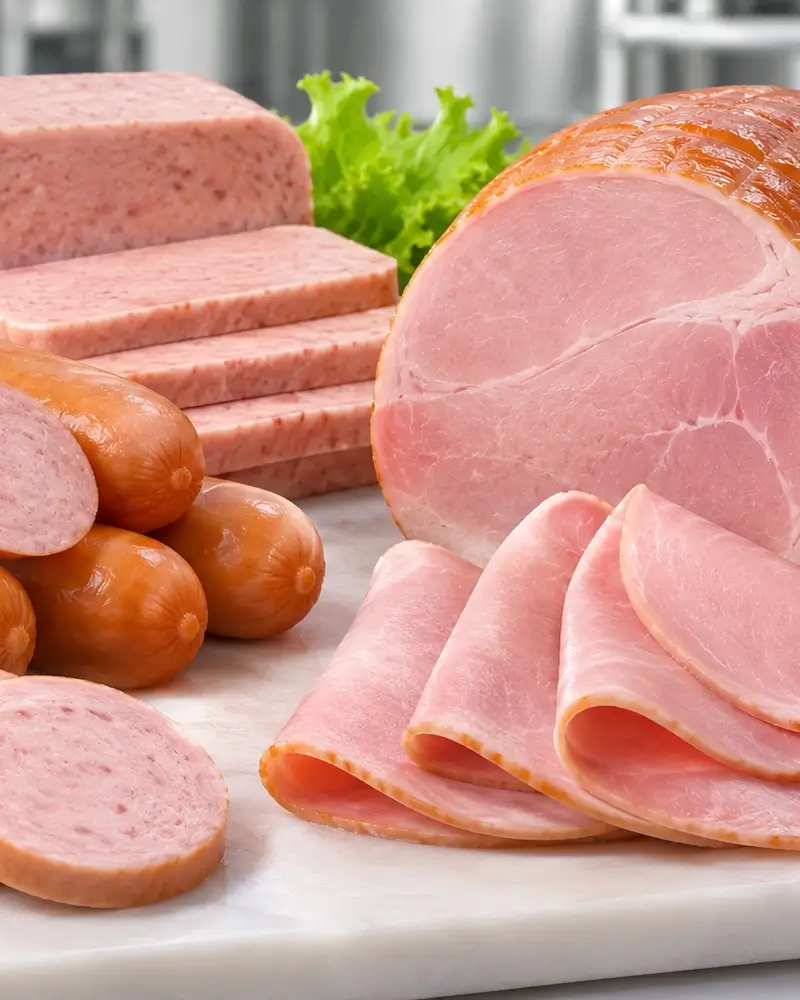
Curdlan powder applications in processed meat, cooked sausages and ham
Processed meat products, cooked sausages and meat emulsions.

Curdlan Powder for Processed Meat, Sausages & Ham

Curdlan can function as a gelling and texturizing ingredient in heat-treated meat products, including certain cooked sausages, ham products, and restructured meat formulations. Its heat-induced gel network can contribute to firmness, bite, sliceability, and product structure during processing.

Water retention is an important consideration in meat emulsions and processed meat systems. Depending on the formulation, curdlan may help manage moisture movement during heating and cooling, supporting product consistency and reducing undesirable fluid separation.

Food technologists should evaluate curdlan alongside meat proteins, starches, salt, phosphates, and other hydrocolloids. Mixing, hydration, cooking temperature, and the finished product's target texture will influence its performance.
EU category 08.3.2: Heat-treated meat products — maximum 20,000 mg/kg, subject to specified exclusions. Other meat preparations have separate conditions.
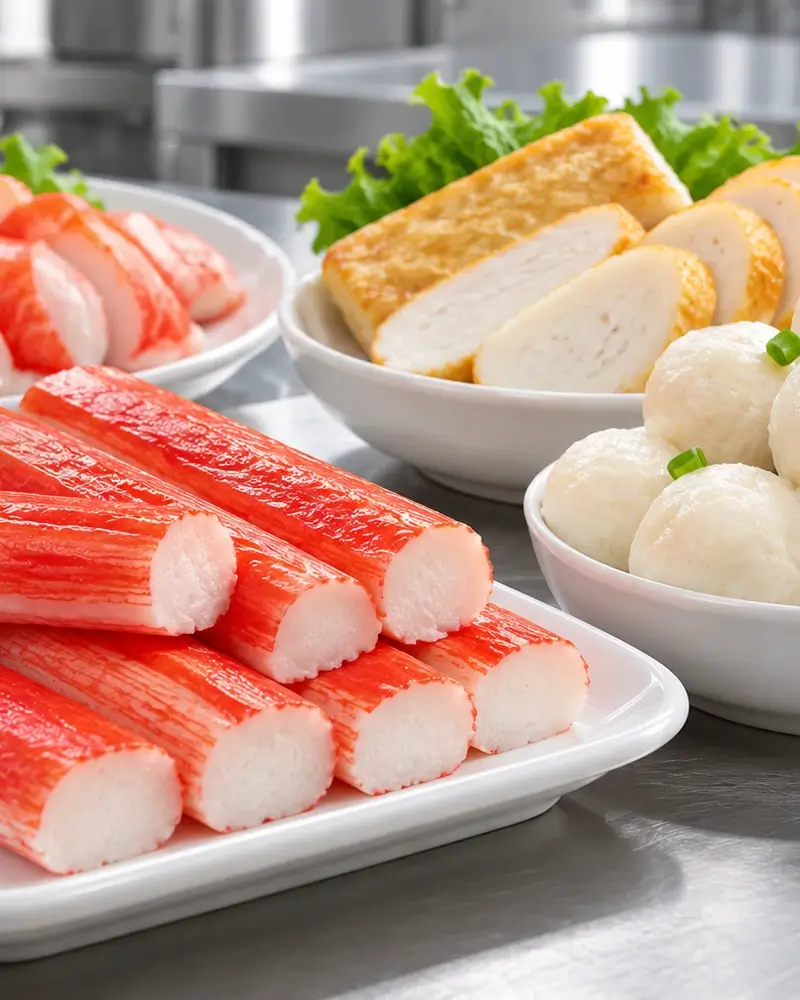
Curdlan food hydrocolloid applications in surimi, fish balls and processed seafood
Surimi, fish balls and processed seafood products.

Curdlan for Surimi, Fish Balls & Processed Seafood

Surimi and processed seafood manufacturers use hydrocolloids to manage gel strength, elasticity, moisture retention, and shape stability. Curdlan is a heat-gelling β-1,3-glucan that can support the development of a structured gel matrix in selected fish and seafood formulations.

In products such as fish balls, seafood analogues, and surimi-based products, curdlan may help improve firmness and maintain shape during thermal processing. Its functional performance depends on the interaction between the curdlan gel and the seafood protein network.

Formulation trials should assess the balance between elasticity and firmness, as excessive gel strength may produce a texture that is too firm for the target product. The type of fish protein, salt level, water content, and heating process must also be considered.

EU category 09.2: Processed fish and fishery products, including molluscs and crustaceans — maximum 30,000 mg/kg.
Curdlan powder used for noodle texture, gluten-free pasta firmness and cooking stability
Noodles and permitted specialty pasta formulations.

Curdlan Powder for Noodles, Gluten-Free Pasta & Texture

Curdlan is used as a texture-modifying ingredient in noodles and selected pasta formulations. Its heat-induced gel formation can contribute to firmness, chewiness, and structural integrity during cooking and food preparation.

In noodle systems, curdlan performance depends on its interaction with starch, flour proteins, water, and other formulation ingredients. Food manufacturers can evaluate curdlan to improve texture consistency and limit undesirable softening during processing.

For gluten-free pasta, curdlan may help support structure where conventional gluten networks are absent. However, its suitability depends on the starch and flour blend, processing equipment, heating conditions, and desired eating texture.

EU category 06.5: Noodles — maximum 20,000 mg/kg.
EU category 06.4.2: Dry pasta — maximum 20,000 mg/kg, only for specified gluten-free pasta and pasta intended for hypoproteic diets.
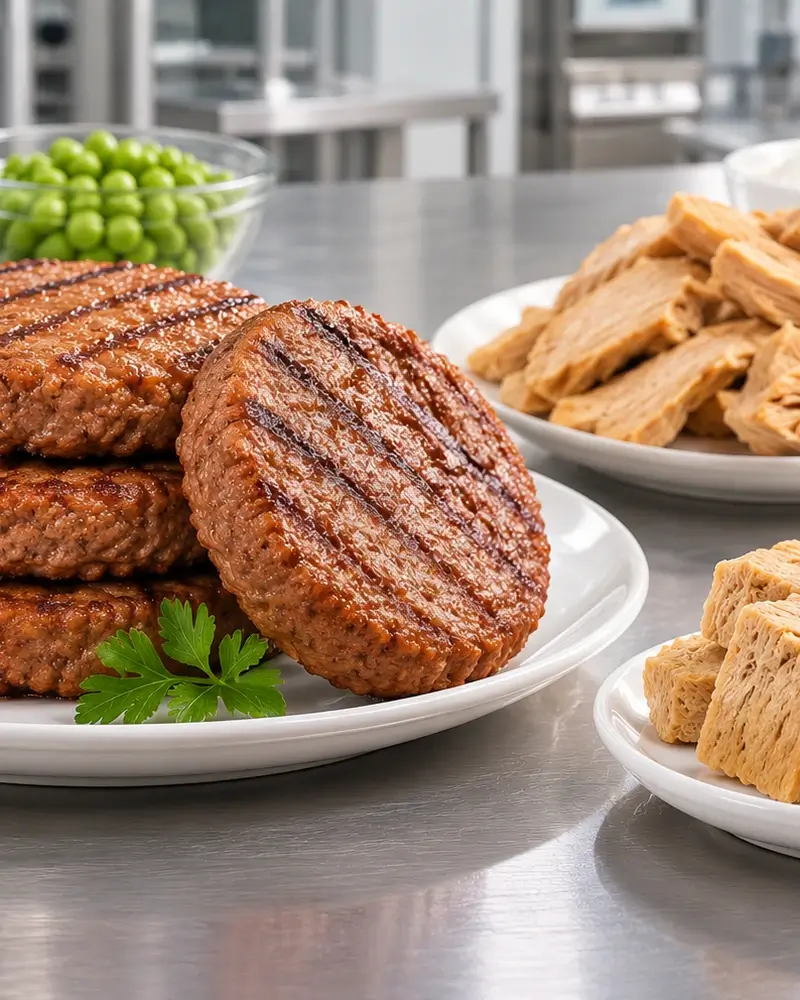
Curdlan powder for plant-based meat alternatives, vegetarian patties and soy protein products
Plant-based patties and structured protein products.

Curdlan for Plant-Based Meat Alternatives & Protein Foods

Plant-based protein manufacturers use gelling agents and binders to develop the structure, texture, and moisture distribution of meat alternatives. Curdlan can form a heat-induced gel network that contributes to firmness and cohesion in suitable plant-protein formulations.

Curdlan may be evaluated in products made with soy protein, pea protein, wheat protein, or other plant-based ingredients. Depending on the recipe, it can support binding, shape retention, and texture development during cooking and cooling.

The optimal curdlan concentration depends on protein type, fat content, water level, and processing conditions. Formulators should test its interaction with methylcellulose, starches, gums, and other texture modifiers to achieve the required bite and stability.
EU category 12.9: Protein products, excluding products covered by category 01.8 — maximum 80,000 mg/kg. Plant-based meat alternatives must be classified under the correct EU food category before use.
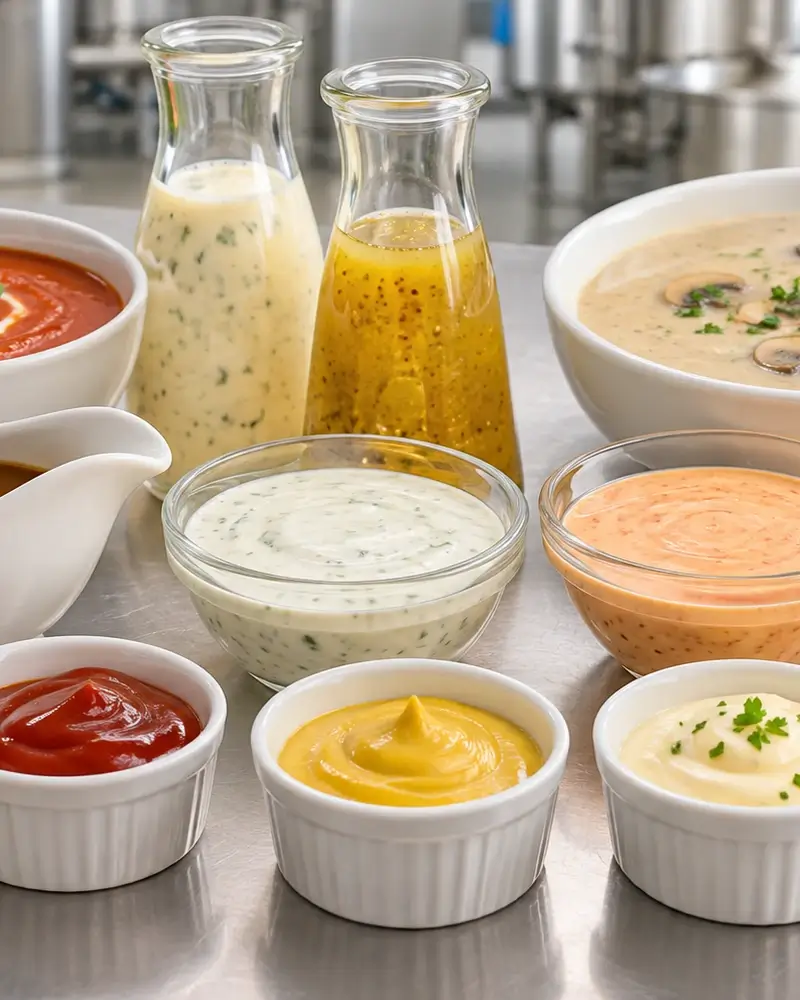
Curdlan food additive applications in thickened sauces, creamy soups and dressings
Processed sauces, dressings and prepared soups.

Curdlan as a Thickener and Stabilizer in Sauces & Soups

Food manufacturers use hydrocolloids to manage viscosity, consistency, and physical stability in sauces, soups, and prepared food systems. Curdlan can contribute to thickening and texture development through heat-induced gel formation.

In suitable sauce formulations, curdlan may help control body, texture, and water distribution. Its performance depends on the aqueous phase, oil content, salt concentration, pH, and thermal processing conditions.

Curdlan behaves differently from cold-soluble thickening agents such as xanthan gum. Manufacturers should evaluate its dispersion and heating requirements before adding it to liquid formulations, especially where a smooth pourable texture is needed rather than a firm gel.

EU category 12.6: Sauces — maximum 30,000 mg/kg.
EU category 12.5: Soups and broths — maximum 10,000 mg/kg.
Curdlan powder applications in fine bakery products, pastries and food fillings
Fine bakery products and permitted food fillings.

Curdlan for Bakery Products, Pastries & Food Fillings

Curdlan can be evaluated as a texturizing and gelling ingredient in selected bakery products and prepared fillings. Its heat-induced network formation may contribute to product structure, firmness, and moisture management during baking and cooling.

In fine bakery products, curdlan performance depends on the interaction between starch, flour proteins, sugars, fats, and water. The ingredient should be tested under the intended mixing, proofing, baking, and storage conditions.

For permitted fillings and coatings, curdlan may be useful where a controlled gel structure or texture is desired. However, finished-product classification matters because bakery wares, bread, decorations, coatings, and fillings are subject to different EU conditions of use.

EU category 07.2: Fine bakery wares — maximum 20,000 mg/kg.
EU category 05.4: Decorations, coatings and fillings — maximum 5,000 mg/kg, excluding fruit-based fillings covered by category 04.2.4.

How to Select Curdlan Powder for Your Food Application

The performance of curdlan depends on gel strength, dosage, dispersion, heating temperature, processing time, and the composition of the finished food. A higher gel strength specification does not always produce a better finished-product texture.

BSH CY-1 provides gel strength ≥600 g/cm², total nitrogen ≤0.3%, and assay ≥80%. BSH Ingredients can discuss customized gel strength and nitrogen specifications for European and Japanese food manufacturers requiring different functional properties.

Regulatory note: The maximum use levels above are EU legal limits under Commission Regulation (EU) 2026/2298, not recommended formulation dosages. Food manufacturers must confirm the precise food category, conditions of use, and finished-product compliance. Japanese food additive use requirements must be assessed separately.

For the complete EU E424 food category list, maximum use levels, and restrictions, read our Curdlan E424 EU Approval and Authorized Food Categories Guide .

Official regulatory source: Commission Regulation (EU) 2026/2298 .

Customized Gel Strength & Low Nitrogen Curdlan Specifications from BSH Ingredients

Food manufacturers often require customized curdlan powder specifications to meet different processing conditions, texture requirements, and regulatory standards. Gel strength and total nitrogen content are two important parameters when selecting food-grade curdlan for the European and Japanese markets.

As a specialized bulk curdlan powder manufacturer in China, BSH Ingredients offers custom gel strength and low nitrogen specifications for customers requiring consistent gelation performance, food texture, and ingredient quality.

Our standard BSH CY-1 curdlan powder is developed for EU E424 and Japanese food additive requirements, with gel strength ≥600 g/cm², total nitrogen ≤0.3%, and assay ≥80%, calculated as anhydrous glucose. Custom specifications can be discussed based on the customer's intended food application and purchasing requirements.

Customized Curdlan Gel Strength

600–1,000+ g/cm²

BSH Ingredients offers different curdlan gel strength specifications for food manufacturers requiring controlled firmness, elasticity, and structural stability.

Customers may request target gel strengths such as 700, 800, or 1,000 g/cm², subject to manufacturing feasibility and batch testing.

The appropriate gel strength depends on the food formulation, heating conditions, curdlan concentration, and desired finished-product texture.

Customized Low Nitrogen Curdlan

≤0.3% Total Nitrogen

BSH CY-1 is developed for European and Japanese buyers requiring low nitrogen food-grade curdlan powder.

Both the EU E424 specification and Japanese curdlan standard establish a maximum total nitrogen content of 0.3%.

For customers with stricter internal quality specifications, BSH Ingredients can discuss lower nitrogen targets, subject to technical feasibility and analytical verification.

Why Customize Curdlan Gel Strength?

Gel strength influences the firmness and mechanical properties of curdlan gels. However, stronger gel performance is not always better for every food formulation.

Processed meat manufacturers may require a firm and stable texture, while surimi and seafood processors may prioritize elasticity and controlled bite. Noodle manufacturers may focus on chewiness, firmness, and cooking stability. Plant-based protein manufacturers often need balanced gel formation and moisture retention.

These applications require different formulation approaches. BSH Ingredients supports customers in selecting appropriate curdlan gel strength specifications according to their processing temperatures, ingredient systems, and texture targets.

Why Customize Total Nitrogen Content?

Total nitrogen is an important purity indicator for fermentation-derived curdlan. Nitrogen-containing substances may originate from microbial biomass and fermentation nutrients. Controlled manufacturing and purification help manage residual nitrogen in the finished ingredient.

The European Union limits total nitrogen in curdlan E424 to 0.3% under Commission Regulation (EU) 2026/2298. Japan also establishes a maximum of 0.3% in its food additive specifications.

BSH Ingredients develops low nitrogen curdlan specifications to meet different international market and customer requirements. For the United States, the company also offers BSH CY-3, designed around the FDA nitrogen limit of ≤0.2%.

BSH CY-1 Standard vs Customized Specifications

BSH CY-1 serves as the standard EU- and Japan-targeted curdlan grade. Additional specifications can be developed according to the customer's target gel strength, nitrogen limit, and intended food application.

Parameter Standard CY-1 / Custom Options
Product Grade BSH CY-1
Target Markets European Union & Japan
Standard Gel Strength ≥600 g/cm²
Custom Gel Strength Higher targets such as 700, 800, or 1,000 g/cm², subject to confirmation
Standard Total Nitrogen ≤0.3%
Custom Nitrogen Content Tighter specifications available for technical discussion
Curdlan Assay ≥80% as anhydrous glucose
Standard Packaging 10 kg/bag
Quality Documentation Technical specifications, batch COA and available test reports
Sample Availability Free samples for qualification trials
Manufacturing Capacity 500 metric tons annually

Custom Curdlan Specifications for Food Formulation

When developing a new food formulation, the selected curdlan grade should be tested under actual production conditions. Important factors include curdlan dosage, dispersion quality, heating temperature, processing time, pH, and interactions with proteins, starches, and other hydrocolloids.

BSH Ingredients provides samples and technical specifications to support ingredient evaluation. Customers can compare gel strength, texture, and processing performance before selecting a commercial curdlan grade.

For bulk orders, buyers can discuss required gel strength, nitrogen content, packaging, purchasing volume, and batch testing documentation directly with BSH Ingredients.

Regulatory qualification: Customizing gel strength or nitrogen content does not by itself establish full EU E424 or Japanese regulatory conformity. The finished curdlan ingredient must also meet applicable identity, manufacturing, purity, microbiological, analytical-method, and food-use requirements.

Request Customized EU E424 Curdlan Powder

Looking for higher gel strength or lower nitrogen curdlan powder? BSH Ingredients offers customized CY-1 specifications, technical documentation, free samples, and bulk wholesale quotations for European and Japanese customers.

Request Custom Specifications & Free Sample

Curdlan Manufacturing Process, Quality Control & Technical Documentation

BSH Ingredients is a specialized bulk curdlan powder manufacturer in China, producing fermentation-derived food hydrocolloids for international food manufacturers, ingredient distributors, and industrial buyers. The company has an annual manufacturing capacity of 500 metric tons and develops market-specific curdlan specifications.

Our EU E424 curdlan powder (CY-1) is developed for European and Japanese food ingredient markets. Its manufacturing and quality control focus on curdlan assay, gel strength, total nitrogen, moisture, ash, heavy metals, and microbiological quality.

As a fermentation-derived β-1,3-glucan, curdlan requires controlled production and purification to achieve consistent functional properties. Manufacturing conditions and downstream processing influence the quality of the finished food-grade curdlan powder.

How Is BSH Curdlan Powder Manufactured?

Curdlan is produced through microbial fermentation rather than extraction from plant materials. The general manufacturing process involves controlled fermentation, recovery and purification of the polysaccharide, drying, powder finishing, and final quality testing.

BSH Ingredients uses fermentation-based production followed by purification and drying. The following overview describes the main manufacturing stages relevant to curdlan quality. Specific processing conditions and production-organism documentation are subject to technical verification.

  1. 01

    Controlled Microbial Fermentation

    Curdlan is synthesized by microorganisms during controlled fermentation. Fermentation conditions such as nutrient availability, temperature, pH, and process duration influence polysaccharide production and product consistency.

  2. 02

    Curdlan Recovery & Purification

    After fermentation, the curdlan polysaccharide must be recovered and purified. Downstream processing helps remove residual microbial material, fermentation nutrients, and other impurities that may affect nitrogen content, ash, appearance, and finished-product quality.

  3. 03

    Drying, Milling & Powder Finishing

    The purified material is dried and processed into curdlan powder. Powder finishing operations, including milling and screening where applicable, help control handling characteristics and particle-size consistency.

  4. 04

    Quality Testing & Final Packaging

    Finished curdlan powder is evaluated against applicable product specifications before release. Quality records support batch identification, technical documentation, packaging, and bulk supply to food manufacturers and international importers.

For a more detailed explanation of industrial fermentation, curdlan recovery, purification, and powder manufacturing, read our Curdlan Manufacturing Process Guide .

Quality Control in Food-Grade Curdlan Manufacturing

Food-grade curdlan must meet both functional and compositional specifications. Gel strength is important for food texture and thermal gelation, while assay, nitrogen, moisture, ash, and contaminant testing provide information about ingredient quality.

BSH Ingredients performs quality control during production and finished-product evaluation. The company uses product specifications and batch Certificates of Analysis to support consistent manufacturing and customer qualification.

For CY-1, quality evaluation focuses on the parameters required by European and Japanese buyers, including low nitrogen content, curdlan assay, gel strength, and relevant purity criteria.

Quality Control Stage Main Quality Considerations
Raw Material Control Suitability and consistency of fermentation raw materials and production inputs.
Fermentation Monitoring Process conditions, batch consistency, and control of fermentation performance.
Purification Control Removal of residual nitrogen-containing substances, inorganic residues, and other process-related impurities.
Physical & Chemical Testing Curdlan assay, gel strength, total nitrogen, pH, loss on drying, and ash content.
Contaminant Testing Lead, arsenic, residual methanol, and other applicable purity parameters.
Microbiological Testing Aerobic plate count, indicator organisms, and destination-market-specific microbiological requirements.
Finished Product Release Specification review, batch identification, quality documentation, and packaging verification.

BSH CY-1 Batch Testing & Certificate of Analysis

A Certificate of Analysis (COA) provides analytical results for a specific production batch. It helps procurement managers, quality assurance teams, and food manufacturers compare actual test results against agreed ingredient specifications.

BSH CY-1 has a product specification of gel strength ≥600 g/cm², total nitrogen ≤0.3%, and assay ≥80%, calculated as anhydrous glucose. These parameters are important for evaluating functional performance and low-nitrogen food-grade curdlan.

The supplied CY-1 COA for batch 2026110704, produced on November 7, 2026, reports an assay of 91.8%, gel strength of 648.2 g/cm², and total nitrogen below 0.3%. It also includes results for moisture-related testing, ash, lead, arsenic, methanol, and microbiological quality.

These results apply to the tested batch. Buyers should request the current COA and suitable method information for the material being purchased.

Technical Documents for EU & Japan Curdlan Importers

Technical documentation is an important part of food ingredient supplier qualification. European and Japanese importers need reliable information about curdlan identity, quality specifications, manufacturing conditions, and batch test results.

BSH Ingredients supports customer qualification through product specifications, COAs, and relevant technical documentation. Additional documents and tests can be discussed based on destination-market requirements and availability.

Document Purpose for Buyers
Technical Data Sheet (TDS) Identifies BSH CY-1 and its physical, chemical, and functional specification limits.
Certificate of Analysis (COA) Provides actual laboratory results for a particular production batch.
Manufacturing Process Information Supports assessment of the fermentation source, production process, and regulatory substance identity.
Heavy Metal Test Reports Supports evaluation of lead, arsenic, and other applicable contaminant limits.
Residual Solvent Test Report Supports verification of the applicable residual methanol specification.
Microbiological Test Reports Supports evaluation of aerobic plate count, coliforms, E. coli, and other required criteria.
Quality System Certificates Supports supplier qualification when applicable certificates and their current scope are available for review.
Export & Shipping Documents Supports commercial shipment, batch traceability, customs procedures, and import documentation.

EU E424 Regulatory Verification & Traceability

For curdlan intended for the European market, the final ingredient must meet the applicable requirements established under Commission Regulation (EU) 2026/2298.

These requirements include product identity, manufacturing conditions, average molecular weight, purity criteria, and microbiological quality. Matching the numerical nitrogen and gel strength limits alone does not establish full E424 conformity.

The current CY-1 COA provides batch results for several important quality parameters. European customers should also verify the required production-organism identity, average molecular weight, and method-specific microbiological criteria through appropriate supporting documentation.

Japan maintains its own food additive specifications and analytical requirements. Importers should confirm that the supplied CY-1 documentation addresses the applicable Japanese requirements before commercial distribution.

For more information, see our EU Curdlan E424 Standard & Import Requirements .

Supplier qualification note: Product specifications, batch COAs, manufacturing records, and laboratory methods serve different purposes. A batch COA is useful evidence of tested product quality, but it does not replace full destination-market regulatory verification.

Batch Traceability, Packaging & Bulk Supply

Batch traceability allows ingredient buyers to connect a shipment with its manufacturing and quality records. Important identifiers include the product grade, batch number, production date, packaging information, and corresponding COA.

BSH CY-1 is supplied as a fine food-grade curdlan powder. The current CY-1 documentation identifies standard packaging of 10 kg/bag. Customers can discuss alternative bulk packaging options based on order requirements and availability.

Curdlan powder should be stored in suitable packaging in a cool, dry, and ventilated environment, protected from moisture and contamination. Buyers should follow the storage instructions provided with the actual shipment.

500 Metric Tons / Year

BSH Ingredients' annual curdlan manufacturing capacity supports bulk ingredient supply, custom specifications, and long-term purchasing programs for food manufacturers, distributors, and international ingredient importers.

Why Manufacturing Consistency Matters for Food Formulators

For industrial food manufacturers, the lowest ingredient price is not the only purchasing consideration. Consistent gel strength, nitrogen content, and powder quality help support repeatable formulation results and stable processing conditions.

Variation in curdlan gel strength may affect finished-product firmness and texture, while changes in powder characteristics can influence dispersion and manufacturing performance.

BSH Ingredients combines fermentation-based production, market-specific curdlan specifications, and technical support to serve food manufacturers requiring consistent hydrocolloid performance and bulk supply.

Customers can request samples for laboratory evaluation before placing commercial orders.

Request BSH CY-1 COA, Technical Documents & Free Sample

Looking for a reliable EU E424 curdlan powder manufacturer in China? Contact BSH Ingredients for CY-1 technical specifications, batch Certificates of Analysis, available quality documentation, free samples, and bulk wholesale quotations.

Request Technical Documents & Free Sample

Frequently Asked Questions About EU E424 Curdlan Powder (CY-1)

Find answers to common questions about EU E424 curdlan powder, BSH CY-1 technical specifications, European and Japanese food additive requirements, gel strength, low nitrogen content, customized formulations, and bulk wholesale purchasing.

What is EU E424 curdlan powder (CY-1)?

EU E424 curdlan powder (CY-1) is a fermentation-derived, food-grade β-1,3-glucan manufactured by BSH Ingredients for the European and Japanese markets.

It has a minimum gel strength of 600 g/cm², total nitrogen ≤0.3%, and assay ≥80%, calculated as anhydrous glucose. Curdlan is a heat-gelling polysaccharide used as a stabilizer, thickener, gelling agent, and firming agent in permitted food applications.

What are the main specifications of BSH CY-1 curdlan?

BSH CY-1 has a minimum gel strength of 600 g/cm², maximum total nitrogen of 0.3%, assay ≥80%, and pH between 6.0 and 7.5.

Its technical specification also covers moisture, ash, heavy metals, residual methanol, and microbiological quality. Buyers can request a Technical Data Sheet (TDS) and batch Certificate of Analysis (COA) to review the complete product specifications.

Does BSH CY-1 meet EU E424 food additive requirements?

BSH CY-1 is developed around the technical requirements of Commission Regulation (EU) 2026/2298. Its published specification includes gel strength ≥600 g/cm², nitrogen ≤0.3%, and assay ≥80%.

However, full EU E424 conformity also requires verification of the authorized substance identity, production organism, manufacturing process, molecular weight, purity criteria, microbiological testing, and applicable food-use conditions. Buyers should review the complete supporting documentation before commercial import.

Read our EU Curdlan E424 Standard Guide for the complete regulatory specifications.

Can BSH CY-1 curdlan powder be supplied to Japan?

Yes. BSH Ingredients developed CY-1 for both the European and Japanese markets. The product has total nitrogen ≤0.3% and assay ≥80%, which match important numerical requirements in Japan's Specifications and Standards for Food Additives.

Japan maintains its own requirements for product identity, purity, microbiology, and testing methods. Japanese importers should verify the complete applicable specifications before purchasing or distributing the ingredient.

Why is low nitrogen content important for curdlan powder?

Total nitrogen is an important quality parameter for fermentation-derived curdlan. It can indicate the presence of residual nitrogen-containing materials from fermentation and downstream processing.

Both the EU E424 specification and the Japanese curdlan food additive standard establish a maximum nitrogen content of 0.3%.

BSH CY-1 is developed with a total nitrogen specification of ≤0.3%. Lower nitrogen targets can also be discussed for customers with stricter internal purchasing requirements.

What is the difference between EU E424 and Japanese curdlan standards?

The European Union and Japan both establish an assay requirement of at least 80% and a total nitrogen limit of 0.3%.

However, the EU E424 specification requires gel strength ≥600 g/cm² and sets explicit limits for arsenic, lead, and residual methanol. Japan uses its own identification tests, impurity requirements, and microbiological criteria.

E424 is the European food additive designation. Japanese regulatory requirements are established through Japan's own food additive framework.

Can curdlan E424 be used in all food products in the EU?

No. Commission Regulation (EU) 2026/2298 authorizes curdlan (E424) in specified food categories, subject to maximum use levels and other restrictions.

Examples include certain processed meat products, processed seafood, noodles, protein products, sauces, and fine bakery wares. The exact conditions depend on the legal classification of the finished food.

Manufacturers should confirm the authorized category and permitted maximum level before using curdlan in a commercial formulation.

See the EU Curdlan E424 Approved Food Categories .

Can BSH Ingredients customize curdlan gel strength and nitrogen content?

Yes. BSH Ingredients offers customized gel strength and total nitrogen specifications for food manufacturers and ingredient distributors.

Customers can discuss higher gel strength targets, such as 700, 800, or 1,000 g/cm², depending on the intended food application and manufacturing feasibility.

Stricter nitrogen targets can also be discussed for buyers with specific quality requirements. Custom specifications are subject to confirmation through appropriate manufacturing and testing.

What is the difference between BSH CY-1 and CY-3 curdlan powder?

BSH CY-1 is developed for the European and Japanese markets, with total nitrogen ≤0.3% and gel strength ≥600 g/cm².

BSH CY-3 is developed for the United States market, with total nitrogen ≤0.2%, reflecting the stricter nitrogen requirement under FDA 21 CFR §172.809.

The U.S. FDA also specifies its own gel strength testing units and analytical methods. Buyers should select the appropriate grade and verify the complete requirements for the destination market.

What documents should EU and Japan importers request for curdlan?

Buyers should request the current product Technical Data Sheet, batch Certificate of Analysis, relevant contaminant and microbiological test reports, and available manufacturing information.

For EU E424 qualification, documentation should also address the specified production organism and process, average molecular weight, identity tests, and required microbiological criteria.

BSH Ingredients can discuss available CY-1 documentation and additional verification requirements with buyers.

Does BSH Ingredients offer free samples and bulk curdlan quotations?

Yes. BSH Ingredients offers free CY-1 curdlan powder samples for formulation testing and supplier qualification.

The company has an annual curdlan manufacturing capacity of 500 metric tons and supplies bulk food-grade curdlan powder to international customers. The documented standard CY-1 packaging is 10 kg/bag.

Buyers can contact BSH Ingredients to request samples, current technical specifications, batch COAs, wholesale prices, and order-specific packaging and shipping terms.

Need More Information About BSH CY-1?

Contact BSH Ingredients for EU E424 curdlan powder specifications, customized gel strength, low nitrogen requirements, technical documentation, free samples, and wholesale quotations.

Request CY-1 Free Sample & Bulk Quote
Get a quote immediately