
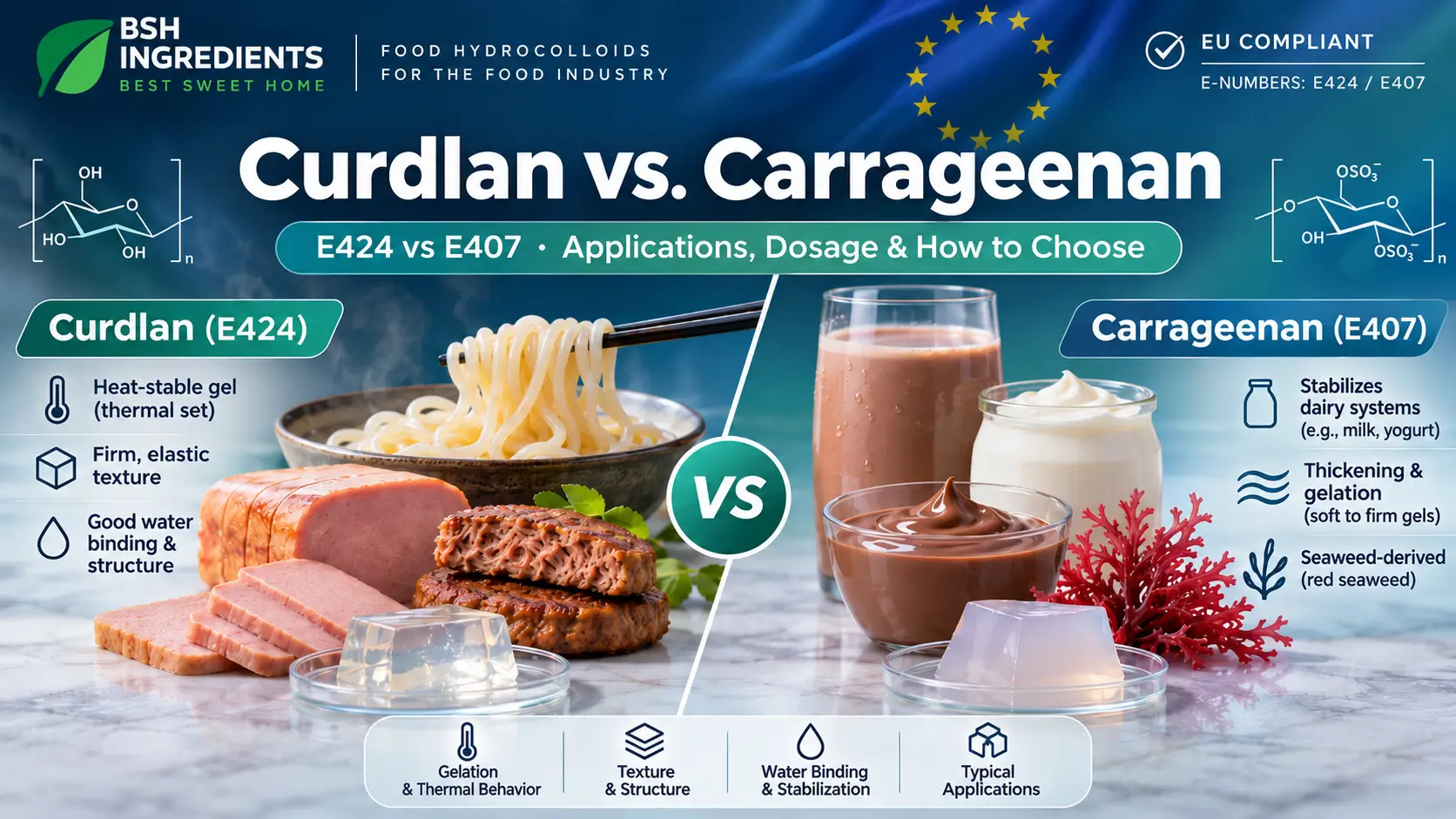
Curdlan vs carrageenan is an important comparison for food manufacturers choosing gelling agents, stabilizers, and texture modifiers. Both are food hydrocolloids, but they differ in raw materials, chemical structure, gel formation, heat resistance, dosage, and food applications.
Curdlan (E424) is a fermentation-derived β-1,3-glucan known for its heat-stable, high-set gels. Carrageenan (E407) is a seaweed-derived polysaccharide widely used in dairy products, processed meat, beverages, and desserts.
The European Union’s new authorization of curdlan under Commission Regulation (EU) 2026/2298, effective November 8, 2026, gives European food manufacturers another gelling agent to consider.
This guide compares their technical properties, advantages, disadvantages, food applications, dosage, EU specifications, and regulatory requirements. It also explains when curdlan can replace carrageenan and how manufacturers should select the right ingredient.
Curdlan vs. Carrageenan: Key Differences at a Glance
The biggest difference between curdlan and carrageenan is their gel formation. Curdlan can form a heat-irreversible high-set gel, while kappa and iota carrageenan form thermoreversible gels that generally develop during cooling.
| Property | Curdlan (E424) | Carrageenan (E407) |
|---|---|---|
| Raw material | Microbial fermentation | Red seaweed |
| Chemical structure | Linear β-1,3-glucan | Sulfated galactan polysaccharides |
| Ionic character | Neutral | Anionic |
| Main functions | Gelling, firming, stabilizing, thickening | Gelling, thickening, stabilizing |
| Gel formation | Heat-induced | Cooling-induced for kappa and iota |
| Gel reversibility | High-set: irreversible; low-set: reversible | Kappa/iota: reversible; lambda: non-gelling |
| Gel texture | Firm, cohesive, elastic, chewy | Firm, brittle, soft, elastic, or viscous |
| Heat resistance | High-set gels resist remelting | Gels melt and reform at formulation-dependent temperatures |
| Ion dependence | No specific added cations required | Kappa responds to K⁺; iota responds to Ca²⁺ |
| Solubility | Insoluble in cold water; soluble in alkali | Depends on type and ionic form |
| Dairy protein interaction | Mainly contributes through physical structure | Strong functional interaction with casein |
| Freeze–thaw performance | Often good for high-set gels | Depends on type and formulation |
| Main food applications | Meat, seafood, noodles, plant-based foods | Dairy, desserts, beverages, processed meat |
| Ingredient cost | Often higher per kilogram | Often lower, depending on grade |
| EU food additive code | E424 | E407 |
| EU regulatory status | Newly authorized from November 8, 2026 | Long-established food additive |
The Three Most Important Differences
1. Gel formation: Curdlan forms gels when its aqueous suspension is heated. Kappa and iota carrageenan generally require hydration followed by cooling under suitable ionic conditions.
2. Heat resistance: Curdlan high-set gels retain much of their structure during subsequent heating. Carrageenan gels can melt when heated and reform when cooled.
3. Food applications: Curdlan is particularly useful for firm, chewy, heat-stable structures. Carrageenan is highly effective in dairy stabilization, reversible gels, and viscosity control.
Neither ingredient is universally better. The right choice depends on the finished product and its manufacturing process.
How to Choose Between Curdlan and Carrageenan
For food manufacturers, the most useful question is not which ingredient has greater gel strength. It is which ingredient produces the required texture under actual processing and storage conditions.
Choose Curdlan E424 for Heat-Stable Gels and Chewy Textures
Curdlan is a strong candidate when food products need to maintain their structure during cooking, boiling, frying, sterilization, or reheating.
Its heat-irreversible high-set gel can help create a firm, resilient bite. This makes curdlan useful in processed meat, sausages, fish balls, imitation seafood, noodles, and plant-based meat alternatives.
Curdlan can also support water retention and reduce cooking losses in selected food systems. Its gelation does not require the addition of potassium or calcium salts.
Choose Carrageenan E407 for Dairy Stabilization and Reversible Gels
Carrageenan is often the better choice for chocolate milk, ice cream, dairy desserts, and products requiring smooth textures or low-dose stabilization.
Kappa carrageenan interacts effectively with casein and helps suspend cocoa particles in milk. Iota carrageenan produces softer, more elastic gels, while lambda carrageenan increases viscosity without forming a conventional gel.
Carrageenan is also well established in processed meat and water-based desserts.
When Should Manufacturers Test Both?
Both ingredients deserve consideration when the formulation requires water retention, structural integrity, and a controlled bite.
Processed meat, seafood products, protein gels, and plant-based foods are examples. The preferred ingredient may change with protein composition, salt content, processing temperature, and product moisture.
| Formulation requirement | Recommended starting choice |
|---|---|
| Heat-stable structure after reheating | Curdlan |
| Firm, chewy meat-like texture | Curdlan |
| Frozen cooked noodles | Curdlan |
| Chocolate milk stabilization | Kappa carrageenan |
| Soft, elastic dessert gels | Iota carrageenan |
| Creamy viscosity without gelation | Lambda carrageenan |
| Clear, thermoreversible jelly | Kappa or iota carrageenan |
| Water retention in injected meat | Compare both |
| Low-cost conventional dairy stabilization | Carrageenan |
| Complex plant-based protein gel | Evaluate curdlan, carrageenan, and blends |
Before final selection, manufacturers should also verify the applicable food additive authorization in their destination market.
What Are Curdlan E424 and Carrageenan E407?
Curdlan Gum: Fermentation-Derived β-1,3-Glucan
Curdlan is a high-molecular-weight polysaccharide composed of glucose units linked through β-1,3-glycosidic bonds.
It is produced by microbial fermentation, followed by purification and drying. The EU specification identifies a particular production strain: Rhizobium radiobacter biovar 1 NTK-u.
| Technical parameter | Curdlan |
|---|---|
| Food additive name | Curdlan |
| EU E-number | E424 |
| INS number | 424 |
| CAS number | 54724-00-4 |
| Chemical identity | β-1,3-D-glucan |
| Polymer formula | H·(C₆H₁₀O₅)ₙ·OH |
| Glucose repeating-unit mass | Approximately 162.14 Da |
| EU average molecular weight requirement | ≥1.4 × 10⁶ Da |
| Main production method | Microbial fermentation |
| Main functions | Firming, gelling, stabilizing, thickening |
Unlike small-molecule ingredients, curdlan is a polymer with a distribution of chain lengths. Its molecular weight therefore depends on its polymerization degree and production specifications.
Curdlan is valued for its ability to form different gels at different heating temperatures.
Carrageenan: Red Seaweed-Derived Sulfated Polysaccharides
Carrageenan is a family of sulfated polysaccharides extracted from red seaweeds belonging to the class Rhodophyceae.
Important commercial sources include Kappaphycus, Eucheuma, and Chondrus species.
Carrageenan consists mainly of sulfated galactose and 3,6-anhydrogalactose units. Its sulfate groups influence solubility, ionic interactions, viscosity, and gel structure.
| Technical parameter | Carrageenan |
|---|---|
| Food additive name | Carrageenan |
| EU E-number | E407 |
| Common CAS number | 9000-07-1 |
| Chemical identity | Sulfated galactan polysaccharides |
| Molecular formula | Variable polymer composition |
| Molecular weight | Variable by type and grade |
| Main raw material | Red seaweed |
| Main commercial types | Kappa, iota, lambda |
| Main functions | Gelling, thickening, stabilizing |
Carrageenan has no single fixed molecular formula or molecular weight applicable to every commercial type.
E407 vs. E407a: What Is the Difference?
E407 refers to carrageenan obtained by extraction and purification from permitted red seaweeds.
E407a refers to processed Eucheuma seaweed, commonly abbreviated PES. It is produced through alkaline treatment, washing, and drying. It retains more seaweed-derived insoluble material, including algal cellulose.
Both are used as food hydrocolloids, but their specifications and legal designations differ.
Curdlan vs. Carrageenan Gelation: Heat Stability, Gel Strength and Texture

Curdlan Low-Set vs. High-Set Gel Formation
Curdlan has two important gelation systems.
Low-set curdlan gel: When an aqueous curdlan suspension is heated to approximately 55–65°C and then cooled to 40°C or below, it can form a thermoreversible gel.
High-set curdlan gel: When the suspension is heated above approximately 80°C, it develops a stronger structure that is predominantly heat-irreversible.
High-set gels are particularly useful where the finished product must retain its shape during further heating.
However, gel strength and thermal irreversibility also depend on temperature, holding time, curdlan concentration, and processing conditions. Heating above 80°C alone does not guarantee identical results in every formulation.
Carrageenan Gelation: Potassium, Calcium and Cooling
Carrageenan forms gels through molecular association during cooling.
Kappa carrageenan responds strongly to potassium ions and generally creates firm, relatively brittle gels.
Iota carrageenan responds strongly to calcium ions and forms softer, more elastic structures.
Lambda carrageenan does not form a conventional gel. It acts primarily as a thickener.
The ion concentration, pH, sugar content, and other hydrocolloids influence carrageenan gel strength.
Thermal Reversibility and Retort Processing
Heat reversibility changes how an ingredient behaves during food processing.
Curdlan high-set gels can help maintain firmness during reheating, boiling, and thermal sterilization. Carrageenan gels may melt during heating but can reform when the product cools.
This does not mean carrageenan cannot be used in retorted meat or other heat-treated foods. Carrageenan can contribute to the finished structure through interactions with proteins and other ingredients.
For retort foods, the correct comparison is the finished product’s texture, moisture retention, and structural stability after the complete thermal cycle.
Gel Strength, Elasticity, Brittleness and Syneresis
Gel strength alone does not describe eating quality.
A firm gel can be brittle. An elastic gel can have lower hardness but better resilience. Manufacturers should evaluate hardness, springiness, cohesiveness, chewiness, fracture properties, and water-holding capacity.
Curdlan often performs well when a dense and resilient structure is required. Kappa carrageenan creates firm gels but may show syneresis. Iota carrageenan is often selected for softer textures and better water retention.
Effects of pH, Salts, Protein and Freeze–Thaw Cycles
Curdlan gelation does not require specific added cations, but salts and pH can still affect its mechanical properties.
Carrageenan is more directly influenced by ionic conditions. It is also susceptible to acid hydrolysis when exposed to low pH and high temperatures.
Freeze–thaw stability is not uniform across carrageenan types. Iota carrageenan may perform better than kappa in applications requiring elastic gels and reduced water release.
Manufacturers should test all these properties in the actual food matrix.
Kappa, Iota and Lambda Carrageenan vs. Curdlan
Carrageenan should not be treated as a single functional grade.
| Hydrocolloid | Gel behavior | Main texture | Common applications |
|---|---|---|---|
| Curdlan low-set | Thermoreversible | Softer gel | Selected gel systems |
| Curdlan high-set | Heat-irreversible | Firm, elastic, chewy | Meat, noodles, seafood |
| Kappa carrageenan | Thermoreversible | Firm, brittle | Dairy gels, desserts |
| Iota carrageenan | Thermoreversible | Soft, elastic | Soft desserts, protein systems |
| Lambda carrageenan | Non-gelling | Viscous, smooth | Beverages, sauces |
Kappa carrageenan is often chosen for firmness. Iota carrageenan suits elastic gel systems. Lambda carrageenan is preferred where viscosity rather than a solid gel is needed.
Curdlan differs from all three because its high-set structure is formed through heating and resists remelting.
Curdlan vs. Carrageenan: Top Food Applications Compared
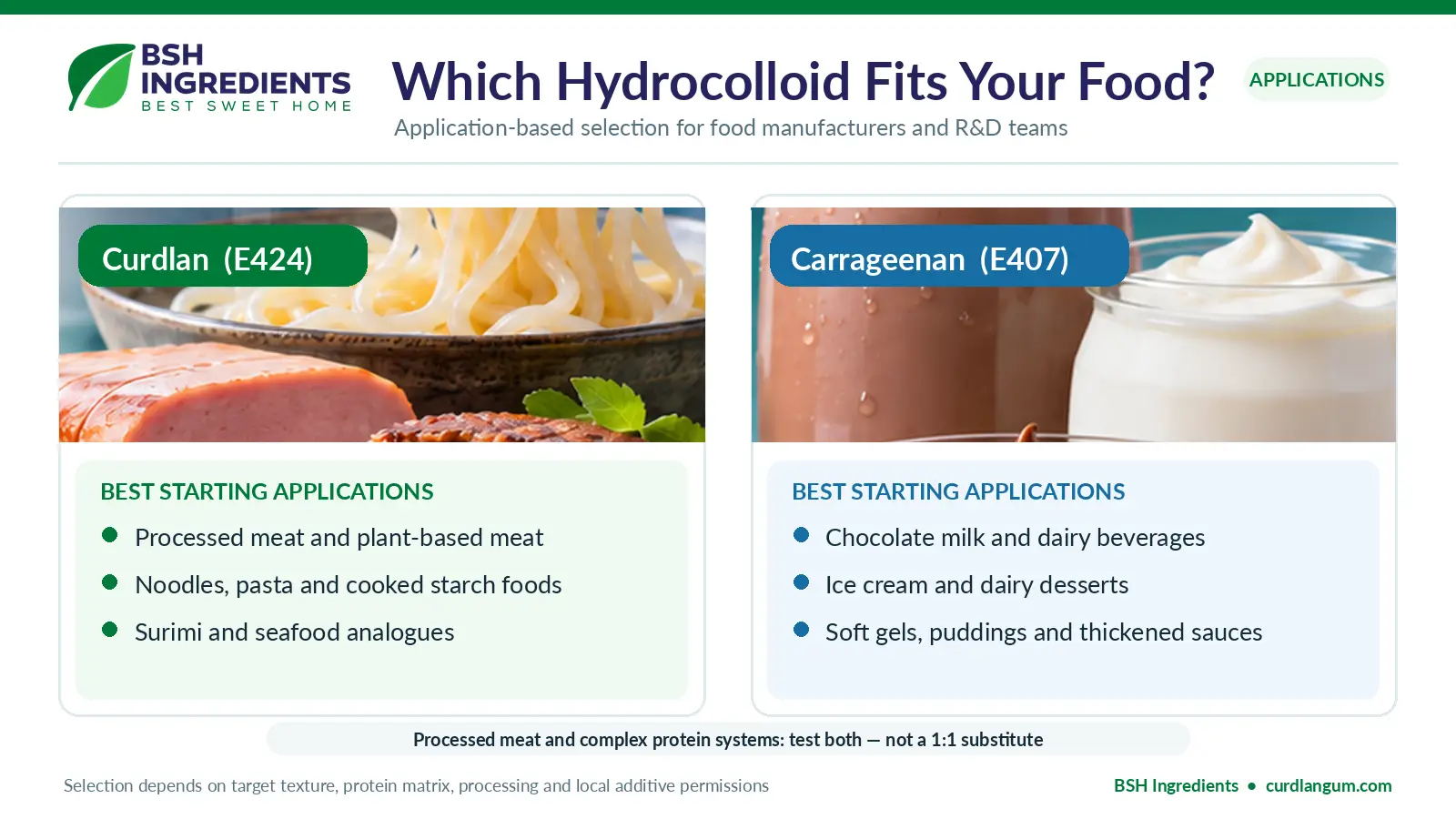
Plant-Based Meat and Meat Alternatives
Plant-based meat manufacturers need to reproduce the firmness, elasticity, juiciness, and bite of animal-based products.
Curdlan is a useful candidate for vegan sausages, plant-based burgers, meat analogues, and structured protein products. Its heat-set network can help products retain their shape during cooking.
Carrageenan is also used in plant-based food systems. It can modify protein gel texture, improve water retention, and contribute to binding.
Recommended choice: Start with curdlan where heat-stable bite and firmness are the main targets. Evaluate carrageenan when softer texture, viscosity, or protein interactions are more important.
Processed Meat, Sausages, Ham and Brine-Injected Poultry
Water retention and cooking yield are major concerns in meat processing.
Curdlan can improve the structure of meat protein gels and reduce cooking loss. In a study of low-fat model sausages, 0.5–1.5% curdlan was evaluated, with 1.0% improving functional and textural properties under the study conditions.
Carrageenan is widely used in injected ham, poultry products, sausages, and other processed meats. It helps control moisture and texture in suitable protein and salt systems.
Recommended choice: Test both. Curdlan is attractive for cooked structural gels. Carrageenan is a mature option for brine-based moisture management.
Surimi, Fish Balls and Plant-Based Seafood Analogues
Fish balls, crab sticks, imitation shrimp, and other seafood products often require a firm, springy bite.
Curdlan can support elastic texture and structure during heat processing. This makes it a useful candidate for surimi products and plant-based seafood alternatives.
Carrageenan can also improve texture and water retention in processed seafood. The best result depends on fish protein composition, moisture, salt, and processing conditions.
For imitation abalone, shrimp, or fish balls, manufacturers should compare resilience, cutting properties, cooking loss, and sensory texture.
Noodles, Pasta, Dumplings and Gluten-Free Foods
Curdlan has strong research support in noodle applications.
A 2022 study reported that adding 0.5% curdlan improved the quality of frozen cooked noodles. It reduced water migration and helped maintain noodle structure during cooking.
A 2024 study of thermally sterilized rice noodles investigated curdlan concentrations of 0.38–1.13%. At 1.13%, the cooking breakage rate fell from 16.85% to 5.22%, while tensile strain increased.
Carrageenan can modify starch-based systems, but it does not provide the same heat-induced gelation mechanism as curdlan.
Recommended choice: Curdlan is a strong starting ingredient for cooked noodles, frozen noodles, and selected gluten-free products requiring firmness and cooking resistance.
For EU products, check the specific authorization conditions for noodles and dry pasta. They are not identical categories.
Dairy Products, Chocolate Milk and Plant-Based Beverages
Carrageenan has a clear advantage in many dairy applications.
Kappa carrageenan interacts with casein and helps suspend cocoa particles in chocolate milk. It can deliver this function at very low concentrations.
Carrageenan is also used in dairy desserts, cream products, and selected plant-based beverages.
Curdlan does not reproduce this specific casein interaction. It may be useful in certain structured or heat-treated dairy-related applications, but it should not be considered a direct low-dose replacement for carrageenan in chocolate milk.
Recommended choice: Carrageenan for conventional dairy suspension and viscosity control.
Ice Cream, Frozen Desserts and Processed Cheese
Carrageenan is an established stabilizer in ice cream. It helps manage interactions among proteins, water, and other stabilizers. It can also reduce whey separation.
In processed cheese, the choice depends on whether the target is a smooth, meltable texture or a more defined structure.
Curdlan may be investigated where firm gel structure or unusual heat stability is needed. However, carrageenan is generally the more established starting point for conventional dairy stabilization.
Jellies, Puddings, Gummies and Heat-Stable Desserts
Carrageenan is widely used in desserts because its different types provide a range of textures.
Kappa carrageenan creates firm gels. Iota carrageenan produces softer, more elastic textures. Blends can adjust firmness, clarity, and mouthfeel.
Curdlan may be useful for products requiring an unusual chewy structure or resistance to remelting.
Recommended choice: Carrageenan for conventional clear or thermoreversible desserts. Evaluate curdlan for firm, heat-stable gelled pieces.
Sauces, Soups, Bakery Fillings and Ready Meals
These applications require different functions, including thickening, stabilization, moisture control, or shape retention.
Lambda carrageenan is useful when viscosity is the primary target. Kappa and iota grades may contribute to more structured systems.
Curdlan is more relevant when heating should create a persistent structure, such as a shaped filling or a heat-processed food component.
For sauces and soups, manufacturers should first decide whether they need viscosity, yield stress, or a firm gel. These are different formulation targets.
Curdlan vs. Carrageenan Dosage: Typical Use Levels by Food Application
There is no universal 1:1 replacement ratio between curdlan and carrageenan.
The required dosage depends on the grade, product composition, processing temperature, moisture content, and desired texture.
The table below contains published experimental levels and established application examples. These figures are not EU maximum permitted levels and are not universally recommended dosages.
| Food application | Curdlan reference | Carrageenan reference |
|---|---|---|
| Frozen cooked noodles | 0.5% performed well in a published study | No directly comparable level established |
| Thermally sterilized rice noodles | 0.38–1.13% studied | No directly comparable level established |
| Low-fat model sausage | 0.5–1.5% studied | Grade- and meat-system-dependent |
| Chocolate milk | No established direct replacement level | Approximately 0.025–0.035% |
| Ice cream | Formulation-specific | Approximately 0.010–0.030% in FAO examples |
| Cooked dairy flans | Formulation-specific | Approximately 0.20–0.30% |
| Ready-to-eat dairy puddings | Formulation-specific | Approximately 0.10–0.20% |
| Cold-prepared milk drinks | Not a typical direct substitute | Approximately 0.10–0.20% for selected lambda applications |
The curdlan examples come from peer-reviewed noodle and sausage studies. The carrageenan examples come from FAO technical application guidance.
A percentage must always state its calculation basis. For example, 0.5% based on flour weight is different from 0.5% based on the total finished-food weight.
Why Dosage Cannot Be Compared Directly
Carrageenan may achieve dairy stabilization at a very low concentration because it interacts with milk proteins.
Curdlan may require a higher concentration when the goal is to create a self-supporting, heat-stable gel.
The two ingredients therefore cannot be compared only by percentage.
Manufacturers should compare the dosage needed to achieve the same defined performance target, such as hardness, water retention, cooking yield, or suspension stability.
Cost-in-Use Matters More Than Price per Kilogram
For ingredient purchasing, calculate the cost contribution to the finished product:
Ingredient cost per kg of finished food = ingredient price per kg × dosage fraction
A cheaper ingredient is not always the lower-cost solution if it requires additional stabilizers, causes processing losses, or fails to achieve the target texture.
The most useful comparison combines ingredient cost, dosage, finished-product yield, and production performance.
Advantages and Disadvantages of Curdlan and Carrageenan
| Ingredient | Advantages | Disadvantages |
|---|---|---|
| Curdlan E424 | Heat-stable high-set gels; firm and chewy textures; no specific ion requirement for gelation; useful in cooked protein systems | Poor cold-water solubility; requires suitable heating; potentially higher cost; irreversible setting limits reprocessing |
| Carrageenan E407 | Multiple functional types; strong dairy protein interactions; effective at low dosages in some applications; established commercial use | Ionic sensitivity; reversible gel behavior; possible syneresis; acid sensitivity during heating; consumer perception concerns |
Advantages of Curdlan
Curdlan’s main advantage is its heat-induced gelation. It can provide a persistent structure during subsequent cooking and reheating.
Its neutral polymer structure also means that specific potassium or calcium ions are not necessary for basic gel formation.
These properties make curdlan attractive for cooked noodles, processed meat, seafood analogues, and plant-based foods.
Limitations of Curdlan
Curdlan does not dissolve in cold water like a conventional soluble gum. It must be dispersed and processed correctly.
High-set gelation can also limit reworking. Once a product has formed a strong heat-irreversible structure, reheating will not simply restore the original fluid mixture.
Its ingredient cost may be higher than that of commodity carrageenan, depending on supply terms and grade.
Advantages of Carrageenan
Carrageenan offers a broad range of textures through kappa, iota, and lambda types.
Its dairy protein interactions make it highly effective in chocolate milk and related products. Its thermoreversible behavior also suits products that must be deposited, cooled, and set.
Limitations of Carrageenan
Carrageenan performance depends on its molecular type and ionic environment.
Kappa gels may be brittle and can release water. Acidic conditions combined with high processing temperatures may reduce polymer integrity.
Some food brands also seek carrageenan-free formulations because of consumer preferences. This is a commercial consideration, not proof that food-grade carrageenan is unsafe.
Formulation and Processing: How to Use Curdlan and Carrageenan
How to Disperse Curdlan Powder
Curdlan needs effective dispersion before thermal gelation.
In a typical development process, the powder is introduced into cold water or another suitable liquid phase with sufficient mixing to limit agglomeration. The dispersion is then incorporated into the food system and heated according to the required gel structure.
The process should control powder concentration, mixing intensity, holding temperature, heating time, and cooling conditions.
Poor dispersion can cause uneven gel strength or visible lumps in the finished product.
How to Hydrate and Gel Carrageenan
Carrageenan processing depends on the selected type and salt form.
Many kappa and iota grades require heating for effective hydration. Gelation develops during cooling under suitable ionic conditions.
Some lambda carrageenan products and selected carrageenan salt forms can be used in cold-process systems.
Manufacturers should follow the technical data sheet for the specific commercial grade rather than apply one hydration method to all carrageenan products.
Common Formulation Problems
| Problem | Possible cause | Recommended action |
|---|---|---|
| Weak curdlan gel | Incomplete dispersion, insufficient thermal treatment, or low concentration | Review mixing, temperature, holding time and dosage |
| Excessively firm curdlan gel | High concentration or unsuitable processing | Reduce dosage or modify gelation conditions |
| Brittle carrageenan gel | Kappa-rich system or unsuitable ion balance | Adjust grade, blend, or ion concentration |
| Carrageenan syneresis | Gel network contraction or formulation imbalance | Evaluate iota content, salts, solids and blends |
| Poor cocoa suspension | Inappropriate carrageenan grade or dosage | Test dairy-specific stabilizing grades |
| Uneven finished-product texture | Poor hydration or incompatible processing | Standardize hydration, mixing and thermal history |
Recommended Bench-Scale Testing
Food R&D teams should compare ingredients under the same product conditions.
A useful trial includes a control formulation, curdlan formulations at several concentrations, and relevant carrageenan formulations. Where appropriate, include a blend.
Measure hardness, springiness, cohesiveness, water-holding capacity, cooking loss, product yield, and performance after storage or reheating.
For beverages, viscosity, sedimentation, and storage stability may matter more than gel strength.
Can Curdlan Replace Carrageenan? Alternatives, Blends and Reformulation
When Curdlan Can Replace Carrageenan
Curdlan may be a practical alternative where the goal is to create firm, heat-stable, chewy structures.
Examples include selected meat products, plant-based seafood, cooked protein gels, and noodles.
However, replacement may require adjustments to hydration, processing temperature, water content, and other ingredients.
When Carrageenan Remains the Better Choice
Carrageenan is difficult to replace directly in some dairy systems.
Its interaction with casein can provide suspension and stabilization at low concentrations. Curdlan does not offer an equivalent interaction.
Similarly, products requiring clear or thermoreversible gels may favor carrageenan.
Can Curdlan and Carrageenan Be Used Together?
Curdlan and carrageenan can be evaluated in mixed hydrocolloid systems, but a blend does not always improve performance.
A study published in the Journal of Texture Studies examined curdlan mixtures with xanthan gum, locust bean gum, carrageenan, and guar gum through repeated freeze–thaw cycles.
Under those experimental conditions, curdlan–xanthan mixtures showed strong stability, while curdlan–carrageenan mixtures were the least stable among those tested.
This demonstrates why compatibility should be tested instead of assuming that combining two gelling agents produces better results.
Other Hydrocolloids to Consider
Other possible ingredients include gellan gum, konjac gum, agar, alginate, xanthan gum, and modified starch.
Each has different gelation conditions and functional advantages.
The choice should follow the product’s required structure, process conditions, labeling requirements, and regulatory market.
E424 vs. E407 EU Regulations: Approval, Food Categories and Maximum Use Levels
Curdlan E424 EU Approval: Regulation (EU) 2026/2298
On October 16, 2026, the European Commission adopted Regulation (EU) 2026/2298 authorizing curdlan as food additive E424.
The regulation was published on October 19, 2026, and enters into force on November 8, 2026.
It adds E424 to the EU food additive framework and establishes its specifications under Regulation (EU) No 231/2012.
The authorization contains 34 specified food category entries, covering products such as processed meat, seafood, noodles, bakery products, sauces, soups, desserts, and certain protein products.
Official source: Commission Regulation (EU) 2026/2298.
E424 Maximum Permitted Levels in Major Food Categories
| EU food category | Category code | Maximum E424 level |
|---|---|---|
| Processed cheese | 01.7.5 | 40,000 mg/kg (4%) |
| Edible ices | 03 | 30,000 mg/kg (3%) |
| Dry pasta, specified products | 06.4.2 | 20,000 mg/kg (2%) |
| Noodles | 06.5 | 20,000 mg/kg (2%) |
| Bread and rolls, with exceptions | 07.1 | 20,000 mg/kg (2%) |
| Fine bakery wares | 07.2 | 20,000 mg/kg (2%) |
| Heat-treated meat products, with exceptions | 08.3.2 | 20,000 mg/kg (2%) |
| Processed fish and fishery products | 09.2 | 30,000 mg/kg (3%) |
| Soups and broths | 12.5 | 10,000 mg/kg (1%) |
| Sauces | 12.6 | 30,000 mg/kg (3%) |
| Protein products, specified category | 12.9 | 80,000 mg/kg (8%) |
| Desserts, specified category | 16 | 30,000 mg/kg (3%) |
These values are legal maximum permitted levels, not typical formulation dosages.
Some authorizations contain important restrictions. For example, the dry pasta entry is limited to specified gluten-free and low-protein products. The meat categories also have defined conditions and exclusions.
Read the full Curdlan E424 EU Approval Guide for the detailed category list.
Carrageenan E407 EU Authorization
Carrageenan E407 has a longer history of use in the European Union.
It is authorized in numerous food categories, often at quantum satis levels. This means its use must be limited to the amount necessary to achieve the intended technological effect, subject to good manufacturing practice.
However, quantum satis does not apply to every product category. Specific numerical limits and restrictions remain important.
For example, Commission Regulation (EU) 2026/196 establishes a maximum of 300 mg/kg for carrageenan in milk-based drinks and similar products intended for young children. The regulation also introduces combination rules for certain stabilizers in this category.
Official source: Commission Regulation (EU) 2026/196.
E424 vs. E407: EU Regulatory Comparison
| Regulatory factor | Curdlan E424 | Carrageenan E407 |
|---|---|---|
| EU authorization | Regulation 2026/2298 | Established under Regulation 1333/2008 |
| Effective status | From November 8, 2026 | Already authorized |
| Permitted categories | 34 specified entries | Numerous authorized categories |
| Maximum use levels | Numerical category-specific limits | Often quantum satis; some numerical limits |
| Identity requirements | Defined fermentation organism and polymer specifications | Defined seaweed-derived polymer specifications |
| Purity requirements | Regulation 231/2012, as amended | Regulation 231/2012 |
| Label declaration | Curdlan or E424, with functional class as applicable | Carrageenan or E407, with functional class as applicable |
EU manufacturers must verify both the legal authorization for the finished food and the compliance of the ingredient itself.
Curdlan E424 vs. Carrageenan E407: EU Food Additive Specifications
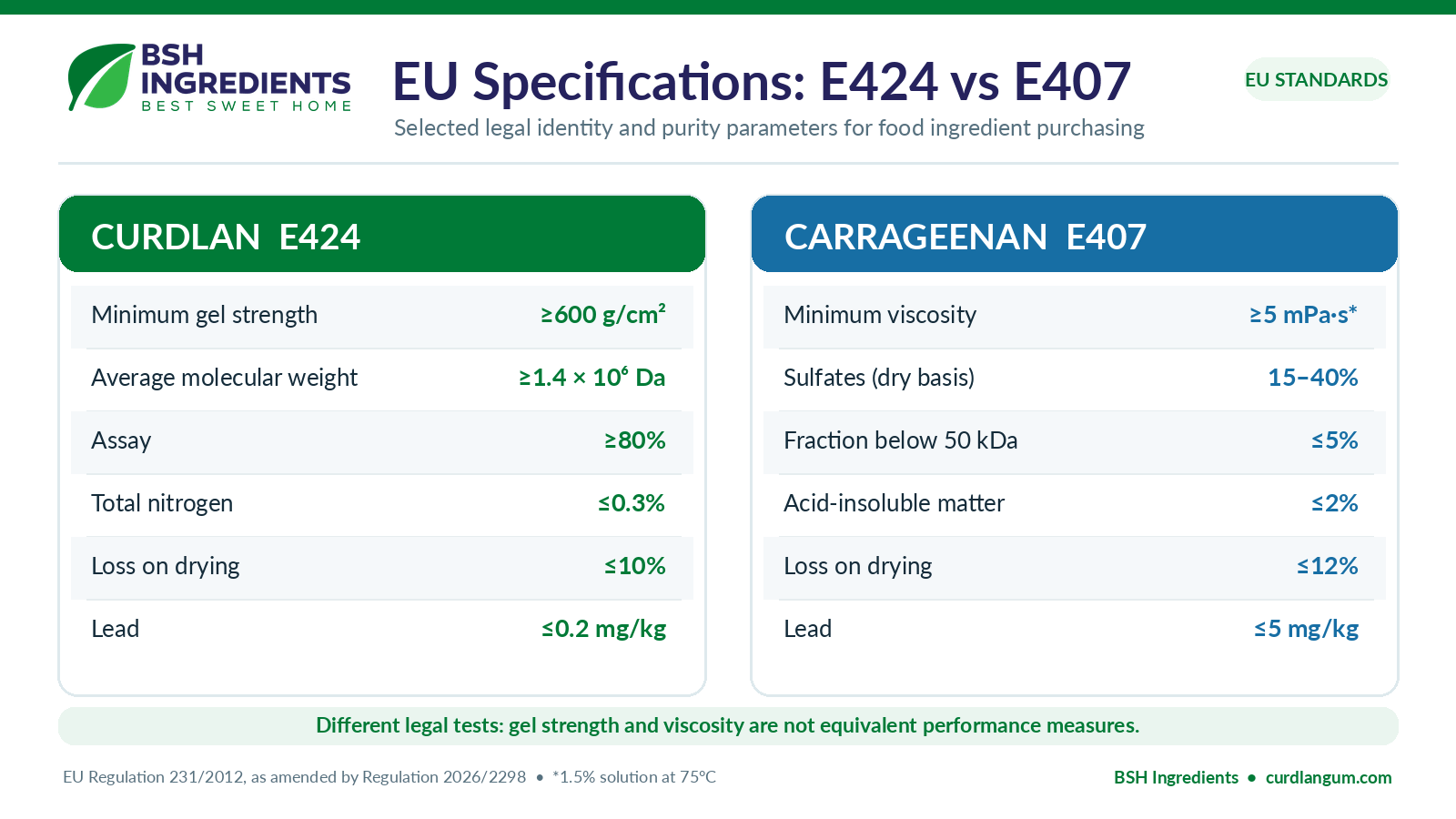
EU food additive specifications define the identity, purity, and minimum quality requirements that materials must meet.
Commission Regulation (EU) No 231/2012 contains these specifications. The E424 entry was introduced by Regulation (EU) 2026/2298.
The following tables summarize the legally specified parameters. They should not be confused with optional commercial grade targets or typical supplier COA results.
EU Curdlan E424 Specifications
Source: Annex II of Commission Regulation (EU) 2026/2298.
| Parameter | EU E424 specification |
|---|---|
| Additive name | Curdlan |
| Synonym | (1→3)-β-D-glucan |
| CAS number | 54724-00-4 |
| Chemical formula | H·(C₆H₁₀O₅)ₙ·OH |
| Production organism | Rhizobium radiobacter biovar 1 strain NTK-u |
| Average molecular weight | ≥1.4 × 10⁶ Da |
| Assay, calculated as anhydrous glucose | ≥80% |
| Appearance | White to nearly white, odorless or almost odorless powder |
| Water and ethanol solubility | Insoluble |
| Solubility in alkali | Passes prescribed test |
| Gel formation | Firm gel after specified heating and cooling test |
| Cupric tartrate precipitation | Passes test |
| pH, 1% aqueous suspension | 6.0–7.5 |
| Gel strength | ≥600 g/cm² |
| Loss on drying | ≤10% |
| Residue on ignition | ≤6% |
| Sulfated ash | ≤6% |
| Nitrogen | ≤0.3% |
| Arsenic (As) | ≤0.05 mg/kg |
| Lead (Pb) | ≤0.2 mg/kg |
| Methanol | ≤10 mg/kg |
| Total plate count | ≤1,000 CFU/g |
| Coliforms | Absent in 1 g |
| Escherichia coli | Absent in 1 g |
The regulation specifies an identity test in which a 2% aqueous suspension is heated in a boiling water bath for 10 minutes and cooled to form a firm gel.
It also describes a purification process involving alkaline dissolution and methanol crystallization. The production process and residual solvent levels must meet the authorized identity and purity requirements.
What do these specifications mean for buyers?
The EU establishes a minimum gel strength of 600 g/cm². Higher gel strength grades, such as 800 g/cm², may be available as commercial specifications.
A higher gel strength value does not automatically mean better performance in every application. Manufacturers should assess the required hardness, resilience, processing conditions, and measurement method.
For E424 procurement, the production organism, molecular weight, nitrogen content, residual methanol, and heavy metal limits are especially important.
See the Curdlan Gum Specifications Guide for more information on grades and gel strength.
EU Carrageenan E407 Specifications
Source: Commission Regulation (EU) No 231/2012.
| Parameter | EU E407 specification |
|---|---|
| Additive name | Carrageenan |
| Chemical identity | Sulfate esters of polygalactose |
| EINECS number | 232-524-2 |
| Source | Permitted red seaweeds |
| Appearance | Yellowish to colorless, coarse to fine, practically odorless powder |
| Galactose identification | Passes test |
| Anhydrogalactose identification | Passes test |
| Sulfate identification | Passes test |
| Solubility | Soluble in hot water; insoluble in alcohol under prescribed conditions |
| Viscosity | ≥5 mPa·s, 1.5% solution at 75°C |
| Loss on drying | ≤12% at 105°C for 4 hours |
| Sulfates, dried basis as SO₄ | 15–40% |
| Ash, dried basis at 550°C | 15–40% |
| Acid-insoluble ash | ≤1% |
| Acid-insoluble matter | ≤2% |
| Low-molecular-weight fraction below 50 kDa | ≤5% |
| Methanol, ethanol and propan-2-ol residues | ≤0.1%, singly or combined |
| Formaldehyde impurity | ≤5 mg/kg |
| Arsenic (As) | ≤3 mg/kg |
| Lead (Pb) | ≤5 mg/kg |
| Mercury (Hg) | ≤1 mg/kg |
| Cadmium (Cd) | ≤2 mg/kg |
| Total plate count | ≤5,000 colonies/g |
| Yeasts and molds | ≤300 colonies/g |
| Escherichia coli | Absent in 5 g |
| Salmonella spp. | Absent in 10 g |
Unlike the EU specification for curdlan, the E407 entry does not establish a universal minimum gel strength in g/cm².
Instead, it includes parameters such as viscosity, sulfate content, ash, insoluble matter, and the low-molecular-weight fraction.
These reflect carrageenan’s different chemistry and the range of commercial grades.
EU Processed Eucheuma Seaweed E407a Specifications
Processed Eucheuma seaweed is a separate food additive designation. Its specifications differ from those of refined carrageenan.
| Parameter | EU E407a specification |
|---|---|
| Additive name | Processed Eucheuma seaweed |
| Common abbreviation | PES |
| Raw material | Specified Eucheuma seaweeds |
| Processing | Hot aqueous alkaline treatment, washing, and drying |
| Appearance | Tan to yellowish powder |
| Algal cellulose | Up to 15% |
| Solubility | Cloudy viscous suspension in water |
| Viscosity | ≥5 mPa·s, 1.5% solution at 75°C |
| Loss on drying | ≤12% |
| Sulfates, dried basis | 15–40% |
| Ash, dried basis | 15–40% |
| Acid-insoluble ash | ≤1% |
| Acid-insoluble matter | 8–15% |
| Fraction below 50 kDa | ≤5% |
| Permitted solvent residues | ≤0.1%, singly or combined |
| Formaldehyde impurity | ≤5 mg/kg |
| Arsenic | ≤3 mg/kg |
| Lead | ≤5 mg/kg |
| Mercury | ≤1 mg/kg |
| Cadmium | ≤2 mg/kg |
| Total plate count | ≤5,000 colonies/g |
| Yeasts and molds | ≤300 colonies/g |
| E. coli | Absent in 5 g |
| Salmonella spp. | Absent in 10 g |
The most visible specification difference is acid-insoluble matter. E407 permits no more than 2%, while E407a specifies 8–15%, reflecting the different degree of processing.
E424 vs. E407: Key EU Specification Differences
| Quality parameter | E424 Curdlan | E407 Carrageenan |
|---|---|---|
| Polymer identity | β-1,3-glucan | Sulfated galactan |
| Molecular weight requirement | ≥1.4 × 10⁶ Da average | ≤5% fraction below 50 kDa |
| Gel strength | ≥600 g/cm² | No universal EU minimum stated |
| Viscosity | No universal EU minimum stated | ≥5 mPa·s |
| Nitrogen | ≤0.3% | No corresponding general limit stated |
| Loss on drying | ≤10% | ≤12% |
| Arsenic | ≤0.05 mg/kg | ≤3 mg/kg |
| Lead | ≤0.2 mg/kg | ≤5 mg/kg |
| Residual solvent requirement | Methanol ≤10 mg/kg | Listed alcohols ≤0.1% combined |
| Total plate count | ≤1,000 CFU/g | ≤5,000 colonies/g |
| E. coli | Absent in 1 g | Absent in 5 g |
These are different legal specifications for different food additives. The numerical limits should not be interpreted as a direct safety ranking.
For example, curdlan and carrageenan have different polymer identities, extraction or fermentation processes, exposure assessments, and impurity profiles.
For EU procurement, a COA should demonstrate compliance with the correct E-number specification. Additional customer requirements may be stricter than the legal minimum.
Curdlan vs. Carrageenan Safety, Labeling and Consumer Perception
What Does EFSA Say About Curdlan E424?
The European Food Safety Authority published its safety evaluation of curdlan in 2024.
EFSA assessed the proposed use of curdlan as a firming agent, gelling agent, stabilizer, and thickener.
Using a margin-of-exposure approach, EFSA concluded that there was no safety concern for the proposed uses and use levels, despite limitations in the available data.
This assessment supported the subsequent EU authorization.
What Does EFSA Say About Carrageenan E407?
EFSA re-evaluated carrageenan E407 and processed Eucheuma seaweed E407a in 2018.
The assessment did not identify concerns regarding genotoxicity or carcinogenicity from the available evidence, but it noted data uncertainties. EFSA therefore considered the existing group acceptable daily intake of 75 mg/kg body weight per day temporary.
A small randomized human study published in 2024 also investigated carrageenan exposure and insulin sensitivity.
The study found no statistically significant overall difference in insulin sensitivity between carrageenan and placebo. However, certain measures suggested unfavorable effects in overweight participants. Larger studies would be needed to clarify those findings.
Food manufacturers should distinguish emerging research questions from established regulatory conclusions.
Food-Grade Carrageenan vs. Poligeenan
Food-grade carrageenan is not the same as poligeenan, a degraded low-molecular-weight material used in certain research settings.
EFSA explicitly distinguishes poligeenan from authorized food-grade carrageenan.
It is therefore inaccurate to treat findings involving poligeenan as automatically applicable to commercial E407 carrageenan.
Carrageenan-Free and Clean-Label Formulation
Some food brands prefer carrageenan-free formulations for positioning or consumer preference.
Curdlan may offer a functional alternative in suitable applications. However, fermentation origin alone does not make an ingredient automatically eligible for a clean-label, dietary fiber, or prebiotic claim.
For both ingredients, labeling and claims must comply with applicable destination-market rules.
Cost and Bulk Supply: What Procurement Managers Should Compare
Curdlan vs. Carrageenan Price
Carrageenan has a mature international supply chain and is commonly used in high-volume food manufacturing.
Curdlan is a more specialized fermentation-derived ingredient. Its price may be higher, depending on grade, supply volume, and commercial conditions.
Buyers should request current quotations rather than rely on generic market price estimates.
Fermentation vs. Seaweed Supply Chains
Curdlan production depends on microbial strains, fermentation control, purification, drying, and quality testing.
Carrageenan production depends on red seaweed cultivation or harvesting, raw-material quality, extraction, and downstream processing.
The two supply chains face different risks.
Curdlan manufacturers must control fermentation consistency and polymer performance. Carrageenan suppliers must manage seaweed quality, species variation, environmental conditions, and extraction consistency.
How to Evaluate a Curdlan Gum Manufacturer
For bulk curdlan powder, procurement managers should evaluate the COA, gel strength, nitrogen content, purity, microbiological quality, heavy metals, manufacturing identity, and application performance.
For European customers, the EU-defined strain and full E424 specifications deserve particular attention.
Buyers should also request technical support, product samples, batch documentation, packaging information, and export-market compliance evidence.
BSH Ingredients: Bulk Curdlan Powder Manufacturer in China
BSH Ingredients is a China-based manufacturer and supplier specializing in bulk curdlan gum powder.
With a stated annual manufacturing capacity of 500 tons, BSH Ingredients focuses on fermentation-derived curdlan for food manufacturers, ingredient distributors, and industrial customers.
Our product portfolio includes different gel strength grades, including 600 g/cm² and higher-strength specifications, with technical support for application development and bulk purchasing.
We support manufacturers developing meat products, seafood analogues, noodles, plant-based foods, and other hydrocolloid-based formulations.
For EU-bound products, buyers should request the current batch COA and documentation needed to assess compliance with E424 requirements.
Learn more about high gel strength curdlan gum powder and our curdlan applications.
Frequently Asked Questions About Curdlan and Carrageenan
Is curdlan the same as carrageenan?
No. Curdlan is a neutral β-1,3-glucan produced by microbial fermentation. Carrageenan is a family of sulfated polysaccharides extracted from red seaweed. Their gel formation mechanisms and main applications differ.
What is the main difference between E424 and E407?
E424 curdlan can form heat-irreversible high-set gels. E407 carrageenan includes thermoreversible gelling types and non-gelling thickening types. They also have different EU specifications and conditions of use.
Can curdlan replace carrageenan in processed meat?
Curdlan can replace or complement carrageenan in selected processed meat formulations, but it is not a universal substitute. Meat protein composition, salt, water content, heating conditions, and finished texture determine performance.
Is curdlan better than carrageenan for plant-based meat?
Curdlan is often a strong choice for firm, chewy, heat-stable structures. Carrageenan may be preferable for softer textures or specific water-binding functions. Both should be tested in the complete plant-based protein formulation.
Which ingredient works better in noodles and pasta?
Curdlan has published evidence supporting improvements in the firmness, water distribution, and cooking stability of frozen cooked and sterilized noodles. Its heat-set gel behavior makes it a useful starting choice.
Can curdlan replace carrageenan in ice cream or chocolate milk?
Not as a straightforward 1:1 replacement. Carrageenan has specialized interactions with dairy proteins and performs at low concentrations. Curdlan does not offer identical dairy stabilization behavior.
What is the recommended dosage of curdlan compared with carrageenan?
There is no universal dosage ratio. Published curdlan studies include 0.5% in frozen cooked noodles and 0.5–1.5% in low-fat sausage systems. Carrageenan may be effective at approximately 0.025–0.035% in chocolate milk. All levels must be verified for the intended application and legal market.
Is curdlan heat-stable after retort sterilization?
High-set curdlan gels are known for resistance to remelting during high-temperature processing. However, performance depends on concentration, heating history, and the complete food matrix. Retort trials are necessary for commercial formulations.
What is the difference between kappa, iota and lambda carrageenan?
Kappa carrageenan typically forms firm, relatively brittle gels. Iota forms softer, more elastic gels. Lambda is primarily a non-gelling thickener. Their functions depend on sulfate structure and ionic conditions.
Can curdlan and carrageenan be mixed together?
Yes, they can be tested in blended hydrocolloid systems. However, synergy is not guaranteed. Some published experiments report poor freeze–thaw stability in certain curdlan–carrageenan mixtures.
Are curdlan E424 and carrageenan E407 both approved in the EU?
Carrageenan E407 is an established authorized EU food additive. Curdlan E424 becomes authorized on November 8, 2026, under Regulation (EU) 2026/2298, for specified categories and maximum use levels.
Is curdlan a carrageenan-free alternative?
Curdlan can be used to develop carrageenan-free formulations in suitable foods, particularly where heat-stable structure and chewy texture are needed. It is not a direct replacement for every carrageenan application.
Conclusion: Curdlan or Carrageenan — Which Should Food Manufacturers Choose?
Curdlan and carrageenan are valuable food hydrocolloids, but they solve different formulation problems.
Choose curdlan E424 when a product requires a firm, chewy, heat-stable structure. It is especially relevant to cooked meat, seafood analogues, noodles, and selected plant-based foods.
Choose carrageenan E407 when dairy stabilization, low-dose suspension, viscosity control, or thermoreversible gel texture is the priority.
For overlapping applications, compare both ingredients through controlled formulation trials. Consider performance, dosage, processing cost, and legal requirements.
The EU’s new E424 authorization creates additional options for European food manufacturers, but product-specific limits and ingredient specifications must still be verified.
Buy Bulk Food-Grade Curdlan Gum Powder from BSH Ingredients
BSH Ingredients supplies bulk curdlan powder for food processing and industrial formulation.
With a stated annual manufacturing capability of 500 tons, we offer different gel strength specifications, bulk supply, technical documentation, and support for product development.
Contact BSH Ingredients to request a free sample, Certificate of Analysis (COA), technical specifications, or a wholesale quotation for curdlan gum powder.
Scientific References and EU Regulatory Sources
EU Regulations and Official Assessments
- European Commission. (2026). Commission Regulation (EU) 2026/2298 of 16 October 2026 as regards the use of curdlan. https://eur-lex.europa.eu/eli/reg/2026/2298/oj/eng
- European Commission. (2012). Commission Regulation (EU) No 231/2012 laying down specifications for food additives. https://eur-lex.europa.eu/eli/reg/2012/231/oj/eng
- European Commission. (2026). Commission Regulation (EU) 2026/196 as regards the use of carrageenan and other food additives. https://eur-lex.europa.eu/eli/reg/2026/196/oj/eng
- EFSA Panel on Food Additives and Flavourings. (2024). Safety evaluation of curdlan as a food additive. EFSA Journal, 22, e8985. https://doi.org/10.2903/j.efsa.2024.8985
- EFSA ANS Panel. (2018). Re-evaluation of carrageenan (E 407) and processed Eucheuma seaweed (E 407a) as food additives. EFSA Journal, 16(4), 5238. https://doi.org/10.2903/j.efsa.2018.5238
Food Science and Formulation Studies
- Lee, C. H., & Chin, K. B. (2019). Evaluation of physicochemical and textural properties of myofibrillar protein gels and low-fat model sausage containing various levels of curdlan. Asian-Australasian Journal of Animal Sciences, 32(1), 144–151. https://doi.org/10.5713/ajas.18.0585
- Liu, H., Liang, Y., et al. (2022). Understanding the strengthening effect of curdlan on the quality of frozen cooked noodles: Studies on water characteristics and migration during cooking. International Journal of Food Science & Technology, 57(9), 5887–5896. https://doi.org/10.1111/ijfs.15910
- Gao, L., et al. (2024). Utilization of heat-induced curdlan gel to improve the cooking qualities of thermally sterilized fresh rice noodles. International Journal of Biological Macromolecules, 262, 129693. https://doi.org/10.1016/j.ijbiomac.2024.129693
- Texture stability of hydrogel complex containing curdlan gum over multiple freeze–thaw cycles. (2009). Journal of Texture Studies, 33(1), 126–139. https://doi.org/10.1111/j.1745-4549.2009.00364.x
- Wagner, R., et al. (2024). Carrageenan and insulin resistance in humans: A randomised double-blind cross-over trial. BMC Medicine, 22, 558. https://doi.org/10.1186/s12916-024-03771-8
- Food and Agriculture Organization of the United Nations. Production, properties and uses of carrageenan. https://www.fao.org/4/X5822E/x5822e05.htm
- U.S. Food and Drug Administration. 21 CFR §172.809 — Curdlan. https://www.ecfr.gov/current/title-21/chapter-I/subchapter-B/part-172/subpart-I/section-172.809