
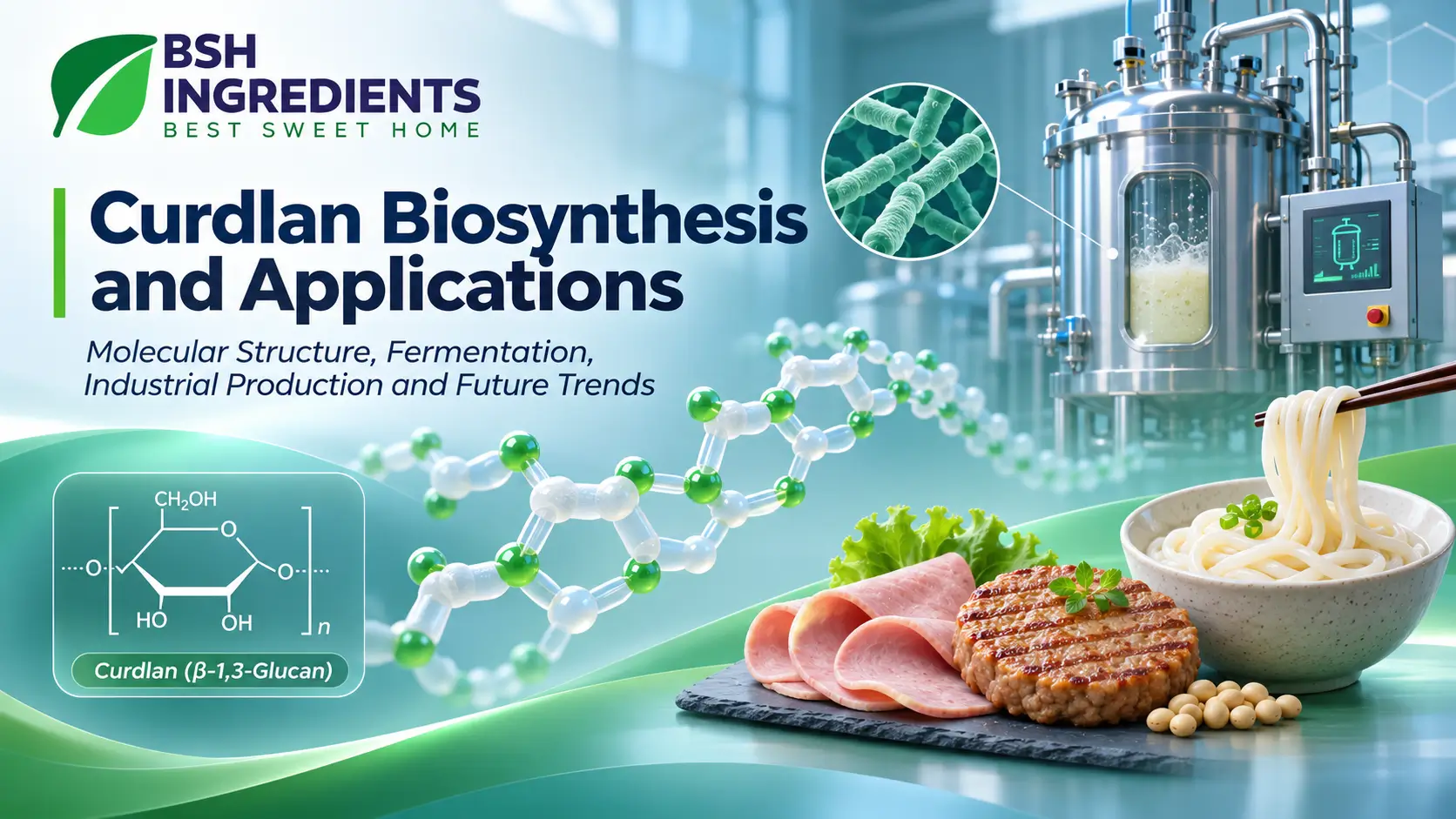
Scientific source: Zhang, S., Chen, P., Lin, Y., Yang, S., Yin, L., Li, J., Liu, B., Fu, X., Ju, J., Li, J., & Ma, Y. (2026). Biosynthesis and application of curdlan. Chinese Journal of Biotechnology, 42(9), 3945–3969. https://doi.org/10.13345/j.cjb.260384
Abstract
Curdlan is a water-insoluble, linear β-(1→3)-D-glucan synthesized by certain microorganisms, especially under nitrogen-limited growth conditions. Its distinctive molecular arrangement enables reversible low-set gels, heat-irreversible high-set gels, freeze–thaw stability, water retention, thickening, and structural reinforcement. These properties have long supported its use in foods and are now attracting interest in plant-based meat, novel protein foods, edible films, pharmaceutical carriers, wound dressings, and other functional materials. The 2026 review by Zhang and colleagues brings together research on molecular structure, applications, glucose-to-UDP-glucose metabolism, curdlan synthase, the crdASC cluster, nitrogen- and pH-sensitive regulation, strain development, metabolic engineering, and fermentation-process optimization. This expanded English resource retains that scientific scope while incorporating formulation data, industrial quality control, current food-additive rules, and commercial production considerations relevant to global manufacturers and ingredient buyers. In particular, the European Union’s 2026 authorization of curdlan as E 424 makes it essential to distinguish a polymer’s scientific identity from the production-strain and purity requirements applicable to a specific market.
Keywords: curdlan biosynthesis; curdlan applications; β-1,3-glucan; microbial fermentation; curdlan gum; curdlan gelation; crdASC; CrdS; fermentation yield; metabolic engineering; EU E 424; food hydrocolloids.
Introduction: Why Curdlan Biosynthesis and Applications Matter
Curdlan, also called a thermogel-forming β-glucan, is a high-molecular-weight microbial exopolysaccharide. Researchers first characterized curdlan-producing bacteria in work associated with Harada and colleagues in the 1960s [1–3]. Unlike plant- or seaweed-derived hydrocolloids, curdlan is formed by microbial biosynthesis rather than extraction from a botanical tissue. Its glucose residues form an essentially linear β-(1→3)-linked polymer that can assemble into highly ordered structures. That architecture explains much of curdlan’s ability to hold water and create firm, elastic gels [4,5].
Early industrial applications emphasized cooked foods, noodles, surimi, meat products, and related texture-sensitive formulations. The material has since been explored as a biocompatible platform for drug encapsulation, immune-related research, wound-care hydrogels, enzyme supports, adsorbents, and other engineered materials [6–9]. Research into plant-based foods and alternative proteins adds a further direction: curdlan can improve protein-network integrity, imitate selected properties of animal fat, retain cooking juices, and change flavor-release behavior [10–12].
Commercial production is not simple. Curdlan synthesis competes with the bacterium’s growth and cell-wall pathways; high polymer concentrations can encapsulate cells and restrict mass transfer; and fermentation performance is sensitive to nitrogen, pH, dissolved oxygen, carbon source, precursors, and metabolic signals. The following sections examine the molecular basis, applications, genetic regulation, strain engineering, and fermentation strategies in the original review, then connect those findings to commercial specifications and regulatory requirements.
1. Molecular Structure, Properties, Safety and Applications of Curdlan
1.1 Molecular Structure of Curdlan: β-1,3-Glucan, Degree of Polymerization and Triple Helices
Curdlan is a linear polysaccharide made from D-glucose residues linked through β-(1→3) glycosidic bonds. Its customary repeat-unit formula is (C₆H₁₀O₅)ₙ and its CAS registry number is 54724-00-4. The molar mass of one anhydroglucose repeat unit is approximately 162.14 g/mol; because curdlan is a polymer, its molecular weight depends on chain length rather than having one fixed molecular weight. The reviewed paper describes a representative polymer of roughly 300–500 glucose units, an average degree of polymerization near 450, and a representative relative molecular mass around 74 kDa [13]. These values describe particular literature material and should not be treated as a universal industrial specification or the EU E 424 minimum molecular weight.
Curdlan is essentially insoluble in water, ethanol, and many organic solvents. It can dissolve under strongly alkaline conditions—for example, solutions of sodium hydroxide above approximately pH 12—or in dimethyl sulfoxide under relevant experimental conditions [13]. Its molecular chains can adopt random-coil, single-helical, and triple-helical conformations. Strong hydrogen bonding within and among the helices contributes to the polymer’s low water solubility and structural persistence.
Alkali can disrupt hydrogen-bonded associations. A classical solution study described a helical conformation at NaOH concentrations below about 0.19 mol/L, transition toward disordered coils between about 0.19 and 0.24 mol/L, and extensive unfolding above roughly 0.24 mol/L [14]. Acid neutralization of an alkaline curdlan solution can allow polymer chains to reassociate into helices through hydrogen bonding and hydrophobic interactions [15]. These phenomena matter both to laboratory structural studies and to some downstream processing approaches.
BSH technical expansion — interpreting molecular weight: Molecular-weight figures can differ between research papers because polymer sources, purification, dissolution, analytical standards, and calculation methods differ. EU E 424 now defines an average molecular weight of at least 1.4 × 10⁶ Da for its specified additive. A scientific description of curdlan with a much lower representative molecular weight is therefore not proof that a commercial batch meets the EU specification. Buyers should request method-specific molecular-weight evidence where required, not assume that the name “curdlan” establishes regulatory equivalence. Source: Commission Regulation (EU) 2026/2298, Annex II.
1.2 Gelation, Rheology, Freeze–Thaw Stability and Water Retention
The physical performance of curdlan depends strongly on polymer chain length, chain conformation, concentration, and heat treatment. Longer chains generally have more opportunity to form intermolecular associations; the reviewed literature indicates that low-degree-of-polymerization material may fail to form a stable gel even in hot water [16]. In one described case, chains below a degree of polymerization of approximately 200 showed poor gel formation.
A defining feature is the presence of two temperature-dependent gel types. In the low-set region, commonly reported around 55–65 °C in commercial regulatory descriptions, an aqueous curdlan suspension can form a gel after heating and subsequent cooling. Such gels are thermally reversible under appropriate conditions. When the suspension is heated at 80 °C or higher, the chains can form more stable, heat-irreversible high-set gels. The resulting network is relatively firm and elastic. Gel strength generally increases with sufficiently strong heating and higher polymer concentration, although formulation conditions also matter [17,18]. The original review discusses a broader experimental low-temperature interval of approximately 55–80 °C; exact transitions are method- and system-dependent.
At elevated temperatures, rearrangement of curdlan into more stable triple-helical associations and a dense three-dimensional network helps explain the strong gel and its resistance to reheating. The network also binds water and can reduce large-scale damage during freezing and thawing. An early comparison reported relatively stable curdlan gel strength after freeze–thaw cycling, whereas carrageenan and agar showed notable losses; konjac gels became harder and less elastic under the tested conditions [19]. This does not imply that all curdlan-containing foods are freeze–thaw-stable without formulation work.
Low-Set vs High-Set Curdlan: Practical Comparison
| Property | Low-set curdlan gel | High-set curdlan gel |
|---|---|---|
| Typical formation | Heat suspension in moderate range, then cool | Heat aqueous suspension above ~80 °C |
| Thermal behavior | Reversible under suitable conditions | Relatively thermally irreversible |
| Typical formulation purpose | Soft, adjustable, elastic structure | Firm bite, structure retention and cooking tolerance |
| Processing sensitivity | Cooling history and matrix composition | Heating time, temperature, dispersion and concentration |
| Important caveat | “Low-set” does not necessarily identify a separate chemical ingredient | “High-set” is a gel behavior, not automatically a tested powder grade |
BSH technical expansion — gel strength is a test result, not an absolute material constant: A certificate’s “600,” “800,” or “1,000 g/cm²” strength value cannot be compared fairly unless sample concentration, suspension preparation, heat treatment, cooling, sample geometry, probe size, speed, and calculation method are comparable. Curdlan powder grades described as “600 grade” and “800 grade” refer to performance targets under stated methods. See BSH’s curdlan gel strength test and curdlan specifications.
1.3 Safety and Regulatory Background
Food-grade curdlan has a history of evaluation by international and national authorities. The U.S. FDA permitted specified curdlan uses in 1996 under 21 CFR §172.809, which names a specified fermentation organism and sets identity, purity, gel strength, and microbiological criteria [20]. China subsequently established a food-additive standard for curdlan, including GB 28304-2012. The Joint FAO/WHO Expert Committee on Food Additives (JECFA) evaluated curdlan and assigned INS 424 with an acceptable daily intake (ADI) “not specified,” which does not remove the need to follow local rules and appropriate use levels.
In September 2024, the European Food Safety Authority published its safety evaluation of proposed food-additive uses of curdlan. EFSA considered toxicological, dietary exposure, and related evidence, acknowledging limitations in the dataset but finding no safety concern for the proposed uses and levels using a margin-of-exposure approach [11]. The review discussed the fermentation polymer’s limited absorption and its metabolism by gut microorganisms, rather than establishing any clinical therapeutic effect.
2026 regulatory update — EU E 424: Commission Regulation (EU) 2026/2298, adopted October 16, published October 19, and entering into force November 8, 2026, authorized curdlan as E 424 in 34 specified food-category entries. Maximum levels and category-specific restrictions apply. It also established E 424 specifications in Regulation (EU) No 231/2012. The EU monograph identifies Rhizobium radiobacter biovar 1 strain NTK-u, stipulates an average molecular weight ≥1.4 × 10⁶ Da, assay ≥80%, gel strength ≥600 g/cm², nitrogen ≤0.3%, lead ≤0.2 mg/kg, arsenic ≤0.05 mg/kg, methanol ≤10 mg/kg, and other requirements. Not every curdlan-producing research strain or commercial batch is thereby EU compliant. The EU definition also describes a particular purification route that includes alkaline dissolution and methanol crystallization; this is a regulatory description, not a claim that every manufacturer uses the same process.
U.S. regulatory distinction: 21 CFR §172.809 provides nitrogen ≤0.2%, lead ≤0.5 mg/kg, assay ≥80%, and a specified U.S. gel-strength method/threshold. A batch tested only to a ≤0.3% nitrogen specification should not be described as compliant with the U.S. nitrogen maximum unless the actual batch result demonstrates ≤0.2%. U.S., EU, JECFA, and Chinese requirements should be checked independently against the latest official texts.
1.4 Applications of Curdlan in Food and Beyond
Curdlan has been studied as a gelling agent, thickener, stabilizer, water-retention aid, fat replacer, film former, and structural component. The review groups its applications into grain and noodle products, processed meat and fish, dairy and beverages, food packaging, plant-based meat and other protein alternatives, pharmaceuticals, and industrial materials [21,22]. Individual results depend on the system and should not be mistaken for standard commercial addition rates.
1.4.1 Rice Noodles, Wheat Noodles and Frozen Noodles
Curdlan chains interact with water, starch, and proteins. In wheat-based doughs they can occupy or reinforce the gluten-associated matrix; in starch-rich systems they can contribute to continuous structures that reduce cooking loss and improve resistance to breakage [23]. A rice-noodle study reported that 0.4–0.6% curdlan improved hardness, elasticity, and chewiness, reduced breakage and cooking loss, and delayed staling during storage under the studied processing conditions [24]. In fresh wet noodles, 0.5% curdlan increased hardness, elasticity, chewiness, and tensile strength while reducing stickiness [25]. These changes can make noodles more stable during cooking and improve sensory performance.
Curdlan’s freeze–thaw properties are especially relevant to frozen cooked noodles. Studies report denser structures, improved water uptake, reduced ice-crystal injury, and better maintenance of cooking properties during frozen storage [26]. In all cases, flour or starch composition, hydration, salt, processing temperature, freezing protocol, and dosage can change the outcome.
BSH technical expansion: A sensible formulation screen is to compare control, low-dose, medium-dose, and high-dose trials rather than adopt one study level without verification. Measure cooking loss, broken strands, firmness, tensile strength, water retention, and reheating quality. Related application guide: Curdlan for noodles.
1.4.2 Processed Meat, Sausages, Surimi and Seafood
In meat and fish products, curdlan can occupy spaces in protein networks and form hydrogen-bonded associations that reinforce structure and improve retention of water and oil. This can reduce voids, improve slicing and juiciness, and help stabilize products during cooking. A Frankfurter sausage experiment reported that 0.3% curdlan reduced cooking loss and improved emulsification and texture, especially where added water challenged the product matrix [27]. A myosin/surimi-related experiment found that 1% curdlan improved gel strength, water retention, and freeze–thaw stability [28].
Curdlan has also been used as a fat-texture mimetic. Its suspension displays properties resembling the yield behavior and body of certain fats: a solid-like response at rest and shear-thinning under deformation. An older study observed that fat-free sausages made with a curdlan-based system showed viscoelastic creep behavior close to sausages containing 20% fat under the test conditions [29]. This is an example of partial physical mimicry, not proof of identical taste, nutritional profile, or consumer acceptance in all formulas.
BSH technical expansion: Evaluate gel structure separately from flavor, protein binding, salt/phosphate effects, water addition, and thermal processing. Curdlan is not a universal substitute for fat or for all binder systems. For meat processors, key trials include cooking yield, expressible moisture, puncture force, slice integrity, sensory juiciness, freeze–thaw stability, and cost per finished kilogram. Related page: Curdlan for sausages.
1.4.3 Dairy, Yogurt and Protein Beverages
In yogurt and fermented dairy, curdlan can affect the microstructure of protein gels. Research has reported improvements in viscosity and consistency, resistance to shear, and reduced whey separation [30]. For aerated plant-protein beverages, a study cited in the review identified a combination of 0.012% gellan gum and 0.004% curdlan that performed well in the particular test system [31]. The reported synergy improved resistance to particle sedimentation and heat-processing instability. These unusually low concentrations should not be extrapolated to unrelated beverages without examining the original method and formulation.
Because β-glucans are of dietary-fiber interest, researchers have also considered curdlan in functional-food design. However, research on general dietary fibers and satiety [32] does not itself establish a curdlan-specific satiety or disease-reduction claim. Claims must be supported and authorized for the target market.
1.4.4 Edible Films and Food-Packaging Materials
Curdlan can form relatively uniform, flexible films when prepared with suitable conditions and companion polymers. Researchers have examined curdlan–xanthan films, reporting structural complementarity, mechanical strength, moisture-barrier behavior, and selected solubility characteristics [33]. Other combinations include chitosan, tea polyphenols, and related bioactive components. In studies of chilled meat, the inclusion of tea polyphenols in curdlan/chitosan films improved barrier and antioxidant properties and showed activity against selected bacteria [34]. In a cherry-tomato model, water-soluble chitosan/curdlan coatings were investigated for inhibiting Botrytis cinerea. A reported minimum inhibitory concentration was 140.625 μg/mL, with spore inhibition of 82.17% under specified laboratory conditions [35].
These findings point to possibilities for packaging and coatings, but commercial food-contact suitability, shelf-life claims, antimicrobial claims, migration testing, and environmental disposal performance require separate validation.
1.4.5 Plant-Based Meat, Alternative Proteins and Fat Mimics
This is among the fastest-developing research areas described by the review. Plant-derived and fermentation-derived proteins often struggle to reproduce the integrated tenderness, elasticity, water/oil retention, and juicy bite of animal tissue. Curdlan’s heat-triggered gelation allows it to form interpenetrating networks with plant proteins and to alter the distribution and release of water, lipids, and flavors [36].
A soy-protein isolate study reported 5.06% greater water-holding capacity and a 240.51% increase in gel strength with particular curdlan incorporation and processing conditions [37]. Another study combined soy protein isolate and curdlan into an emulsion gel. With only 10% oil, selected texture metrics were statistically similar to those of pork backfat in the study’s comparisons [38]. Composite systems containing curdlan and chitin or cellulose nanofibers held as much as 50% oil while retaining strong mechanical behavior; a shear elastic modulus exceeding 20 kPa was reported for certain preparations [39].
A pea-protein/curdlan double-layer interface was used to make a low-oil emulsion gel whose viscoelastic response approached higher-fat materials. In simulated digestion, the research reported free fatty acid release of 22.1% under the particular test conditions [40]. Researchers have also applied curdlan in 3D printing: faba-bean-based prawn mimics improved their post-steaming chewiness, while a composite of soy and chickpea protein containing 6% curdlan formed a two-phase gel with egg-white-like characteristics in a different model [12,41].
BSH technical expansion: These papers point toward multiple target architectures: structured lean-meat analogues, fat-like inclusions, plant-based seafood, egg-white analogues, and 3D-printable protein inks. Formulators should first identify the product’s target response—fracture force, elastic recovery, oil retention, melt resistance, chewiness, or thermal shape retention—then optimize curdlan with the protein type, salt environment, shear history, and heating profile. The published percentages are experimental formulations, not interchangeable industrial recommendations.
1.4.6 Drug Delivery and Functional Biomedical Materials
The reviewed literature examines curdlan and modified derivatives as possible drug carriers because their polymer networks can be biocompatible and controllable. Chemically modified curdlan has been explored for encapsulating salbutamol, prednisolone, and other active agents in controlled-release systems [42]. One study developed cholesterol-conjugated carboxymethyl curdlan that self-assembled into nanoparticles able to carry epirubicin and exhibit pH-sensitive release behavior; pharmacokinetic and tissue-distribution effects were studied in experimental systems [43]. These systems are biomedical research platforms, not established uses of standard food-grade curdlan as medicines.
In wound-care materials, porous curdlan hydrogels can absorb liquid while maintaining a moist interface. The review describes fluid uptake of around ten times the material’s own volume in certain formulations and summarizes preliminary in-vitro findings involving fibroblast viability and proliferation [44]. Clinical effectiveness, sterility, medical-device classification, and product approvals require independent evaluation.
1.4.7 Immunomodulation and Modified Curdlan Derivatives
Curdlan’s β-1,3-glucan structure can be recognized by innate immune receptors, including Dectin-1 and some Toll-like receptor-linked signaling systems. Researchers have investigated macrophage and dendritic-cell responses, cytokine production, and potential immunological applications [45,46]. A mouse-model study explored possible effects on high-fat-diet-induced cognitive deficits through gut-microbiota and brain-related pathways [47]; such findings do not establish a human cognitive-health benefit.
Sulfated curdlan derivatives are of research interest because chemical modification changes water solubility, charge, and biological interaction. Studies have examined antiviral interactions, including inhibition of HIV infection in vitro [48]; antigen-adjuvant potential in experimental antitumor vaccination [49]; and anticoagulant behavior mediated differently from that of heparin, including heparin-cofactor-II-related pathways [50]. Curdlan-functionalized nanoparticles have also been investigated for experimental host-directed tuberculosis therapy and autoimmune liver-injury models [51,52]. None of these results makes ordinary curdlan gum an approved antiviral, anticoagulant, or cancer treatment.
1.4.8 Enzyme Immobilization, Heavy-Metal Sorption, Mineral Processing and Construction
Curdlan presents numerous hydroxyl groups that can be functionalized to support immobilized enzymes. Epoxide activation, often using epichlorohydrin in laboratory work, can enable covalent coupling to enzymes through nucleophilic functional groups. Studies have reported immobilized pancreatic lipase with a 58.7% binding rate and very low observed activity loss under the described conditions [53]. Other studies developed chemically modified curdlan microspheres for protein interactions and calcium-chelated magnetic microspheres for enzyme immobilization and recovery [54,55].
Curdlan/activated-carbon composites have been tested for heavy-metal removal. In one reported system the Cu(II) adsorption capacity reached 161 mg/g, compared with 19.5 mg/g for a referenced gellan-gum material under the experimental comparison [56]. In mineral processing, curdlan has been studied as a selective depressant for separating fluorite from calcite and in reverse flotation of quartz and hematite, where surface adsorption changes particle hydrophilicity and collector response [57,58]. Research also mentions applications in self-compacting concrete, where suitable polymer systems can modify viscosity, reduce segregation, and influence pumpability [59].
Important materials distinction: These are diverse experimental applications with different grades, processing histories, and sometimes chemically modified derivatives. They do not imply that food-grade curdlan powder is automatically suitable for pharmaceutical, environmental, or construction use without separate technical qualification.
2. Biosynthetic Pathways and Regulatory Mechanisms of Curdlan
2.1 Microbial Biosynthesis: Glucose Uptake, UDP-Glucose, Polymerization and Secretion
Microbial curdlan biosynthesis can be understood as a coordinated sequence of four processes: formation of the nucleotide-sugar precursor UDP-glucose, assembly of β-(1→3)-linked glucose residues into a polymer, secretion of the newly formed polysaccharide, and regeneration of the energy-carrying nucleotides required to sustain production. These reactions occur against the background of ordinary cell growth and central-carbon metabolism, so the bacterium must allocate carbon and energy between building biomass and producing extracellular polysaccharide [10,60–63].
The initial reaction is glucose uptake. Intracellular glucokinase (Glk) converts glucose to glucose-6-phosphate (G6P). Phosphoglucomutase (ExoC) converts G6P into glucose-1-phosphate (G1P), and UDP-glucose pyrophosphorylase (GalU) catalyzes formation of UDP-glucose (UDP-Glu) from G1P and UTP. The cell can then use UDP-Glu as the activated glucose donor for chain elongation. The review’s biosynthetic pathway also places the Embden–Meyerhof–Parnas (EMP) glycolytic pathway, pentose-phosphate pathway (PPP), Entner–Doudoroff (ED) pathway, tricarboxylic-acid (TCA) cycle, and respiratory electron transport network around this UDP-glucose branch [60–63].
Curdlan polymerization takes place at the inner-cell-membrane interface. The central biosynthetic locus is the crdASC gene cluster. Its component crdS encodes CrdS, a membrane-associated curdlan synthase responsible for building β-(1→3) glycosidic bonds. The protein has seven predicted transmembrane segments and an intracellular catalytic region containing a characteristic D,D,D35QxxRW sequence motif associated with substrate binding and catalysis [64–67]. The other proteins, CrdA and CrdC, appear to be involved with transmembrane or periplasmic handling of the developing polymer, although their precise roles remain less firmly established. CrdA has been proposed as an inner-membrane-associated factor and CrdC as a periplasmic protein [17,65].
The nascent polymer must travel from its membrane-associated site of synthesis toward the exterior of the cell. During this journey, the β-1,3-glucan may be affected by extracellular or periplasmic glucanases, including ExsH and ExoK, while protection by tetratricopeptide-repeat (TPR) proteins and movement through a β-barrel outer-membrane pore have been proposed as parts of the export process [66,68]. This creates a major bioprocess trade-off: the organism needs to produce and export a high-molecular-weight polymer, but the polymer can itself interfere with material exchange when it accumulates densely around cells.
Curdlan synthesis also requires a substantial supply of UTP and ATP. UTP is consumed during formation of the activated sugar donor, while its regeneration draws on nucleotide metabolism. The original review highlights PyrH, a uridylate kinase, and Ndk, a nucleoside diphosphate kinase, among the enzymes that help regenerate UTP from lower-phosphorylated nucleotides, using ATP equivalents. This energetic demand links curdlan productivity to central metabolism and respiration.
Not all glucose is available for curdlan. G6P and other intermediates supply competing pathways such as lipopolysaccharide and peptidoglycan biosynthesis, which are essential for cell-envelope growth. For instance, Pgi channels G6P to fructose-6-phosphate and GlmS contributes to glucosamine-6-phosphate production for cell-envelope constituents [61]. Successful strain engineering must preserve viable cell physiology while directing more carbon to the target polymer.
Conceptual Curdlan Biosynthesis Flow
Glucose → Glucose-6-phosphate (Glk) → Glucose-1-phosphate (ExoC) → UDP-glucose (GalU + UTP) → β-(1→3)-glucan polymerization (CrdS/crdASC) → Membrane transport and secretion → Extracellular curdlan.
Associated competing/controlling systems: EMP/PPP/ED/TCA pathways; ATP–UTP regeneration; lipopolysaccharide and peptidoglycan synthesis; β-1,3-glucanase activity; export proteins; nitrogen status; pH; dissolved oxygen; and second messengers.
Figure guidance: Recreate an original bilingual-to-English pathway illustration inspired by the scientific facts in Figure 3 (original-paper page 9). Do not copy the journal figure or imply that the simplified pathway includes every reaction.
2.2 Regulation of Curdlan Biosynthesis by Nitrogen, pH and Intracellular Signals
Curdlan does not accumulate at a constant rate under all culture conditions. Nitrogen availability, external pH, phosphate availability, dissolved oxygen, and global cellular regulatory networks affect the transition between cell growth and polysaccharide production [69]. The review devotes considerable attention to nitrogen response, pH response, and intracellular second messengers. Its Figure 4 (original-paper page 10) maps those networks.
2.2.1 Nitrogen Limitation and NtrB–NtrC Signaling
Nitrogen depletion is an important signal for curdlan accumulation. When available ammonium becomes exhausted, cellular glutamine levels decline. A nitrogen-sensing protein, GlnD, responds to this state and promotes uridylylation of PII-family signaling proteins GlnB and GlnK [70]. Changes in these regulatory proteins can release inhibition of the histidine kinase NtrB, allowing NtrB to phosphorylate the transcriptional regulator NtrC. Activated NtrC works with sigma-factor-dependent RNA polymerase, including RpoN (σ⁵⁴), to regulate genes associated with nitrogen assimilation, core metabolism, and curdlan biosynthesis [70–75].
In one transcriptional analysis cited in the review, expression of the curdlan synthase operon crdASC increased by more than 100-fold under a nitrogen-limited condition [70]. This shows how central regulatory systems can produce an unusually strong shift toward polymer synthesis without assuming that all nitrogen-starved strains behave in precisely the same way.
The NtrY–NtrX system is a related two-component response pathway. Studies in nitrogen-fixing bacteria first characterized this family, and work with Agrobacterium species suggests possible cross-regulation with NtrB–NtrC [76,77]. Under nitrogen limitation in Agrobacterium sp. ATCC 31749, the review reports upregulation of ntr genes, with ntrB/ntrC changes approximately twice those of ntrX/ntrY in one dataset [75]. Genetic disruption studies showed loss of productivity when components of these systems were disturbed, but the phenotypes also suggested that NtrC can receive signals from more than one upstream regulator [71].
A separate screen identified a previously uncharacterized two-component system involving gene0716–gene0717. Its deletion altered expression of roughly 70 genes associated with energy generation, ribosomes, ion handling, acetylation, motility, and cell-envelope functions, while producing curdlan with poorer gel-strength and fracture-displacement performance [78]. This underscores that regulation can affect polymer quality, not just the grams produced.
2.2.2 Acidic pH and ExoR–ChvG/ChvI Signaling
A typical two-stage strategy is to allow cell growth around pH 7.0, then shift the fermentation toward pH 5.5 when ammonium is depleted and the cells enter a polysaccharide-production stage [79]. The original review identifies this combined nitrogen/pH control as a commonly studied route to higher curdlan accumulation.
At more neutral pH, the periplasmic protein ExoR can suppress signaling through the membrane histidine kinase ChvG. In an acidic environment, proteolytic processing of ExoR can reduce that suppression, allowing ChvG to autophosphorylate and transfer a phosphate group to ChvI. Activated ChvI can then regulate target genes related to extracellular polysaccharide formation and central metabolism, including genes such as exoP, exoQ, exoF, and chvG itself [80–82]. Genetic studies of ExoR disruption also report shifts in carbon metabolism, TCA-cycle activity, electron transport, and nucleotide regeneration, all potentially favorable to the energy-intensive biosynthesis process [80]. ExoX is another reported negative regulatory element connected with this pH-responsive pathway, although its full mechanism has not been established.
BSH technical expansion — production interpretation: Switching pH is an example of metabolic-phase control: early fermentation conditions maximize healthy biomass; later conditions favor polymer production. The exact set points must be validated for each strain, medium, vessel size, and control strategy. Published experimental pH values should not be represented as confidential BSH operating settings or as mandatory process specifications for every curdlan factory.
2.2.3 c-di-GMP, (p)ppGpp and Stringent-Response Regulation
The intracellular second messenger cyclic di-GMP (c-di-GMP) influences extracellular polysaccharide behavior in many bacteria [83]. Its level is controlled by diguanylate cyclases bearing GGDEF domains and phosphodiesterases bearing EAL or HD-GYP-associated functions. The genome of Agrobacterium sp. ATCC 31749 was predicted to contain many GGDEF-domain proteins. In an experiment summarized by the review, deletion of AGRO_3967 reduced curdlan-producing ability by about 50%, indicating the importance of this signaling network. Interaction of c-di-GMP with CrdS or a CrdA–CrdS complex has been proposed as a possible activation mechanism, but the precise binding and structural mechanism was not fully established by the cited evidence [70,83,84].
Another important response system is (p)ppGpp, referring to guanosine tetra- and pentaphosphate alarmones involved in bacterial nutrient stress. The enzymes encoded by relA and spoT participate in their synthesis and turnover. When both relevant activities were disrupted in experimental work, curdlan formation could be abolished [70]. The review discusses two possible routes: regulation of Ppx exopolyphosphatase and polyphosphate accumulation, and effects on gene transcription and translation. A transcriptional regulator CrdR has also been proposed as a downstream route that may support the biosynthesis operon [85,86].
Potential contributions from other signaling elements have not yet been fully mapped. Bioinformatic studies identified candidate oxygen-responsive FixL–FixJ elements, global regulators FnrN and NolR, phosphate-related PhoR–PhoB systems, and LuxR–LuxI-type quorum-sensing regulators such as TraI and TraR [62,87,88]. Their potential participation should be described as a research direction when direct functional evidence remains incomplete.
2.2.4 Summary: Regulation Is a Quality-and-Yield Problem
The combined regulatory model is not simply “less nitrogen equals more curdlan.” Product accumulation reflects a balance among stress responses, precursor availability, energy regeneration, polymer synthase expression, hydrolytic degradation, membrane secretion, and broth transport. Altering one gene may improve gel strength but lower titer; changing culture conditions may improve titer yet change molecular weight. An industrial development program therefore has to optimize titer (g/L), volumetric productivity (g/L/h), conversion yield (g polymer/g substrate), polymer molecular characteristics, and gel performance together, rather than focusing on titer alone.
3. Advances in Curdlan Production Technology
3.1 Screening, Isolation and Mutagenesis of Curdlan-Producing Strains
The discovery of naturally curdlan-producing bacteria and the selection of improved mutants have been central to the field since the original work on Alcaligenes faecalis var. myxogenes strain 10C3K in 1966 [2,3]. Isolation studies have recovered possible curdlan producers among Agrobacterium, Rhizobium, Bacillus, Pseudomonas, Paenibacillus, Priestia, and Enterobacter taxa, using glucose, sucrose, or other carbon sources [89–103]. The suitability of a species for an approved food additive is an additional issue and cannot be inferred simply from the presence of a curdlan-like polymer.
Classical strain-development methods include ultraviolet irradiation, cobalt-60 exposure, atmospheric and room-temperature plasma (ARTP), low-energy ion treatment, and chemical mutagenesis. Commonly reported mutagens or screening agents include NTG/MNNG, 8-methoxypsoralen, diethyl sulfate, ethyl methanesulfonate, lithium chloride, and 5-fluorouracil. Aniline-blue staining has frequently been used to screen for β-glucan-producing colonies. The review also mentions a selective screening strategy in which iodine-generating reagents suppress acid-producing organisms, increasing the chance of finding promising curdlan-producing isolates [104].
Table 1. Curdlan-Producing Strains and Selection Strategies Reported in the 2026 Review
| Species or group | Strain (parent, if reported) | Selection strategy | Reported titer (g/L) | Year / source |
|---|---|---|---|---|
| Agrobacterium radiobacter | IFO12665 | Culture from Institute of Fermentation, Osaka | 0.15 | 1977 [89] |
| A. radiobacter | L-15 (As.1.150) | Successive UV, Co-60 and plasma mutagenesis | 33.5 | 2001 [90] |
| A. radiobacter | G-1 (DT-7) | UV plus 8-MOP mutagenesis | 47.2 | 2004 [91] |
| A. radiobacter | A-15 (FD3-5) | UV, DES and ARTP combination | 20.6 | 2018 [92] |
| Agrobacterium sp. | HX1126 | Soil isolation | 21.4 | 2015 [93] |
| Agrobacterium sp. | 0.5-50 (714) | Sequential UV, NTG, UV-LiCl and UV-5-FU | 30.0 | 2017 [94] |
| Agrobacterium sp. | 16# (HS615) | NTG mutagenesis | 53.1 | 2017 [95] |
| Agrobacterium sp. | CGMCC 11546 (ATCC 31749) | UV mutagenesis | 41.24 | 2020 [66] |
| Agrobacterium sp. | R259 (ATCC 31750) | MNNG mutagenesis | 76 | 2003 [96] |
| Agrobacterium sp. | NTG160615-05 (CAO3) | Successive UV and NTG | 53.2 | 2017 [97] |
| Rhizobium radiobacter | CGMCC 12099 | Isolation from moist soil | 24.8 | 2016 [98] |
| Bacillus cereus | PR3 | Soil isolation | 20.88 | 2018 [99] |
| Pseudomonas sp. | QL212 | Soil isolation | 5.92 | 2016 [100] |
| Paenibacillus sp. | NBR-10 | Sandy-soil isolation | 4.82 | 2016 [101] |
| Priestia aryabhattai | BMS3 | Soil isolation | 0.5 | 2025 [102] |
| Enterobacter cloacae | RSW2n | Red-seaweed isolation | 11.5 | 2023 [103] |
Source: research table translated and reformatted from Zhang et al. (2026), Table 1, p. 3956. Titers reflect different organisms and experimental conditions; they do not establish a standardized ranking of commercial manufacturing performance.
Some isolated or engineered organisms use substrates beyond conventional glucose and sucrose. The review mentions marine isolates able to use starch, soil-derived strains using lactose, and engineered bacteria capable of using dextrin or cellobiose [93,103,108,109]. This broadening of carbon-source flexibility could reduce costs in selected settings, but raw-material quality, conversion efficiency, impurity profiles, and food-regulatory acceptability remain critical.
3.2 Metabolic Engineering of Curdlan-Producing Bacteria
As complete genomes and genetic tools became available, researchers moved from broad mutagenesis to targeted control of specific biosynthetic genes, degradation systems, precursor pathways, and global regulators. The main intervention categories are: increase polymerization capacity; reduce glucan degradation; redirect carbon and energy toward UDP-glucose; alter negative regulators; expand usable substrates; and construct more precise gene-editing tools [105–115].
Increasing the expression of the crdASC biosynthetic cluster is a direct strategy. In Agrobacterium tumefaciens C58, replacing a native promoter with the stronger PphaP promoter enabled detectable curdlan production in a previously nonproducing background, but the reported titer was only 0.2 g/L [105]. Overexpression of a positive regulator crdR in ATCC 31749 increased the reported titer to 7.8 g/L, approximately 38% higher than the corresponding comparator [86]. Other work showed that different degrees of expression of crdS, crdA, crdC, and crdR could affect yield [111]. Stronger expression does not guarantee better commercial performance, because all steps and energy supplies need to remain balanced.
The glucanases ExoK and ExsH are logical targets for reducing polymer breakdown. Disrupting exoK in one strain reduced titer by 10.4% but increased reported gel strength by 17.6% and molecular weight by 53% [106]. In another strain, deleting exoK alone or both exoK and exsH reduced total titer but could improve gel strength and molecular weight; one double-deletion experiment reported 41% higher gel strength and 14% higher molecular weight [66]. This is a particularly important practical finding: high polymer yield and high gel strength may compete. Dense, high-molecular-weight polysaccharide may encapsulate producer cells, reduce oxygen and nutrient transport, and ultimately restrain accumulation.
Other targets include genes for glucokinase (glk), nucleoside diphosphate kinase (ndk), cellulose-synthase-related functions (celA), phosphatidylserine synthesis (pssA), and extracellular-polysaccharide regulators (mucS). Fine adjustment of their expression sometimes improved curdlan titer, while excessive expression reduced it [111]. Nitrogen assimilation and pH regulation have likewise been addressed. Overexpressing glnA in a tested strain produced 38.17 g/L, approximately 18% higher than the control [110]. Disrupting negative regulators exoR or exoX yielded approximately 24.79 g/L and 24.4 g/L respectively in one experimental background, with improvements in glucose conversion [80,107].
Table 2. Genetic Modifications and Curdlan Titers Reported in the Review
| Host strain | Modification | Reported titer (g/L) | Reference |
|---|---|---|---|
| A. tumefaciens C58 | Express crdASC under PphaP promoter | 0.2 | [105] |
| Agrobacterium sp. ATCC 31749 | Overexpress crdR | 7.8 | [86] |
| Agrobacterium sp. ATCC 31749 | Delete exoK | 32.6 | [106] |
| Agrobacterium sp. ATCC 31749 | Delete exoR | 24.79 / 23.9 (different reports) | [80,107] |
| Agrobacterium sp. ATCC 31749 | Delete exoX | 24.4 | [80] |
| Agrobacterium sp. ATCC 31749 | Introduce α-amylase gene | 30.4 | [108] |
| Agrobacterium sp. ATCC 31749 | Introduce cellobiose phosphorylation pathway | 25.9 | [109] |
| Agrobacterium sp. CGMCC 11546 | Delete exsH | 41.24 | [66] |
| Agrobacterium sp. CGMCC 11546 | Delete both exoK and exsH | 34.23 | [66] |
| Agrobacterium sp. CGMCC 11546 | Overexpress glnA | 38.17 | [110] |
Source: Zhang et al. (2026), Table 2, p. 3957. These are study-specific titers with different baselines and experimental conditions.
3.2.1 Broadening Carbon Sources: Dextrin and Cellobiose
One engineered strain expressing an α-amylase from Xanthomonas campestris was able to process dextrin as a fermentation substrate. A reported experiment produced 30.4 g/L curdlan, while an optimized dextrin fed-batch fermentation reached 66.7 g/L after 108 hours, with a conversion yield of 0.56 g/g and volumetric productivity of 0.62 g/(L·h) [108]. Another strategy introduced a cellobiose-phosphorylation pathway, resulting in a reported 25.9 g/L and identifying useful constitutive and inducible promoters for future strain development [109].
3.2.2 Genome Editing and Cell-Free Enzymatic Routes
Researchers have developed more precise tools for genetically modifying Agrobacterium. A Target-AID CRISPR-associated cytosine base-editing system enabled targeted mutations without conventional double-strand breaks and was reported to achieve ≥80% editing efficiency in one studied setting [112]. Another method integrated Agrobacterium-adapted recombineering with CRISPR/Cas9 and improved editing efficiency to >90% with longer homology arms, including replacement of curdlan-related genetic targets [113]. These methods may accelerate strain optimization, but their production and regulatory implications depend on the organism and manufacturing context.
Noncellular synthesis is also being investigated. In one study, membrane synthase CrdS was expressed in a wheat-germ cell-free system and reconstituted in lipid-associated environments, enabling limited curdlan synthesis on the milligram scale [114]. Other glycosynthase or glycoside-phosphorylase approaches can create β-(1→3)-linked glucose oligomers using activated sugar donors [115]. However, these products often have a degree of polymerization below approximately 30 and should not be confused with ordinary high-molecular-weight curdlan gum. The need for nucleotide substrates, specialized membranes, or enzyme regeneration limits current economic practicality.
3.3 Optimizing Fermentation Media, Oxygen Transfer, Feeding and Scale-Up
Fermentation performance depends on both the microbial strain and its surroundings. The reviewed literature compares carbon-source selection, nitrogen type and feed control, inorganic salts, phosphate, uracil, pH switching, dissolved oxygen, mixing, product encapsulation, and staged fermentation. The studies reported a wide range of titers, from single digits to more than 90 g/L. Each should be understood within its stated fermentation duration and reactor configuration rather than as a directly comparable industry benchmark [60,79,98,116–148].
Table 3. Experimental Fermentation Optimization and Reported Curdlan Titers
| Strain | Optimized factor or strategy | Reported titer (g/L) | Source |
|---|---|---|---|
| Bacillus sp. SNC07 | Carbon source | 7 | [116] |
| B. cereus PR3 | Medium composition | 20.88 | [99] |
| B. cereus PR3 | Nitrogen source | 55 | [117] |
| Agrobacterium sp. LQC22G | Carbon source | 83.17 | [106] |
| Agrobacterium sp. DH-2 | Carbon source | 13–38.1 | [118–120] |
| A. faecalis | Carbon source | 15.9–39.3 | [121–123] |
| A. faecalis | Nitrogen source | 30.5 | [124] |
| A. faecalis | Carbon source and medium | 47.73 | [125,126] |
| A. faecalis | Antibiotic and aqueous-ammonia strategy | 24.65 | [127] |
| A. faecalis | Mass-transfer control | 36.1 | [128] |
| Agrobacterium leguminum Ag003 | Carbon source | 32.9 | [129] |
| Agrobacterium sp. ATCC 31749 | Carbon source | 40.2 | [130] |
| Agrobacterium sp. ATCC 31749 | Nitrogen source | 28.16 | [131] |
| Agrobacterium sp. ATCC 31749 | Polyphosphate supplementation | 30 | [132] |
| Agrobacterium sp. ATCC 31749 | Dissolved-oxygen control | 43.08 | [60] |
| Agrobacterium sp. ATCC 31749 | Reduce cell encapsulation | 4.28–51.94 | [133–137] |
| Agrobacterium sp. ATCC 31749 | Dual fed-batch fermentation | 67 | [138] |
| Agrobacterium sp. ATCC 31750 | Phosphate concentration | 65 | [139] |
| Agrobacterium sp. ATCC 31750 | Uracil supplementation | 93 | [140] |
| Agrobacterium sp. ATCC 31750 | pH control | 64 | [79] |
| Agrobacterium sp. ATCC 31750 | Oxygen-transfer control | 64.4 | [141] |
| Agrobacterium sp. CGMCC 11546 | Inorganic-salt supplementation | 55 | [142] |
| Agrobacterium sp. A02 | Feeding strategy | 66.6 | [143] |
| Agrobacterium sp. No. 25 | Feeding strategy | 48.78 | [144] |
| Agrobacterium sp. IFO 13140 | Cell immobilization | 17.84 | [145] |
| Rhizobium radiobacter CGMCC 12099 | Nitrogen source | 65.27 | [98] |
| Pseudomonas sp. QL212 | Nitrogen source | 5.9 | [100] |
| A. faecalis WX-C12 | pH control | 28.19 | [146] |
| A. faecalis WX-C12 | Feeding strategy | 72 | [147] |
| A. faecalis WX-C12 | Two-stage fermentation | 66 | [148] |
Source: Zhang et al. (2026), Table 3, p. 3959. Some source rows aggregate several publications or conditions; the ranges should not be interpreted as uncertainty intervals.
3.3.1 Carbon Sources, Alternative Substrates and Fermentation Economics
Glucose and sucrose remain widely studied substrates. Some strains respond differently to carbon type: one Bacillus isolate produced the most curdlan from glucose compared with tested fructose, sucrose, and galactose [116]; an Agrobacterium strain DH-2 generated 38.1 g/L on sucrose and 37.4 g/L on maltose in the cited comparison [118–120]. Raising sucrose to 122 g/L for a high-sugar-tolerant strain LQC22G resulted in 83.17 g/L under the study conditions [106].
Lower-cost substrates have also been investigated, including orange-processing residues, date juice, asparagus by-products, sugarcane molasses, and cassava starch hydrolysate [119,120,123,129,130]. The economic benefit depends on actual fermentable-sugar concentration, sterilization requirements, pretreatment, inhibitory contaminants, variability across suppliers, downstream purification, and batch consistency. Cheap feedstock is not automatically the lowest-cost route to compliant food-grade powder.
3.3.2 Nitrogen Type, Phosphate, Uracil and Inorganic Salts
The review compares urea, ammonium chloride, sodium nitrate, ammonium nitrate, potassium nitrate, ammonium carbonate, yeast extract, and other sources. One study found 4.5 g/L urea to be favorable in its specific system, producing 28.16 g/L, an 85.63% improvement relative to the ammonium-chloride comparator [131]. Controlled ammonium-phosphate feeding of R. radiobacter CGMCC 12099 produced a reported 65.27 g/L [98]. In another system, increasing initial ammonium chloride from 1.1 to 3.6 g/L increased curdlan from 20.1 to 30.5 g/L [124].
Medium optimization has included sucrose, magnesium sulfate, corn steep liquor, ammonium phosphate, potassium phosphate, and calcium carbonate. One optimized recipe produced 47.73 g/L, approximately 35.6% more than its prior formulation [125,126]. Phosphate may influence both growth and polymer production; adding low-polyphosphates increased titer in one study to 30 g/L, more than doubling its control [132]. A separate report described 93 g/L following a timed uracil addition, a 126.8% improvement under the particular experimental conditions [140]. Trace-metal optimization involving cobalt, iron, manganese, and zinc has also been studied, with one titer near 55 g/L [142].
3.3.3 pH Switching, Dissolved Oxygen and Mixing
A classic two-stage pH program maintains a more neutral growth phase and then moves to an acidic production phase. In one experiment, switching from approximately pH 7.0 to pH 5.5 after ammonium exhaustion yielded 64 g/L, compared with 36 g/L when pH remained near 7.0 [79]. Another study at pH 5.6 reported improvements in curdlan titer, productivity, and sugar conversion relative to its control [146].
Oxygen transfer is equally important. A reported two-phase dissolved-oxygen strategy used 60% saturation early and 45% subsequently, reaching 43.08 g/L, approximately 28% higher than the study comparator [60]. Agitation optimization at 600 rpm in one laboratory arrangement produced 64.4 g/L [141]. Such agitation numbers are equipment-specific and cannot be transferred directly from a small reactor to a large industrial fermenter. For viscous broths, changes in impeller type, geometry, aeration, viscosity, and power input can dominate the oxygen-transfer outcome. In one study, continuous glucose feeding to hold the broth around 10–20 g/L was combined with modified impellers, reaching 36.10 g/L, a 44.40% improvement over the comparator [128].
3.3.4 Cell Encapsulation, Glucanase Control and Coupled Cultures
As curdlan builds around bacterial cells, it can impair nutrient diffusion and oxygen transfer. Researchers have sought to disperse the extracellular material or control polymer hydrolysis. Adding Tween-80 produced 51.94 g/L in one Agrobacterium experiment, an increase of 31.98% over its baseline [137]. A mixed-culture strategy paired Agrobacterium with a fungus producing endo-β-1,3-glucanase; the reported titer reached 47.9 g/L, or 119.93% above a comparator, but polymer molecular weight decreased from approximately 110.85 kDa to 73.15 kDa [136]. Another β-1,3-glucanase addition strategy achieved 34.53 g/L, an increase of 67% in the described system [135].
These experiments illuminate the same trade-off observed in genetic engineering: relieving the mass-transfer burden may increase production but also shorten polymer chains or alter gel characteristics. They should not be described as established commercial food-grade processing protocols without detailed safety, impurity, strain, and specification evaluation. A separate coupled fermentation using Pichia pastoris and Agrobacterium produced curdlan-derived oligosaccharides with degree of polymerization 17–22, which are distinct from ordinary full-length curdlan [133,134].
3.3.5 Fed-Batch, Semi-Continuous and Two-Vessel Fermentation
Substrate feeding can prevent inhibition, avoid excess sugar in the broth, and sustain active polysaccharide synthesis. An optimized fed-batch process for Agrobacterium sp. A02 yielded 66.6 g/L, with a volumetric productivity of 0.69 g/(L·h) and a reported substrate conversion yield of 44.31% [143]. A semi-continuous strategy involving scheduled broth replacement reached 48.78 g/L, approximately 69.25% higher than a continuously fed comparison [144].
In a two-stage fermentation of A. faecalis WX-C12, concentrated cells were propagated first and transferred to production conditions later, resulting in 66 g/L, about 106% above the conventional batch comparator [148]. Another dual-vessel system retained a cell-growth environment in one tank and a polymer-production environment in another. It reached 67 g/L, 0.98 g/(L·h) productivity, and a reported conversion ratio of 57%, with significantly improved production relative to its baseline [138].
3.3.6 What the Fermentation Literature Means for Industrial Production
The research suggests a systems approach: select or engineer the organism, provide an economical and consistent substrate, control nitrogen and pH at the right growth stage, ensure oxygen transfer in a viscous fermentation, optimize nucleotide and phosphate metabolism, manage polymer accumulation, and validate product recovery. A good result must be repeatable across fermentation batches and scale-up stages. Industrial success should be judged not only by broth titer, but by recoverable kilograms of compliant powder, energy and water consumption, waste burden, final gel strength, microbial quality, and supply reliability.
BSH technical expansion — mass balance: The formula “broth titer × working volume = theoretical crude polymer mass” gives only a preliminary quantity. Commercial output additionally depends on recovery yield, moisture, purification losses, equipment downtime, and rejection of nonconforming lots. The literature’s record-like titers cannot be used to calculate BSH’s annual output without verified plant-specific operating data.
4. Conclusions and Future Research Directions
The 2026 review concludes that the basic biochemistry and major environmental controls of curdlan production are increasingly understood, but several obstacles still limit high-efficiency industrial production and advanced product development. These include incomplete knowledge of the regulatory network, limited availability of exceptionally productive strains, difficulty transferring laboratory processes to industrial vessels, product encapsulation and mass-transfer restrictions, and a relatively narrow range of high-value commercial formulations.
4.1 Resolve the Biosynthetic Regulatory Network
Future studies need to examine how nitrogen and pH signals connect with oxygen sensing, phosphate metabolism, quorum sensing, and global metabolic regulation. Combining functional gene validation with transcriptomics, proteomics, metabolomics, and metabolic-flux analysis could help identify how producers distribute carbon and energy between cell growth and polymer formation. Particular targets include UDP-glucose synthesis, UTP regeneration, polymer chain extension, secretion, and the coordination of competing envelope-biosynthesis pathways.
4.2 Develop Better Strains and Precision Gene-Editing Systems
Classical mutagenesis and high-throughput screening remain valuable for discovering bacteria with improved sugar tolerance, curdlan accumulation, polymer molecular weight, and gel strength. Synthetic-biology approaches can build on those strains using CRISPR-based tools and more precisely controlled expression. Candidate interventions discussed by the review include enhanced precursor pathways, reduced glucanase activity (exoK, exsH), modified nitrogen signaling (ntrB/ntrC), altered pH-response regulators (exoR/exoX), and improved polymer export.
The review emphasizes that combinations of changes will probably be more useful than isolated genetic interventions. A change that improves polysaccharide titer may lower gel strength; an intervention that creates exceptionally long chains may reduce oxygen transfer. Strain development must balance those outcomes, as well as genetic stability and manufacturing suitability.
4.3 Improve Industrial Fermentation Scale-Up and Smart Process Control
Further cost reductions may come from careful use of glucose, molasses, and other economical substrates, accompanied by medium optimization and more consistent raw-material quality. Integrated pH control, dissolved-oxygen feedback, fed-batch operation, staged culture, and methods to reduce cell encapsulation could raise recoverable productivity. Online monitoring, multiscale modeling, and data-driven control may help solve the changing rheology and mass-transfer problems that arise when a polysaccharide accumulates in a fermenter.
4.4 Develop Specialized and Higher-Value Curdlan Products
The paper identifies a need to move beyond generic food-additive curdlan toward application-specific materials. For foods, this includes new protein structures, plant-based meats, imitation seafood, fat analogues, and controlled flavor release. For other materials, researchers are exploring drug carriers, wound dressings, modified bioactive β-glucans, enzyme matrices, and environmental adsorbents. The expected development path is from a general gelling ingredient toward a portfolio of tailored functional polymers, but research-stage applications require proof of safety and efficacy before commercialization.
5. Industrial Curdlan Manufacturing and Quality Control: BSH Technical Expansion
This chapter is additional BSH editorial content, not a translation of Zhang et al. (2026). It connects the published science to commercial-grade powder, supplier qualification, testing, and formulation support.
5.1 How Industrial Curdlan Gum Is Manufactured
At industrial scale, curdlan is produced through controlled microbial fermentation followed by separation, purification, drying, size reduction, inspection, and packaging. Unlike hydrocolloids extracted from seaweed or plant seeds, curdlan’s backbone is created by the fermentation organism itself. This gives strain selection and process control a direct influence on polymer characteristics. The exact production strain, medium, and purification route must comply with the rules of the intended destination market.
A typical high-level manufacturing flow is:
Raw-material qualification → fermentation-medium preparation → inoculum and seed culture → controlled fermentation → biomass/polymer separation → appropriate purification → solid–liquid processing → drying → milling and sieving → batch testing → bulk packaging.
This is a conceptual manufacturing sequence rather than a disclosure of confidential BSH operating settings. Conditions used in the scientific experiments described earlier should not be presented as BSH’s process unless independently documented. The BSH curdlan manufacturing guide provides additional information on fermentation, isolation, purification, milling, and quality assurance.
5.2 BSH Ingredients: Commercial Profile and Supply Capability
BSH Ingredients Limited is a China-based bulk curdlan gum manufacturer and supplier specializing in fermentation-derived hydrocolloids. According to its company profile, it has 500 metric tons of annual curdlan production capacity. The company supplies curdlan powder for industrial users, food manufacturers, ingredient distributors, importers, and formulation developers. It offers standard and customized gel-strength options, low-set and high-set system expertise, custom specifications, export documentation, and bulk or customized packaging.
This company-reported capacity is a manufacturing capability statement, not evidence that an individual lot or production line meets the standards of every overseas jurisdiction. Buyers should verify product grade, manufacturing source, COA, strain eligibility where relevant, and specific regulatory compliance for their market.
Related pages: BSH homepage; Factory; OEM services; Certifications.
5.3 Curdlan Specifications and High-Gel-Strength Grades
Purchasers should evaluate more than the ingredient name. Relevant metrics include curdlan assay, gel strength under a documented method, total nitrogen, pH, moisture, residue on ignition or ash, heavy metals, microbiological quality, particle size, water-dispersion behavior, and stability of the finished food. For some markets, molecular weight, production organism, and residual processing substances are also material regulatory criteria.
BSH markets food-grade powder types with performance levels including approximately 600 g/cm² and 800 g/cm² or higher, as well as custom specifications where technically feasible. A published BSH high-gel-strength COA shows a particular batch with measured gel strength 815.7 g/cm², curdlan assay 91.9%, and pH 6.58 against its stated internal and Chinese-grade criteria. Another BSH gel-strength article describes a separate tested sample that exceeded 1,000 g/cm². These are individual published sample results, not universal guarantees or a replacement for a current shipment-specific COA.
The high-strength grade’s publicly shown COA lists a nitrogen acceptance criterion of ≤0.3%. That alone does not show conformity to the U.S. FDA limit of ≤0.2%; nor does a single “<0.3%” report establish that the measured concentration is below 0.2%. Similarly, the published 600-grade page shows a sample nitrogen result of 0.37%, which would exceed both the U.S. ≤0.2% limit and the EU E 424 ≤0.3% limit if confirmed by comparable methods. Buyers must not treat a product page’s general food-grade label as sufficient evidence for export-market compliance.
5.4 Curdlan Gel Strength Testing and Method Comparability
One key cause of disagreement among powder suppliers is that results are not always produced under comparable methods. Curdlan gel strength is influenced by dispersion, polymer hydration, concentration, heat history, cooling, gel geometry, instrument probe, and speed. The JECFA monograph uses a 2% aqueous suspension and specifies heating in a boiling water bath, cooling, and a rheometer-type measurement. Its minimum specification is 600 g/cm². The FDA codifies a corresponding numerical threshold in different units and references an incorporated test procedure. Buyers should specify the recognized method or a validated equivalent when comparing suppliers.
For an industrial evaluation, request the full method and actual test record. A useful test pack contains preparation masses, water volume, heating temperature and time, cooling procedure, sample dimensions, plunger size, crosshead speed, peak force, calculation, number of replicates, and acceptance criteria. Then run a formulation trial under the final product’s own heat profile. A strong laboratory gel does not always predict the best sensory outcome in a noodle, meatball, dairy product, or plant protein analogue.
Related page: Curdlan gel strength test: method and example results.
5.5 What a Curdlan Buyer Should Request
A qualified supplier can reduce evaluation time by providing a current specification sheet, lot-specific Certificate of Analysis (COA), method references, microbiological data, heavy-metal results, manufacturing-flow description, relevant certifications, allergen and GMO declarations where applicable, shelf-life statement, packaging details, and export documentation. When purchasing for the EU, the exact regulatory identity and purification requirements need confirmation. Where a pharmaceutical or biomedical project is involved, separate quality-system, sterility, material, and safety standards may be needed.
Curdlan quality is not one number. A useful procurement test begins with the final product: define processing temperature, desired bite, shelf life, shear conditions, freeze–thaw cycles, target market, and regulatory category. Only then choose a polymer grade and dosage range. This reduces the risk of purchasing the strongest laboratory gel when a softer, more elastic or more dispersible grade would perform better.
6. International Food Additive Regulations: FDA, JECFA, EU E 424 and China
Additional regulatory update checked against public legal and technical sources on November 7, 2026. The exact food category, use level, identity, manufacturing strain, and purity specification should always be checked against the destination-market rule at the time of sale.
6.1 United States: FDA 21 CFR §172.809
In the U.S., curdlan may be used according to the conditions set out in 21 CFR §172.809. The provision describes a high-molecular-weight β-(1→3)-glucan produced by pure-culture fermentation from a specified nonpathogenic, nontoxigenic strain of Alcaligenes faecalis var. myxogenes. Permitted functions include formulation aid, processing aid, stabilizer/thickener, and texturizer, subject to good manufacturing practice and applicable standards of identity.
Selected U.S. requirements are assay ≥80%, pH of a 1% suspension 6.0–7.5, total nitrogen ≤0.2%, lead ≤0.5 mg/kg, loss on drying ≤10%, residue on ignition ≤6%, and aerobic plate count ≤1,000/g. The regulation also specifies identification, gel strength, other metals, and coliform limits. Official reference: https://www.ecfr.gov/current/title-21/chapter-I/subchapter-B/part-172/subpart-I/section-172.809 (alternative legal-text view: https://www.law.cornell.edu/cfr/text/21/172.809).
6.2 FAO/WHO JECFA: INS 424
The JECFA curdlan monograph identifies β-1,3-glucan (INS 424), CAS 54724-00-4, with assay ≥80%, gel strength ≥600 g/cm², nitrogen ≤0.3%, lead ≤0.5 mg/kg, plate count ≤1,000 CFU/g, and other quality requirements. The 2001 evaluation established ADI “not specified.” This designation is a risk-assessment outcome under the evaluated conditions; it does not supersede a country’s legislation or authorize every use. Official monograph: https://www.fao.org/fileadmin/user_upload/jecfa_additives/docs/Monograph1/Additive-141.pdf.
6.3 European Union: New E 424 Authorization Effective November 8, 2026
Commission Regulation (EU) 2026/2298 amended the EU list of food additives and its identity/purity specifications. Its publication on October 19, 2026 means entry into force on November 8, 2026. It introduced 34 food-category entries for curdlan E 424, including defined products such as processed cheese, selected fat emulsions, edible ices, specified noodles and cereal products, heat-treated meat products, fish products, sauces, soups, and protein products. Each entry has a maximum level and may contain exceptions.
For example, the new entry for noodles (category 06.5) specifies 20,000 mg/kg; heat-treated meat products (08.3.2) generally have 20,000 mg/kg with named exclusions; processed fish (09.2) have 30,000 mg/kg; and qualifying protein products (12.9) have 80,000 mg/kg. These figures are legal maximum amounts, not ideal recommended industrial dosages. The full table of 34 entries is maintained in BSH’s dedicated EU E 424 authorization guide.
The EU’s E 424 purity monograph is unusually important for procurement because it identifies a specific production strain and route: nonpathogenic, nontoxigenic Rhizobium radiobacter biovar 1 strain NTK-u, with a described purification process involving alkaline dissolution and methanol crystallization. It requires average molecular weight ≥1.4 × 10⁶ Da, assay ≥80%, gel strength ≥600 g/cm², nitrogen ≤0.3%, arsenic ≤0.05 mg/kg, lead ≤0.2 mg/kg, methanol ≤10 mg/kg, and other physicochemical and microbiological criteria.
This does not mean that any curdlan produced by any organism listed in an academic table can be sold as compliant E 424. Producers and importers must establish conformity to the exact legal identity, process definition, purity specification, and intended use. Legal source: https://eur-lex.europa.eu/eli/reg/2026/2298/oj.
6.4 China: GB 28304-2012 and Application-Specific Requirements
China’s GB 28304-2012 is a food-additive specification for curdlan. It appears in BSH’s published testing materials and product information. Exact regulatory claims for Chinese sales should be checked against the current standard, the applicable food-additive use standard, and any later amendments. Because the original review is about biosynthesis and applications, its scientific strain examples should not be interpreted as a replacement for China’s food-additive identity and test requirements.
Table 4. Selected International Specifications — Do Not Treat as Interchangeable
| Parameter | U.S. FDA 21 CFR 172.809 | JECFA INS 424 | EU E 424, 2026/2298 |
|---|---|---|---|
| Assay | ≥80% | ≥80% | ≥80% |
| Total nitrogen | ≤0.2% | ≤0.3% | ≤0.3% |
| Lead | ≤0.5 mg/kg | ≤0.5 mg/kg | ≤0.2 mg/kg |
| Gel strength | ≥600 × 10³ dyne/cm² (specified method) | ≥600 g/cm² | ≥600 g/cm² |
| Average molecular weight | Consult incorporated method/rule | High-molecular-weight definition | ≥1.4 × 10⁶ Da |
| Specified production strain | A. faecalis var. myxogenes | Defined Agrobacterium strains | R. radiobacter biovar 1 NTK-u |
| Arsenic, methanol and other criteria | Consult full U.S. rule | Consult full monograph | As ≤0.05 mg/kg; methanol ≤10 mg/kg, plus other criteria |
This is a selected comparison, not a complete compliance checklist. Unit conversion alone does not guarantee that different testing methods are interchangeable.
7. Industrial Application Guide: From Research Findings to Product Development
This additional chapter brings together data scattered through the research and links them to the practical questions of product-development teams. Each percentage is an experimental condition reported in a particular study, not a legally permissible maximum or an automatic recommended formula.
7.1 Study-Specific Dosages and Outcomes
| Application model | Reported amount of curdlan | Studied outcome | Original reference |
|---|---|---|---|
| Rice noodles | 0.4–0.6% | Texture and cooking-performance improvements | [24] |
| Fresh wet noodles | 0.5% | Firmness, elasticity, chewiness and tensile strength improvement | [25] |
| Frankfurter sausage | 0.3% | Lower cooking loss and better emulsion/texture in study | [27] |
| Myosin/surimi model | 1% | Higher gel strength, water retention and freeze–thaw stability | [28] |
| Aerated plant-protein beverage | 0.004% curdlan + 0.012% gellan | Favorable stability in the tested beverage | [31] |
| Soy/chickpea egg-white analogue | 6% | Two-phase gel approximating selected egg-white properties | [12] |
| Selected plant-protein/fat mimic | Often formulated with 10% oil or 50% oil depending on study | Altered viscoelasticity, structure and fat-like behavior | [38–40] |
How to read this table: Values are neither universal dosage recommendations nor directly comparable because they refer to different matrix compositions, manufacturing methods, and outcomes. In an industrial trial, establish a control recipe, predefine measurable texture and processing targets, use enough replicates, and compare cost-in-use with competing systems.
7.2 Formulation Variables That Change Curdlan Performance
Dispersion: Curdlan does not simply dissolve like sugar in room-temperature water. Uniform predispersion and controlled hydration help prevent lumps and uneven gelation. The best dispersion method depends on the recipe and powder particle distribution.
Heat history: Heating is a major switch for gel formation. A food cooked only briefly or at low temperature may not develop the same curdlan network as a product exposed to high-set conditions. Cooling history can also matter, especially for low-set gel systems.
Matrix interactions: Proteins, starches, salts, lipids, water and other hydrocolloids affect texture. The interaction may be synergistic or antagonistic depending on ionic environment, pH, competition for water, and shear during processing.
Grade choice: A high laboratory gel-strength powder may be valuable for firm products, but an overly rigid gel may be undesirable in soft dairy, seafood, or some plant-based foods. Trial both the curdlan grade and the actual finished formulation.
Compliance: A formulation must satisfy the destination country’s permitted food category and maximum addition level. A scientifically promising use is not automatically approved in every market.
8. Frequently Asked Questions About Curdlan Biosynthesis and Applications
What is curdlan and how is it different from other β-glucans?
Curdlan is a predominantly linear, water-insoluble β-(1→3)-D-glucan produced by microorganisms. Other β-glucans may have different branching structures, solubility and physiological properties. Those differences strongly affect gelation, processing and possible biological interactions.
Which bacteria can produce curdlan?
The scientific literature reports production by strains associated with Agrobacterium, Rhizobium, Alcaligenes, and some other genera. Regulatory food-additive definitions are narrower: the U.S. and EU specify particular identity conditions. A scientifically productive strain is not automatically an acceptable commercial food-additive organism.
Why does nitrogen limitation promote curdlan production?
When nitrogen becomes limiting, the cell’s regulatory network shifts its expression and metabolic priorities. GlnD/PII and Ntr-related signaling can activate genes involved in curdlan production. Production still requires sufficient carbon, oxygen transfer, energy and suitable pH; severe limitation without adequate process control is not a guarantee of high yield.
What genes are involved in curdlan biosynthesis?
The central gene cluster is crdASC, in which crdS encodes the β-1,3-glucan synthase. Other relevant genes include those supporting UDP-glucose synthesis, nucleotide regeneration, polymer degradation, nitrogen response, pH response and second-messenger signaling.
What is the difference between low-set and high-set curdlan gels?
Low-set gels can form under moderate-temperature heating followed by cooling and can be thermally reversible. High-set gels develop under stronger heating—commonly above 80 °C—and are relatively heat-irreversible. Exact behavior depends on polymer properties and the surrounding formulation.
Can laboratory curdlan fermentation yield predict commercial production cost?
Not on its own. Broth titer excludes many factors, including recovery yield, energy, cycle time, purification, product quality, waste handling, and equipment utilization. Comparing studies also requires matching reactor configuration and experimental conditions.
What are the most promising emerging curdlan applications?
Research points to alternative-protein and plant-based meat structures, fat mimics, 3D-printed foods, edible films, biomedical hydrogels, drug delivery, enzyme immobilization, and environmental adsorbents. Many nonfood uses remain experimental and require separate material validation and approvals.
Is curdlan approved in the European Union?
The EU adopted Commission Regulation (EU) 2026/2298 on October 16, 2026, with entry into force on November 8, 2026. It authorized E 424 for 34 specified food-category entries under defined use limits and purity criteria. This is not blanket authorization for every curdlan grade or food category.
What specifications should an importer check before buying bulk curdlan powder?
At minimum, review the lot-specific COA and methods for assay, gel strength, nitrogen, moisture, ash, pH, contaminants and microbiology. For the EU, verify the exact E 424 production identity, molecular weight and purification-related requirements. Confirm packaging, shelf life, supply capacity and the specific finished-food regulatory use.
Where can food manufacturers buy curdlan gum in bulk?
BSH Ingredients Limited supplies fermentation-derived curdlan gum powder from China and reports annual production capacity of 500 tons. It provides bulk supply, customized specifications, and technical documentation. For a quotation or sample, visit curdlangum.com or contact info@bshingredients.com. Verify the requested regulatory grade and obtain a current sample COA before making a purchasing decision.
9. References, Attribution and Further Reading
9.1 Original Scientific Review
Zhang, S., Chen, P., Lin, Y., Yang, S., Yin, L., Li, J., Liu, B., Fu, X., Ju, J., Li, J., & Ma, Y. (2026). Biosynthesis and application of curdlan. Chinese Journal of Biotechnology, 42(9), 3945–3969. https://doi.org/10.13345/j.cjb.260384
The numbered citations [1]–[148] in Sections 1–4 refer to the bibliography in that original review. The complete original reference list is reproduced as a working bibliography below, preserving the source’s source-order and English bibliographic information where supplied. It should be copy-edited against the publishers’ records before final publication.
9.2 Additional Verified Regulatory and BSH Sources
- European Commission. (2026). Commission Regulation (EU) 2026/2298 of 16 October 2026 as regards the use of curdlan. Official Journal of the European Union. https://eur-lex.europa.eu/eli/reg/2026/2298/oj
- EFSA Panel on Food Additives and Flavourings. (2024). Safety evaluation of curdlan as a food additive. EFSA Journal, 22(9), e8985. https://doi.org/10.2903/j.efsa.2024.8985
- U.S. Food and Drug Administration. (Current). 21 CFR §172.809 — Curdlan. https://www.ecfr.gov/current/title-21/chapter-I/subchapter-B/part-172/subpart-I/section-172.809
- Joint FAO/WHO Expert Committee on Food Additives. (2006 compendium). Curdlan (INS 424): Food additive specifications. https://www.fao.org/fileadmin/user_upload/jecfa_additives/docs/Monograph1/Additive-141.pdf
- BSH Ingredients. (2026). How is curdlan gum made? Manufacturing process. https://curdlangum.com/how-is-curdlan-gum-made/
- BSH Ingredients. (2026). Curdlan gum specifications: Grades, gel strength and nitrogen. https://curdlangum.com/curdlan-gum-specifications/
- BSH Ingredients. (2026). Curdlan gel strength test: Method, equipment and calculation. https://curdlangum.com/curdlan-gel-strength-test/
- BSH Ingredients. (2026). High gel strength curdlan gum powder. https://curdlangum.com/high-gel-strength-curdlan-gum-powder/
- BSH Ingredients. (2026). Curdlan E424 EU approval: Food categories, limits and effective date. https://curdlangum.com/curdlan-e424-eu-approval/
9.3 Original Review’s Full Numbered Bibliography
[1] DONG XQ, ZHAO SZ, LAN WZ, JI WK, SU L. Properties, applications and production technology of a new microbial polysaccharide curdlan (I) [J]. Shandong Food Fermentation, 2008(3): 6-11 (in Chinese).
[2] HARADA T, YOSHIMURA T. Production of a new acidic polysaccharide containing succinic acid by a soil bacterium[J]. Biochimica et Biophysica Acta (BBA) – Specialized Section on Mucoproteins and Mucopolysaccharides, 1964, 83(3): 374-376.
[3] HARADA T, FUJIMORI K, HIROSE S, MASADA M. Growth and β-Glucan 10C3K production by a mutant of Alcaligenes faecalis var. myxogenes in defined medium[J]. Agricultural and Biological Chemistry, 1966, 30(8): 764-769.
[4] HARADA T. Special bacterial polysaccharides and polysaccharases[J]. Biochemical Society Symposium, 48: 97-116.
[5] ZHANG RR, EDGAR KJ. Properties, chemistry, and applications of the bioactive polysaccharide curdlan[J]. Biomacromolecules, 2014, 15(4): 1079-1096.
[6] SHUKLA S, VISHWAKARMA K, SINGH AK, YADAV PK, SINGH SP, JADAUN JS. Curdlan: a microbial biopolymer of multifarious applications for a sustainable environment[J]. Protoplasma, 2025, 262(6): 1387-1399.
[7] CHAUDHARI V, BUTTAR HS, BAGWE-PARAB S, TULI HS, VORA A, KAUR G. Therapeutic and industrial applications of curdlan with overview on its recent patents[J]. Frontiers in Nutrition, 2021, 8: 646988.
[8] ADEKUNLE A, UKAIGWE S, BEZERRA dos SANTOS A, IORHEMEN OT. Potential for curdlan recovery from aerobic granular sludge wastewater treatment systems: a review[J]. Chemosphere, 2024, 362: 142504.
[9] AQUINAS N, BHAT M R, SELVARAJ S. A review presenting production, characterization, and applications of biopolymer curdlan in food and pharmaceutical sectors[J]. Polymer Bulletin, 2022, 79(9): 6905-6927.
[10] YUAN M, FU G, SUN YM, ZHANG DW. Biosynthesis and applications of curdlan[J]. Carbohydrate Polymers, 2021, 273: 118597.
[11] ANDREASSEN M, AQUILINA G, BASTOS ML, BOON P, FALLICO B, FitzGERALD R, FRUTOS FERNANDEZ MJ, GRASL-KRAUPP B, GUNDERT-REMY U, GÜRTLER R, HOUDEAU E, KUREK M, LOURO H, MORALES P, PASSAMONTI S, BARAT BAVIERA JM, DEGEN G, GOTT D, HERMAN L, LEBLANC JC, MOLDEUS P, WAALKENS-BERENDSEN I, WÖLFLE D, CIVITELLA C, ENTRENA JA, MECH A, MULTARI S, RUGGERI L, et al. Safety evaluation of curdlan as a food additive[J]. EFSA Journal, 2024, 22(9): e8985.
[12] CUI B, ZHANG SH, HUANG T, LI H, GONG ZD, WU C, ZHOU B. Plant-based egg white analogue: curdlan-mediated crosslinking of soy and chickpea protein replicates egg white functionality[J]. Food Research International, 2026, 225: 118065.
[13] ZHANG HL, GUAN ZW, YANG JJ. Properties of curdlan and its applications[J]. Food and Nutrition in China, 2010(1): 36-39 (in Chinese).
[14] OGAWA K, WANATABE T, TSURUGI J, ONO S. Conformational behavior of a gel-forming (1→3) – β -D-glucan in alkaline solution[J]. Carbohydrate Research, 1972, 23(3): 399-405.
[15] YAN JK, CAI WD, WANG C, YU YB, ZHANG HN, YANG Y, WANG WH. Macromolecular behavior, structural characteristics and rheological properties of alkali-neutralization curdlan at different concentrations[J]. Food Hydrocolloids, 2020, 105: 105785.
[16] HARADA T, KANZAWA Y, KANENAGA K, KOREEDA A, HARADA A. Electron microscopic studies on the ultrastructure of curdlan and other polysaccharides in gels used in foods [J]. Food Structure, 1991, 10(1): 1-18.
[17] McINTOSH M, STONE BA, STANISICH VA. Curdlan and other bacterial (1→3)-β-D-glucans[J]. Applied Microbiology and Biotechnology, 2005, 68(2): 163-173.
[18] ZHANG HB, NISHINARI K, WILLIAMS MAK, FOSTER TJ, NORTON IT. A molecular description of the gelation mechanism of curdlan[J]. International Journal of Biological Macromolecules, 2002, 30(1): 7-16.
[19] NAKAO Y, KONNO A, TAGUCHI T, TAWADA T, KASAI H, TODA J, TERASAKI M. Curdlan: properties and application to foods[J]. Journal of Food Science, 1991, 56(3): 769-772.
[20] CFR 172: Food additives permitted for direct addition to food for human consumption: curdlan[EB/OL]. [2026-07-15]. https://www. govinfo. gov/app/details/CFR-2025-title21-vol3/CFR-2025-title21-vol3-part172.
[21] YU S, DUAN MX, TONG CL, SUN JS, JIANG HX, LI DJ, ZHAO JB, PANG J, WU CH. Progress in research on functional properties of curdlan and its application in food[J]. Food Science, 2022, 43(19): 277-284 (in Chinese).
[22] ZENG LD, DING YT, XIAO AF, XIAO Q, ZHANG YH, CHEN J, CHEN FQ. Functional properties of thermally irreversible polysaccharide gels and their applications in food[J]. Science and Technology of Food Industry, 2025, 46(20): 488-501 (in Chinese).
[23] LEE SY, KIM JY, LEE S-W. Textural improvement of sweet potato starch noodles prepared without freezing using gums and other starches[J]. Food Science and Biotechnology, 2006, 15(6): 986-989.
[24] LI CM, CHEN D, LU RQ, GU ZB, BAN XF, HONG Y, CHENG L, LI ZF. Effect of curdlan on processing and eating quality of rice noodles[J]. Food Science, 2021, 42(16): 23-28 (in Chinese).
[25] CHEN ZL, LIANG Y, WANG RY, LIU M, ZHANG X, WANG JS. Effects of curdlan on quality of fresh wet noodles and moisture change during cooking[J]. Journal of Henan University of Technology (Natural Science Edition), 2022, 43(2): 56-62 (in Chinese).
[26] LIANG Y, QU ZT, LIU M, WANG JS, ZHU MF, LIU ZL, LI J, ZHAN XB, JIA F. Effect of curdlan on the quality of frozen-cooked noodles during frozen storage[J]. Journal of Cereal Science, 2020, 95: 103019.
[27] JIANG S, CHEN YC, CAO CA, ZHANG S, KONG BH, LIU Q. Effects of curdlan and water addition on quality characteristics of Frankfurters[J]. Food Science, 2018, 39(14): 57-66 (in Chinese).
[28] WANG PS, LI QR, JIANG WT, MIAO S, ZHANG LT, ZHENG BD. Effects of curdlan on the freeze-thaw stability of myosin gel[J]. Food and Machinery, 2017, 33(5): 30-34, 53 (in Chinese).
[29] FUNAMI T, YADA H, NAKAO Y. Curdlan properties for application in fat mimetics for meat products[J]. Journal of Food Science, 1998, 63(2): 283-287.
[30] ZHAO YH, FU RJ, LI J. Effects of the β-glucan, curdlan, on the fermentation performance, microstructure, rheological and textural properties of set yogurt[J]. LWT-Food Science and Technology, 2020, 128: 109449.
[31] FEI YQ, WANG J, LI WQ, WU WD, LV GS, LI YJ, CHENG GZ. Research on improving the stability of carbonated plant protein beverage with curdlan gum[J]. Beverage Industry, 2025, 28(3): 6-12 (in Chinese).
[32] LYLY M, LIUKKONEN KH, SALMENKALLIO-MARTTILA M, KARHUNEN L, POUTANEN K, LÄHTEENMÄKI L. Fibre in beverages can enhance perceived satiety[J]. European Journal of Nutrition, 2009, 48(4): 251-258.
[33] MOHSIN A, ZAMAN WQ, GUO MJ, AHMED W, KHAN IM, NIAZI S, REHMAN A, HANG HF, ZHUANG YP. Xanthan-Curdlan nexus for synthesizing edible food packaging films[J]. International Journal of Biological Macromolecules, 2020, 162: 43-49.
[34] ZHOU Y, XU TL, ZHANG Y, ZHANG C, LU ZX, LU FX, ZHAO HZ. Effect of tea polyphenols on curdlan/ chitosan blending film properties and its application to chilled meat preservation[J]. Coatings, 2019, 9(4): 262.
[35] YU YW, LIU KY, ZHANG SY, JING ZY, CHANG JQ, LI JS. Inhibitory effect and mechanism of water-soluble chitosan/curdlan edible composite coating on Botrytis cinerea in cherry tomato[J]. Food Science, 2024, 45(22): 239-246 (in Chinese).
[36] Committee on NeoProtein, Chinese Institute of Food Science and Technology. Top 10 technical challenges of NeoProtein in 2025[J]. Journal of Chinese Institute of Food Science and Technology, 2026, 26(1): 1-14 (in Chinese).
[37] LONG PW, LIU SY, LIN YX, MO LF, WU Y, LI LQ, PAN LY, JIN MY, YAN JK. Gelling characteristics and mechanisms of heat-triggered soy protein isolated gels incorporating curdlan with different helical conformations[J]. Foods, 2025, 14(14): 2484.
[38] CUI B, MAO YY, LIANG HS, LI Y, LI J, YE SX, CHEN WX, LI B. Properties of soybean protein isolate/curdlan based emulsion gel for fat analogue: Comparison with pork backfat[J]. International Journal of Biological Macromolecules, 2022, 206: 481-488.
[39] PHOON PY, TAN ZLA. Synergy between curdlan and nanofibres of cellulose and chitin and its impact on the mechanical strength of oil-rich composite structures[J]. International Journal of Biological Macromolecules, 2025, 319: 144474.
[40] SHAN YH, ZHAO Y, WANG HJ, DAI L, WANG YF, SUN QJ, McCLEMENTS DJ, CHENG YQ, XU XF. Improvement of low-oil emulsion gel performance using interfacial engineering: Impact of pea protein-curdlan interfacial structure on freeze-thaw stability and in vitro digestion[J]. Food Chemistry, 2025, 495: 146379.
[41] TAY JU, OH JL, LU YY, ANTIPINA MN, ZHOU WB, HUANG DJ. 3D printing of prawn mimics with faba proteins: The effects of transglutaminase and curdlan gum on texture[J]. International Journal of Biological Macromolecules, 2024, 274: 133235.
[42] BERA H, GUO X, ABBASI YF, MAHANTY A, NAYAK AK, SAHA S, BAQUI MN. Curdlan-based nanomaterials in drug delivery applications[M]// Biopolymer-Based Nanomaterials in Drug Delivery and Biomedical Applications. Amsterdam: Elsevier, 2021: 253-273.
[43] LI L, GAO FP, TANG HB, BAI YG, LI RF, LI XM, LIU LR, WANG YS, ZHANG QQ. Self-assembled nanoparticles of cholesterol-conjugated carboxymethyl curdlan as a novel carrier of epirubicin[J]. Nanotechnology, 2010, 21(26): 265601.
[44] NURZYNSKA A, KLIMEK K, PALKA K, SZAJNECKI Ł, GINALSKA G. Curdlan-based hydrogels for potential application as dressings for promotion of skin wound healing: preliminary in vitro studies[J]. Materials, 2021, 14(9): 2344.
[45] BAO MM, EHEXIGE E, XU J, GANBOLD T, HAN SQ, BAIGUDE H. Oxidized curdlan activates dendritic cells and enhances antitumor immunity[J]. Carbohydrate Polymers, 2021, 264: 117988.
[46] GANIE SA, RATHER LJ, LI Q. Review on anti-cancer and anti-microbial applications of curdlan biomaterials[J]. Journal of Polymers and the Environment, 2022, 30(4): 1284-1299.
[47] YANG XY, ZHENG MX, HAO SS, SHI HL, LIN DH, CHEN X, BECVAROVSKI A, PAN W, ZHANG P, HU MM, HUANG XF, ZHENG KY, YU YH. Curdlan prevents the cognitive deficits induced by a high-fat diet in mice via the gut-brain axis[J]. Frontiers in Neuroscience, 2020, 14: 384.
[48] YOSHIDA T, HATANAKA K, URYU T, KANEKO Y, SUZUKI E, MIYANO H, MIMURA T, YOSHIDA O, YAMAMOTO N. Synthesis and structural analysis of curdlan sulfate with a potent inhibitory effect in vitro of AIDS virus infection[J]. Macromolecules, 1990, 23(16): 3717-3722.
[49] JIN YM, MU Y, ZHANG SH, LI PL, WANG FS. Preparation and evaluation of the adjuvant effect of curdlan sulfate in improving the efficacy of dendritic cell-based vaccine for antitumor immunotherapy[J]. International Journal of Biological Macromolecules, 2020, 146: 273-284.
[50] ALBAN S, FRANZ G. Characterization of the anticoagulant actions of a semisynthetic curdlan sulfate[J]. Thrombosis Research, 2000, 99(4): 377-388.
[51] D’SOUZA S, PLESSIS SD, EGIEYEH S, BEKALE R, MAPHASA R, IRABIN A, SAMPSON S, DUBE A. Physicochemical and biological evaluation of curdlan-poly(Lactic-co-glycolic acid) nanoparticles as a host-directed therapy against Mycobacterium tuberculosis[J] Journal of Pharmaceutical Sciences, 2021, 111(2): 469-478.
[52] FEI CL, LIU L, QI HD, PENG YY, HAN JF, WAND CR, LI X. Curdlan-decorated fullerenes mitigate immune-mediated hepatic injury for autoimmune hepatitis therapeutics via reducing macrophage infiltration[J]. ACS Applied Materials & Interfaces, 2024, 16(5): 5536-5547.
[53] SAUDAGAR PS, SINGHAL RS. Curdlan as a support matrix for immobilization of enzyme[J]. Carbohydrate Polymers, 2004, 56(4): 483-488.
[54] MOCANU G, MIHAI D, MOSCOVICI M, PICTON L, LeCERF D. Curdlan microspheres. Synthesis, characterization and interaction with proteins (enzymes, vaccines)[J]. International Journal of Biological Macromolecules, 2009, 44(3): 215-221.
[55] ZHANG YF, QI XH, YAO S, GAO S, XU SM, WANG HL, LIU X, AN YF. Construction of novel curdlan-based and Ca2+-chelated magnetic microspheres (CCMM) for efficient protein purification and oriented immobilization[J]. Enzyme and Microbial Technology, 2021, 148: 109802.
[56] MOON CJ, LEE JH. Use of curdlan and activated carbon composed adsorbents for heavy metal removal[J]. Process Biochemistry, 2005, 40(3/4): 1279-1283.
[57] HAN WJ, ZHU YM, GE WC, LIU J, LI YJ, LI WB. Flotation separation of fluorite from calcite by a new depressant curdlan and its mechanism[J]. Journal of Central South University, 2023, 30(3): 800-810.
[58] HAN WJ, ZHU YM, GE WC, LIU J, LI YJ. Curdlan as a new depressant of hematite for quartz-hematite reverse flotation separation[J]. Minerals Engineering, 2022, 185: 107708.
[59] SHINDOH T, MATSUOKA Y. Development of combination-type self-compacting concrete and evaluation test methods[J]. Journal of Advanced Concrete Technology, 2003, 1(1): 26-36.
[60] ZHANG HT, ZHAN XB, ZHENG ZY, WU JR, ENGLISH N, YU XB, LIN CC. Improved curdlan fermentation process based on optimization of dissolved oxygen combined with pH control and metabolic characterization of Agrobacterium sp. ATCC 31749[J]. Applied Microbiology and Biotechnology, 2012, 93(1): 367-379.
[61] ZHAN XB, LIN CC, ZHANG HT. Recent advances in curdlan biosynthesis, biotechnological production, and applications[J]. Applied Microbiology and Biotechnology, 2012, 93(2): 525-531.
[62] ZHANG HT, ZHAN XB, ZHENG ZY, WU JR, YU XB, JIANG Y, LIN CC. Sequence and transcriptional analysis of the genes responsible for curdlan biosynthesis in Agrobacterium sp. ATCC 31749 under simulated dissolved oxygen gradients conditions[J]. Applied Microbiology and Biotechnology, 2011, 91(1): 163-175.
[63] ANANE RF, LIN C, SUN HF, ZHAO LM, LIU ZJ, MAO ZC. Complete genome sequence of Agrobacterium sp. ATCC31749 and insights into its curdlan biosynthesis [J]. Current Trends in Genetics and Microbiology, 2019(1): CTGM-100001.
[64] GOODNER B, HINKLE G, GATTUNG S, MILLER N, BLANCHARD M, QUROLLO B, GOLDMAN BS, CAO YW, ASKENAZI M, HALLING C, MULLIN L, HOUMIEL K, GORDON J, VAUDIN M, IARTCHOUK O, EPP A, LIU F, WOLLAM C, ALLINGER M, DOUGHTY D, et al. Genome sequence of the plant pathogen and biotechnology agent Agrobacterium tumefaciens C58[J]. Science, 2001, 294(5550): 2323-2328.
[65] KARNEZIS T, EPA VC, STONE BA, STANISICH VA. Topological characterization of an inner membrane (1→ 3)-β-D-glucan (curdlan) synthase from Agrobacterium sp. strain ATCC31749[J]. Glycobiology, 2003, 13(10): 693-706.
[66] GAO HL, XIE FR, ZHANG W, TIAN JT, ZOU CJ, JIA CF, JIN MF, HUANG J, CHANG ZY, YANG XX, JIANG DM. Characterization and improvement of curdlan produced by a high-yield mutant of Agrobacterium sp. ATCC 31749 based on whole-genome analysis[J]. Carbohydrate Polymers, 2020, 245: 116486.
[67] STASINOPOULOS SJ, FISHER PR, STONE BA, STANISICH VA. Detection of two loci involved in (1→ 3)-β-glucan (curdlan) biosynthesis by Agrobacterium sp. ATCC31749 and comparative sequence analysis of the putative curdlan synthase gene[J]. Glycobiology, 1999, 9(1): 31-41.
[68] MARTEL-BENÍTEZ CJ, ALAYÓN-AFONSO R, CASTILLO DP, CHAMIZO-LÓPEZ FJ, GARCÍA-LAORDEN MI, de LOS MONTEROS Y ZAYAS AE, RIVERO-VERA JC, SALGUEIRO PN, REAL F, BORDES-BENÍTEZ A, QUINTANA AM, ALMEIDA PEÑA C, CABRERA CD, GONZÁLEZ-MARTÍN JM, CABALLERO JM, BENEYTO RF, VILLAR J, MARTÍN-BARRASA JL. Long-term treatment with Alcaligenes faecalis A12C improves host resistance to pathogens in septic rats: possible contribution of curdlan-like immune trainer[J]. Probiotics and Antimicrobial Proteins, 2025, 17(5): 3100-3119.
[69] WU D, LI A, MA F, YANG JX, XIE YT. Genetic control and regulatory mechanisms of succinoglycan and curdlan biosynthesis in genus Agrobacterium[J]. Applied Microbiology and Biotechnology, 2016, 100(14): 6183-6192.
[70] RUFFING AM, CHEN R. Transcriptome profiling of a curdlan-producing Agrobacterium reveals conserved regulatory mechanisms of exopolysaccharide biosynthesis[J]. Microbial Cell Factories, 2012, 11(1): 17.
[71] WU JR, YU LJ, ZHAN XB, ZHENG ZY, LU J, LIN CC. NtrC-dependent regulatory network for curdlan biosynthesis in response to nitrogen limitation in Agrobacterium sp. ATCC 31749[J]. Process Biochemistry, 2012, 47(11): 1552-1558.
[72] LEIGH JA, DODSWORTH JA. Nitrogen regulation in bacteria and archaea[J]. Annual Review of Microbiology, 2007, 61: 349-377.
[73] MAGNUSSON LU, FAREWELL A, NYSTRÖM T. ppGpp: a global regulator in Escherichia coli[J]. Trends in Microbiology, 2005, 13(5): 236-242.
[74] MERRICK MJ, EDWARDS RA. Nitrogen control in bacteria[J]. Microbiological Reviews, 1995, 59(4): 604-622.
[75] YU LJ, WU JR, ZHENG ZZ, LIN CC, ZHAN XB. Changes in gene transcription and protein expression involved in the response of Agrobacterium sp. ATCC 31749 to nitrogen availability during curdlan production[J]. Applied Biochemistry and Microbiology, 2011, 47(5): 487-493.
[76] CAPRA EJ, PERCHUK BS, SKERKER JM, LAUB MT. Adaptive mutations that prevent crosstalk enable the expansion of paralogous signaling protein families[J]. Cell, 2012, 150(1): 222-232.
[77] PAWLOWSKI K, KLOSSE U, de BRUIJN FJ. Characterization of a novel Azorhizobium caulinodans ORS571 two-component regulatory system, NtrY/NtrX, involved in nitrogen fixation and metabolism[J]. Molecular and General Genetics MGG, 1991, 231(1): 124-138.
[78] ZHANG JY. Screening and regulation mechanism of two-component systems of Agrobacterium related to curdlan biosynthesis[D]. Shanghai: East China Normal University, 2023 (in Chinese).
[79] LEE JH, LEE IY, KIM MK, PARK YH. Optimal pH control of batch processes for production of curdlan by Agrobacterium species[J]. Journal of Industrial Microbiology and Biotechnology, 1999, 23(2): 143-148.
[80] GAO MJ, LIU ZL, ZHAO ZS, WANG ZC, HU XY, JIANG Y, YAN JJ, LI ZT, ZHENG ZY, ZHAN XB. Exopolysaccharide synthesis repressor genes (exoR and exoX) related to curdlan biosynthesis by Agrobacterium sp.[J]. International Journal of Biological Macromolecules, 2022, 205: 193-202.
[81] WU CF, LIN JS, SHAW GC, LAI EM. Acid-induced type VI secretion system is regulated by ExoR-ChvG/ChvI signaling cascade in Agrobacterium tumefaciens[J]. PLoS Pathogens, 2012, 8(9): e1002938.
[82] JIN LH, UM HJ, YIN CJ, KIM YH, LEE JH. Proteomic analysis of curdlan-producing Agrobacterium sp. in response to pH downshift[J]. Journal of Biotechnology, 2008, 138(3/4): 80-87.
[83] HENGGE R. Principles of c-di-GMP signalling in bacteria[J]. Nature Reviews Microbiology, 2009, 7(4): 263-273.
[84] ZHAO LM, SUN HF, LIU ZJ, LIN C, MAO ZC. Regulation in EPS biosynthesis and transportation by cyclic diguanylate[J]. Microbiology China, 2017(5): 1196-1205 (in Chinese).
[85] SRIVATSAN A, WANG JD. Control of bacterial transcription, translation and replication by (p)ppGpp[J]. Current Opinion in Microbiology, 2008, 11(2): 100-105.
[86] YU XQ, ZHANG C, YANG LP, ZHAO LM, LIN C, LIU ZJ, MAO ZC. CrdR function in a curdlan-producing Agrobacterium sp. ATCC31749 strain[J]. BMC Microbiology, 2015, 15: 25.
[87] QIAO ZX, HUANG J, CAO YJ, SHI KX, WANG GJ. Genetics and proteomics analyses reveal the roles of PhoB1 and PhoB2 regulators in bacterial responses to arsenite and phosphate[J]. Research in Microbiology, 2019, 170(6/7): 263-271.
[88] LI A, GENG JN, CUI D, SHU C, ZHANG S, YANG JX, XING J, WANG JN, MA F, HU SN. Genome sequence of Agrobacterium tumefaciens strain F2, a bioflocculant-producing bacterium[J]. Journal of Bacteriology, 2011, 193(19): 5531.
[89] HISAMATSU M, OTT I, AMEMURA A, HARADA T, NAKANISHI I, KIMURA K. Change in ability of Agrobacterium to produce water-soluble and water-insoluble-glucans[J]. Journal of General Microbiology, 1977, 103(2): 375-379.
[90] LIU N. Screening for a high-productive mutant and determining the nature of the raised polysaccharide[D]. Nanning: Guangxi University, 2001 (in Chinese).
[91] WANG ZJ. The selection of high producing strain of curdlan, the optimization of fermentation process and the fermentation kinetics analysis[D]. Nanning: Guangxi University, 2004 (in Chinese).
[92] XIE XX, HOU YY, TONG QP, LI WQ, YANG HB, ZHU P, LIANG HQ, ZHOU HZ, YANG H. Combined mutation breeding of glucose-tolerant high-yield curdlan strain[J]. Light Industry Science and Technology, 2018, 34(7): 3-6 (in Chinese).
[93] LIU YM, GU QY, OFOSU FK, YU XB. Isolation and characterization of curdlan produced by Agrobacterium HX1126 using α-lactose as substrate[J]. International Journal of Biological Macromolecules, 2015, 81: 498-503.
[94] FU YX. Mutation and screening of strain for enhancing curdlan yield[D]. Shanghai: Donghua University, 2017 (in Chinese).
[95] WANG Q, JIN XH, NIU BL, RUAN KR, LU ZY, JIN MF, CHANG ZY, GAO HL. Mutagenesis breeding of nitrosoguanidine and optimization of fermentation conditions in high yield strain of curdlan[J]. Journal of Anhui Agricultural Sciences, 2017, 45(33): 83-86, 105 (in Chinese).
[96] KIM MK, RYU KE, CHOI WA, RHEE YH, LEE IY. Enhanced production of (1→3)-β-d-glucan by a mutant strain of Agrobacterium species[J]. Biochemical Engineering Journal, 2003, 16(2): 163-168.
[97] LU ZY. Mutation breeding and fermenting of curdlan producing strain[D]. Shanghai: East China Normal University, 2017 (in Chinese).
[98] WANG XYZ, DONG JJ, XU GC, HAN RZ, NI Y. Enhanced curdlan production with nitrogen feeding during polysaccharide synthesis by Rhizobium radiobacter[J]. Carbohydrate Polymers, 2016, 150: 385-391.
[99] PRAKASH S, RAJESWARI K, DIVYA P, FERLIN M, RAJESHWARI CT, VANAVIL B. Optimization and production of curdlan gum using Bacillus cereus PR3 isolated from rhizosphere of leguminous plant[J]. Preparative Biochemistry & Biotechnology, 2018, 48(5): 408-418.
[100] YANG M, ZHU Y, LI YM, BAO J, FAN XY, QU YH, WANG YW, HU ZH, LI Q. Production and optimization of curdlan produced by Pseudomonas sp. QL212[J]. International Journal of Biological Macromolecules, 2016, 89: 25-34.
[101] EL-SAYED MH, ARAFAT HH, ELSEHEMY IA, BASHA M. Optimization, purification and physicochemical characterization of curdlan produced by Paenibacillus sp. strain NBR-10[J]. Biosciences, Biotechnology Research Asia, 2016, 13(2): 901-909.
[102] BALASUBRAMANI A, KOUNDINYA E, AQUINAS N, NIDHI G, BHAT RM, SELVARAJ S. Biopolymer curdlan production from rhizospheric bacteria Priestia aryabhattai BMS3 from Vigna radiata (mung bean) [J]. Preparative Biochemistry & Biotechnology, 2026, 56(5): 660-674.
[103] EZHILARASI P, VANAVIL B. Curdlan gum production using marine bacteria isolated from red seaweeds: screening and optimization studies[J]. Microbiology, 2023, 92(5): 725-733.
[104] LU ZY, MA HD, GAO HL, JIANG WZ, CHANG ZY, JIN MF, HUANG J, BU GJ. The invention relates to a method for improving the screening efficiency of a high-yield curdlan strain: CN110004140A[P]. 2019-07-12 (in Chinese).
[105] McINTOSH M. Genetic engineering of Agrobacterium increases curdlan production through increased expression of the crdASC genes[J]. Microorganisms, 2024, 12(1): 55.
[106] YU TT, HAN HY, ZHANG YG, WANG W, ZHANG YM, DONG XQ. Construction and screening of high gel strength curdlan production bacteria and optimization of fermentation medium[J]. Food and Fermentation Industries, 2024, 50(18): 82-90 (in Chinese).
[107] ZHAO ZS, ZHU DQ, WANG YY, ZHENG ZY, ZHAN XB. Characterestics of cell growth and curdlan production in exoR gene knockout Agrobacterium sp. ATCC 31749[J]. Food and Fermentation Industries, 2015, 41(8): 30-35 (in Chinese).
[108] YU TT, WANG Y, WANG W, ZHANG YG, ZHANG YM, HAN HY, LIU Y, ZHOU SD, DONG XQ. Optimizing curdlan synthesis: engineering Agrobacterium tumefaciens ATCC31749 for enhanced production using dextrin as a carbon source[J]. Fermentation, 2024, 10(5): 240.
[109] SHIN HD, LIU L, KIM MK, PARK YI, CHEN R. Metabolic engineering of Agrobacterium sp. ATCC31749 for curdlan production from cellobiose[J]. Journal of Industrial Microbiology and Biotechnology, 2016, 43(9): 1323-1331.
[110] ZHANG W, GAO HL, HUANG YM, WU SQ, TIAN JT, NIU YN, ZOU CJ, JIA CF, JIN MF, HUANG J, CHANG ZY, YANG XX, JIANG DM. Glutamine synthetase gene glnA plays a vital role in curdlan biosynthesis of Agrobacterium sp. CGMCC 11546[J]. International Journal of Biological Macromolecules, 2020, 165: 222-230.
[111] YUAN M. Curdlan production by metabolic engineering of Agrobacterium sp.[D]. Dalian: Dalian Polytechnic University, 2022 (in Chinese).
[112] RODRIGUES SD, KARIMI M, IMPENS L, van LERBERGE E, COUSSENS G, AESAERT S, ROMBAUT D, HOLTAPPELS D, IBRAHIM HMM, van MONTAGU M, WAGEMANS J, JACOBS TB, de CONINCK B, PAUWELS L. Efficient CRISPR-mediated base editing in Agrobacterium spp.[J]. Proceedings of the National Academy of Sciences of the United States of America, 2021, 118(2): e2013338118.
[113] GAO SQ, WANG XL, YANG RY, BIAN ZL, YONG DJ, XU SY, HUO LJ, TU Q, ZHANG YM, FU J, LI RJ. Efficient genome engineering in Agrobacterium tumefaciens C58 using recombineering assisted by CRISPR/Cas9[J]. Journal of Biotechnology, 2025, 406: 99-104.
[114] PERIASAMY A, SHADIAC N, AMALRAJ A, GARAJOVÁ S, NAGARAJAN Y, WATERS S, MERTENS HDT, HRMOVA M. Cell-free protein synthesis of membrane (1, 3) -β-d-glucan (curdlan) synthase: co-translational insertion in liposomes and reconstitution in nanodiscs[J]. Biochimica et Biophysica Acta (BBA)- Biomembranes, 2013, 1828(2): 743-757.
[115] BULMER GS, de ANDRADE P, FIELD RA, van MUNSTER JM. Recent advances in enzymatic synthesis of β-glucan and cellulose[J]. Carbohydrate Research, 2021, 508: 108411.
[116] GUMMADI SN, KUMAR K. Production of extracellular water insoluble β-1,3-glucan (curdlan) from Bacillus sp. SNC07[J]. Biotechnology and Bioprocess Engineering, 2005, 10(6): 546-551.
[117] LI XP, WANG ZK, LI SB, FENG SH, YAN N. Optimization of fermentation and extraction process of high gel strength curdian[J]. Industrial Microbiology, 2024, 54(6): 49-52 (in Chinese).
[118] WAN J, WANG YF, JIANG DM, GAO HL, YANG G, YANG XX. Effects of carbon sources on production and properties of curdlan using Agrobaterium sp. DH-2[J]. Preparative Biochemistry & Biotechnology, 2020, 50(9): 857-864.
[119] WAN J, SHAO ZY, JIANG DM, GAO HL, YANG XX. Curdlan production from cassava starch hydrolysates by Agrobacterium sp. DH-2[J]. Bioprocess and Biosystems Engineering, 2022, 45(5): 969-979.
[120] LI YN, WAN J, GAO HL, YANG XX. Production of curdlan by Agrobacterium sp. DH-2 using sugarcane molasses-based medium[J]. Journal of Polymers and the Environment, 2023, 31(10): 4382-4392.
[121] ZHANG Q, SUN JY, WANG ZJ, HANG HF, ZHAO W, ZHUANG YP, CHU J. Kinetic analysis of curdlan production by Alcaligenes faecalis with maltose, sucrose, glucose and fructose as carbon sources[J]. Bioresource Technology, 2018, 259: 319-324.
[122] WANG ZJ, LI B, WANG P, ZHANG Q, HANG HF, LIANG JG, ZHUANG YP. Effects of glucose and maltose substrates on the intracellular metabolic flux distribution of curdlan polysaccharides biosynthesis by Alcaligenes faecalis[J]. China Biotechnology, 2020, 40(5): 30-39 (in Chinese).
[123] MOHSIN A, SUN JY, KHAN IM, HANG HF, TARIQ M, TIAN XW, AHMED W, NIAZI S, ZHUANG YP, CHU J, MOHSIN MZ, SALIM-UR-REHMAN, GUO MJ. Sustainable biosynthesis of curdlan from orange waste by using Alcaligenes faecalis: a systematically modeled approach[J]. Carbohydrate Polymers, 2019, 205: 626-635.
[124] SUN YS, WANG L, ZHAN XB, ZHENG ZY, CHEN YZ. Influence of nitrogen source NH4Cl concentration on curdlan production in Alcaligenes faecalis[J]. Chinese Journal of Biotechnology, 2005(2): 328-331 (in Chinese).
[125] YUAN F. Research on curdlan fermentation conditions[D]. Jinan: Qilu University of Technology, 2014 (in Chinese).
[126] YUAN F, ZHAO SZ, SU L, ZHANG YH, GUO HM. Optimization of fermentation medium for curdlan by response surface methodology[J]. Science and Technology of Food Industry, 2013, 34(24): 150-154 (in Chinese).
[127] ZHANG HT, ZHAN XB, ZHENG ZY, WU JR, CHEN DQ. New strategy for enhancement curdlan biosynthesis in Alcaligenes faecalis by activating gene expression[C]. 2010 4th International Conference on Bioinformatics and Biomedical Engineering. June 18-20, 2010, Chengdu, China. IEEE, 2010: 1-5.
[128] SUN JY, ZHANG Q, ZHANG LD, ZHAO W, YANG H, HANG HF, WANG ZJ, ZHUANG YP. Optimization of curdlan fermentation process by combining impeller combinations and glucose fed-batch modes[J]. Journal of East China University of Science and Technology, 2019, 45(4): 585-592 (in Chinese).
[129] AL-RUMAIDH YSS, AL-SAHLANY STG, ALI HI. Impact of using date juice as a carbon source on curdlan produced by a local isolate of Agrobacterium leguminum[J]. Basrah Journal of Agricultural Sciences, 2023, 36(1): 149-163.
[130] ANANE RF, SUN HF, ZHAO LM, WANG L, LIN C, MAO ZC. Improved curdlan production with discarded bottom parts of Asparagus spear[J]. Microbial Cell Factories, 2017, 16: 59.
[131] JIANG LF. Effect of nitrogen source on curdlan production by Alcaligenes faecalis ATCC 31749[J]. International Journal of Biological Macromolecules, 2013, 52: 218-220.
[132] YU LJ, WU JR, LIU J, ZHAN XB, ZHENG ZY, LIN CC. Enhanced curdlan production in Agrobacterium sp. ATCC 31749 by addition of low-polyphosphates[J]. Biotechnology and Bioprocess Engineering, 2011, 16(1): 34-41.
[133] LI FF, JIN SX, ZHU L, ZHAN XB, ZHAO Y, LIU LP, GAO MJ. Direct production of curdlan oligosaccharides by coupled fermentation system of Agrobacterium sp. – Pichia pastoris[J]. The Chinese Journal of Process Engineering, 2019, 19(4): 801-808 (in Chinese).
[134] GAO MJ, YANG GS, LI FF, WANG ZC, HU XY, JIANG Y, YAN JJ, LI ZT, ZHAN XB. Efficient endo-β -1, 3-glucanase expression in Pichia pastoris for co-culture with Agrobacterium sp. for direct curdlan oligosaccharide production[J]. International Journal of Biological Macromolecules, 2021, 182: 1611-1617.
[135] LIU ZL, XU Y, WANG ZC, ZHU L, LI ZT, JIANG Y, ZHAN XB, GAO MJ. Promoting substrates uptake and curdlan synthesis of Agrobacterium sp. by attenuating the exopolysaccharide encapsulation[J]. Carbohydrate Polymers, 2023, 315: 120941.
[136] LIANG Y, ZHU L, DING H, GAO MJ, ZHENG ZY, WU JR, ZHAN XB. Enhanced production of curdlan by coupled fermentation system of Agrobacterium sp. ATCC 31749 and Trichoderma harzianum GIM 3.442[J]. Carbohydrate Polymers, 2017, 157: 1687-1694.
[137] LIANG Y, ZHU L, GAO MJ, ZHENG ZY, WU JR, ZHAN XB. Influence of Tween-80 on the production and structure of water-insoluble curdlan from Agrobacterium sp.[J]. International Journal of Biological Macromolecules, 2018, 106: 611-619.
[138] ZHENG ZY, JIANG Y, ZHAN XB, MA LW, WU JR, ZHANG LM, LIN CC. An increase of curdlan productivity by integration of carbon/nitrogen sources control and sequencing dual fed-batch fermentors operation[J]. Applied Biochemistry and Microbiology, 2014, 50(1): 35-42.
[139] KIM MK, LEE IY, LEE JH, KIM KT, RHEE YH, PARK YH. Residual phosphate concentration under nitrogen-limiting conditions regulates curdlan production in Agrobacterium species[J]. Journal of Industrial Microbiology and Biotechnology, 2000, 25(4): 180-183.
[140] LEE JH, LEE IY. Optimization of uracil addition for curdlan (β-1→3-glucan) production by Agrobacterium sp.[J]. Biotechnology Letters, 2001, 23(14): 1131-1134.
[141] LEE IY, KIM MK, LEE JH, SEO WT, JUNG JK, LEE HW, PARK YH. Influence of agitation speed on production of curdlan by Agrobacterium species[J]. Bioprocess Engineering, 1999, 20(4): 283-287.
[142] ZHU XY, YAO BW, YUE SY, CHANG ZY, YANG XX, GAO HL. Effects of inorganic salts on curdlan production and structural properties[J]. Gels, 2025, 11(5): 313.
[143] YAO BW, TAO P, CHANG ZY, GAO HL. Optimization of fed-batch fermentation process for curdlan production by Agrobacterium sp. A02[J]. Journal of Food Safety & Quality, 2026, 17(7): 93-100 (in Chinese).
[144] LIU EH, YANG XX, TAO P, GAO HL, SUN Q, OU WC. The optimization of feeding process in curdlan production[J]. Food and Fermentation Science & Technology, 2018, 54(2): 69-74 (in Chinese).
[145] ORTIZ MARTINEZ C, PEREIRA RUIZ S, CARVALHO FENELON V, RODRIGUES de MORAIS G, LUCIANO BAESSO M, MATIOLI G. Characterization of curdlan produced by Agrobacterium sp. IFO 13140 cells immobilized in a loofa sponge matrix, and application of this biopolymer in the development of functional yogurt[J]. Journal of the Science of Food and Agriculture, 2016, 96(7): 2410-2417.
[146] WANG L, ZHAN XB, ZHU YH, LI ZY, YANGY. Influence of pH control on the production of curdlan by Alcaligenes faecalis strain[J]. Chinese Journal of Biobiotechnology, 2002, 18(5): 634-637 (in Chinese).
[147] LIU H, ZHAN XB, WU JR. Curdlan production by Alcaligenes faecalis with varied feeding strategy[J]. Biotechnology, 2008, 18(4): 78-81 (in Chinese).
[148] MA LW, ZHAN XB, WU JR. Curdlan production by a two-stage fermentation process with high cell density cultivation[J]. Journal of Food Science and Biotechnology, 2008, 27(5): 39-44 (in Chinese).
Publication note: This manuscript was prepared from the user-supplied 2026 review and BSH public materials as an expanded English editorial adaptation. It preserves all three original research data tables and a working bibliography of 148 cited items, but does not claim to be an authorized, verbatim, line-by-line translation of the Chinese article. Obtain permission before publishing a full translated version or reproducing protected figures or tables. Verify all translated citations and external standards before release.